AI in the Kitchen: What It Actually Does for Chefs

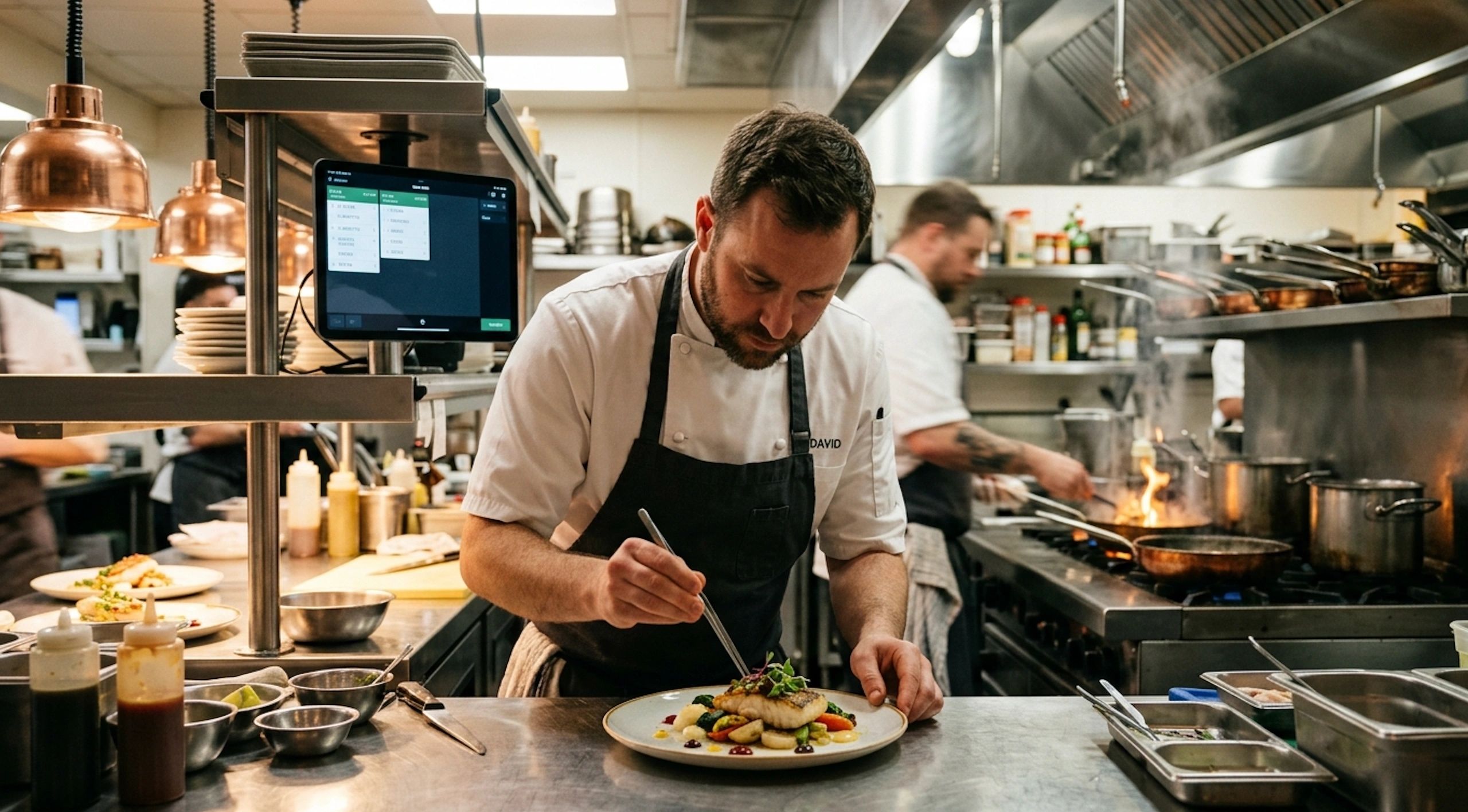
AI won't replace your chefs. After 35+ years in hospitality, here's what it actually does for a short-staffed kitchen this summer — and where it's just hype
Everyone keeps telling me AI is coming for chefs' jobs. After 35+ years in hospitality, I think they've got it backwards.
I've stood in kitchens through recessions, through supplier collapses, through the years nobody wanted to talk about, and through the good ones too. In all that time the thing that's broken a service has never been a shortage of technology. It's been a shortage of hands, a shortage of hours, and a shortage of headspace on a busy night. So when people ask me whether AI is going to replace their chefs, my honest answer is: your chefs are the last thing it's coming for. The paperwork, the guesswork and the waste — that's where it belongs.
Let me explain what I mean, because there's a lot of noise about at the moment and not much of it is written by people who've actually run a section.
The real problem isn't robots. It's empty sections.
Walk into most kitchens this summer and the problem isn't too many people. It's too few. Skilled staff are hard to find and harder to keep. Anyone who's tried to fill a chef de partie role in the last couple of years knows exactly what I'm talking about the good ones are already working, and the ones who aren't tend to be unavailable for a reason.
That's the backdrop every operator is dealing with. Fewer people, the same number of covers, and costs that have crept up on every side. In that environment, the question isn't "how do I replace my team with machines?" It's "how do I get more out of the team I've fought so hard to keep?"
That reframe matters, because it changes what you're actually shopping for. You're not looking to automate cooking. You're looking to take everything that isn't cooking off your chefs' plates so they can get on with the job you hired them for.
What AI actually does in a kitchen
Strip away the marketing and most of what's being sold as "AI for hospitality" comes down to three practical jobs.
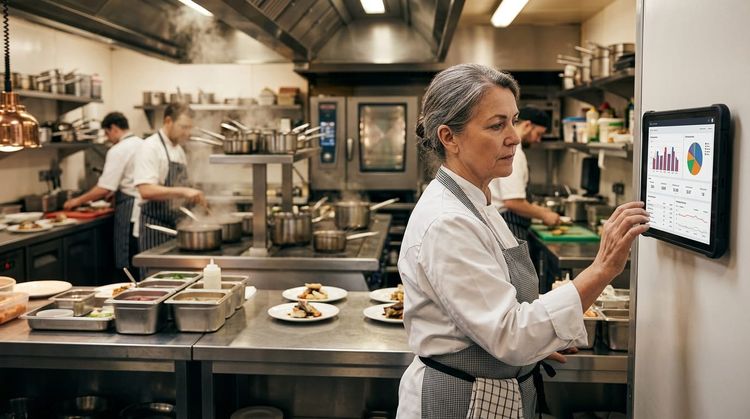
The first is order flow. A kitchen display system replaces the paper dockets with a screen that shows every order in real time, prioritised by what needs to leave the pass and when. No more chasing a spike of tickets in the breeze from the door, no more illegible scrawl, no more a table's mains going out before someone spots the starters were never fired. It sounds small. On a full Saturday it isn't.
The second is forecasting. The better prep-planning tools read your booking patterns and your past covers and give you a sensible steer on what to prep for so you're getting ready for the service you'll actually get, not the one you're guessing at over a coffee on Tuesday morning. Over-prep and you're throwing food away. Under-prep and you're in the weeds by half seven. Anything that tightens that guess pays for itself quietly, week after week.
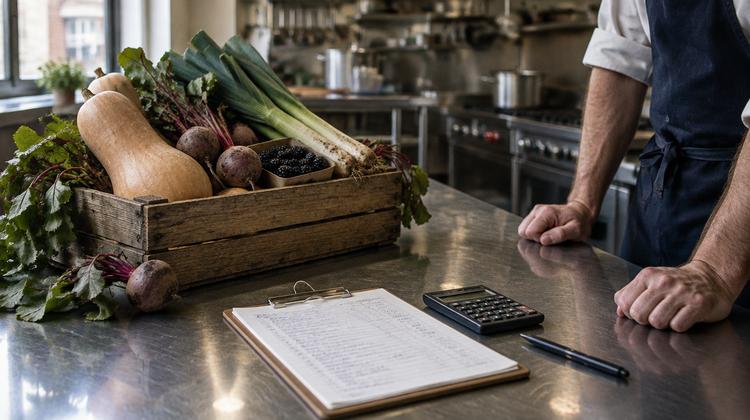
The third is stock and waste. Tools that track what's coming in, what's going out and what's ending up in the bin will flag a problem before it becomes a habit. And waste, in this game, is just money in the bin — nobody plans to throw good food away, it happens a fiver at a time until it's a serious number at the end of the month. Having something watch that for you, and nudge you when a line's drifting, is genuinely useful.
None of that is glamorous. All of it is the stuff that quietly decides whether a kitchen is a pleasure or a grind to run.
What it doesn't do — and won't
Here's the part the hype merchants tend to skip.
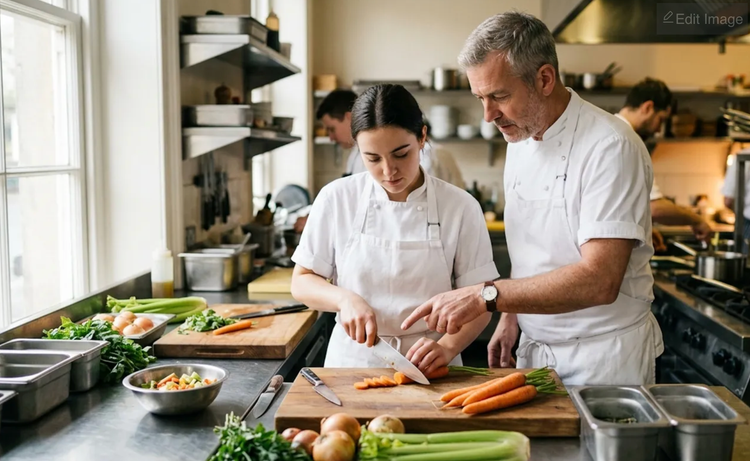
AI doesn't plate a dish. It doesn't taste a sauce and know it needs a squeeze of lemon or another minute. It doesn't read a section on a Saturday night and feel that the fish is coming under pressure and quietly pull a plate back thirty seconds. It doesn't train a young commis, doesn't calm a kitchen when the printer's down and forty covers just walked in, doesn't have the judgement that only comes from years of standing where the heat is.
Cooking is a craft and a human one. The moment a supplier lets you down and you've got to rebuild a dish from what's actually in the fridge, the moment a regular's dietary requirement lands on the pass and someone has to think on their feet that's your team, not a screen. Anyone selling you different has never had to get food out under real pressure.
So when I talk about AI in the kitchen, I'm talking about a tool that takes the admin off an already stretched team, so your people spend their shift on the work that needs a human. That's the whole of it. Used that way, it doesn't shrink your team it gives the team you've got room to breathe.
Where the hype falls down
A word of caution, because I've seen good operators spend money badly here.
A screen won't fix a badly run section. If your prep is disorganised, your ordering is chaotic and nobody's clear on who does what, bolting a slick bit of software on top just gives you an organised way to watch the same problems play out. The kit is only ever as good as the hands and the systems behind it. Technology is an amplifier it makes a well-run kitchen sharper and a badly run one more expensive.
The other trap is buying the tool before you've named the problem. Plenty of people come to it the wrong way round: they hear that everyone's doing AI, they panic about being left behind, and they buy something shiny without ever asking what it's actually meant to solve. Start with the pain. Is it waste? Is it ordering? Is it that services feel out of control because nobody can see what's coming? Fix the question first, then find the tool never the other way about.
And be honest about training. No app replaces teaching your people how to use it and, just as importantly, how to work when it's down. The best kitchens I know treat any new system the way they'd treat a new piece of equipment: proper training, a clear reason for it being there, and a plan for the night the wifi drops.
How to bring it in without losing the plot
If you're weighing this up, keep it simple. Pick the single biggest source of friction in your week the thing that eats your time or your margin and look for one tool that addresses just that. Trial it properly, with your team involved from the start, because a system your chefs resent is a system that quietly gets ignored. Measure whether it actually gave you time or money back after a month. If it did, keep it and move to the next problem. If it didn't, drop it without sentiment.
Bring your people with you and be straight about why it's there: not to watch them, not to replace them, but to hand them back the hours that were being lost to admin and guesswork. In my experience, once a team feels that in their own shift a calmer pass, less faff, fewer arguments about who ordered what they stop seeing it as a threat and start asking what else it can take off them.
That's the real opportunity here. Not a robot on the line. An hour back on every shift, and a team with the headspace to cook properly again.
So the question I'd leave you with is this: if AI gave you back an hour on every service, where in your kitchen would that hour go?
So when I talk about AI in the kitchen, I'm talking about a tool that takes the admin off an already stretched team, so your people spend their shift on the work that needs a human. That's the whole of it. Used that way, it doesn't shrink your team it gives the team you've got room to breathe.
Weighing up where AI fits in your kitchen? On The Pass Consultancy helps operators cut through the hype and put the right tools in the right place. Get in touch for a free initial consultation.