AI in the Kitchen: Train Your Team, Not Replace It
AI in the kitchen won't replace your chefs. Used well, it trains them faster and cuts the admin. A practical guide for UK catering operators.
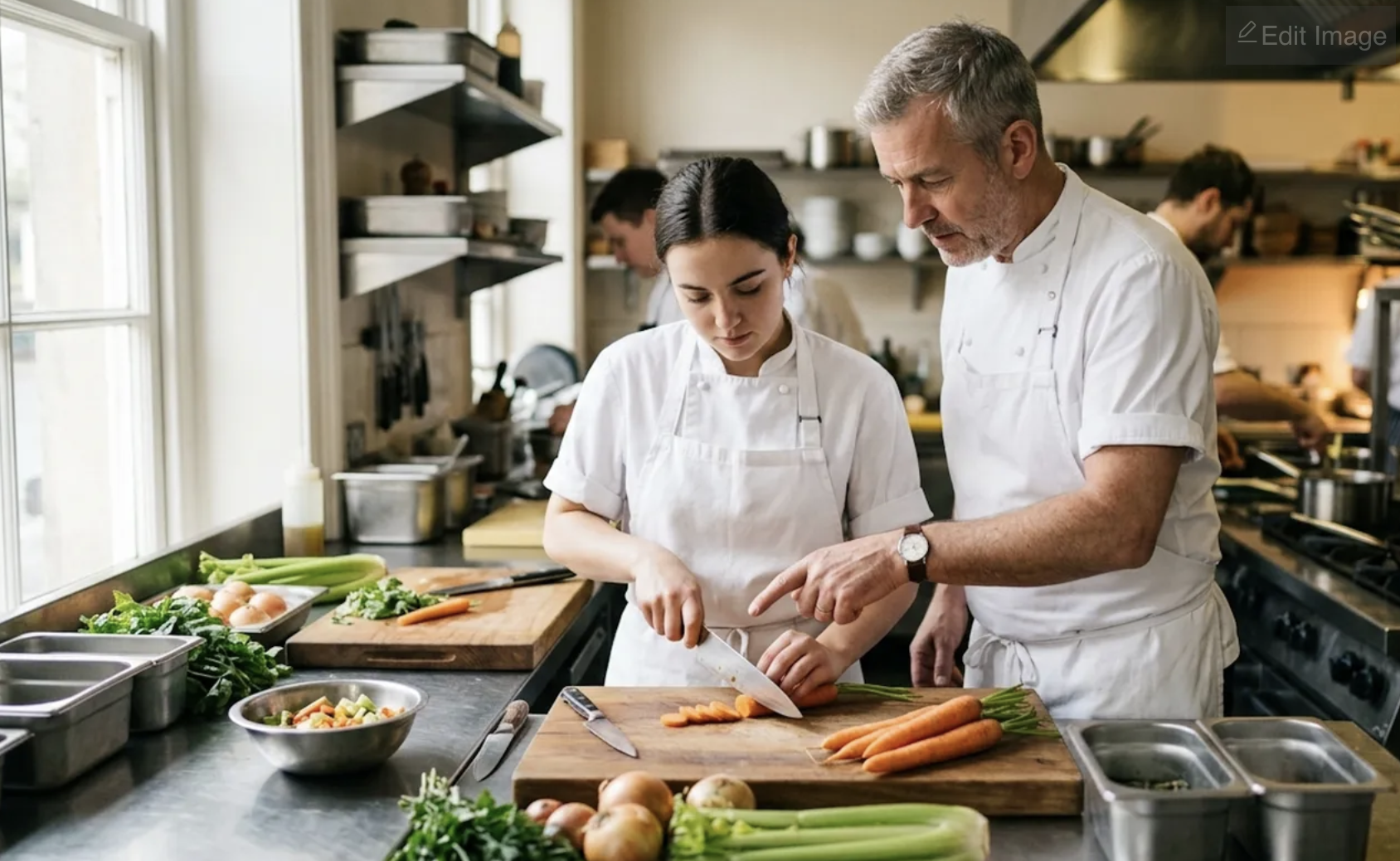
Every headline about AI in the kitchen seems to end the same way: the robots are coming for the chefs. It makes for a good scare story. It also happens to be pointing you at the wrong problem. After 35+ years in hospitality, on the pass, in wholesale, and now advising kitchens across South Wales and the wider UK, I can tell you the real opportunity is quieter and a lot more useful. AI is not here to replace the cook you can't find. It is here to help you train and keep the ones you already have.
That distinction matters, because the pressure on your kitchen is not imaginary. It is showing up on every rota and every wage bill in the country.
The fear is aimed at the wrong target
When people hear "AI for restaurants," they picture a machine flipping burgers and a redundancy notice on the noticeboard. The version actually landing in UK kitchens is far less dramatic. It is software that drafts a prep list, a tool that summarises a week of customer feedback in thirty seconds, a system that flags when your walk-in temperature is drifting before the stock spoils. None of that replaces a chef. All of it gives a short-staffed brigade a bit of breathing room.
The catering businesses I work with are not lying awake worried about automation. They are worried about covering Saturday service. So the question is not "will AI take my chef's job." The question is "can AI make the job my chef already does a little easier, so they stay." Framed that way, AI in the kitchen stops being a threat and starts being a retention tool.
What AI in the kitchen actually means right now
Let's keep this practical, because vague talk about technology helps nobody standing in an apron at 6pm. Here is where AI is genuinely earning its place in a commercial kitchen today.
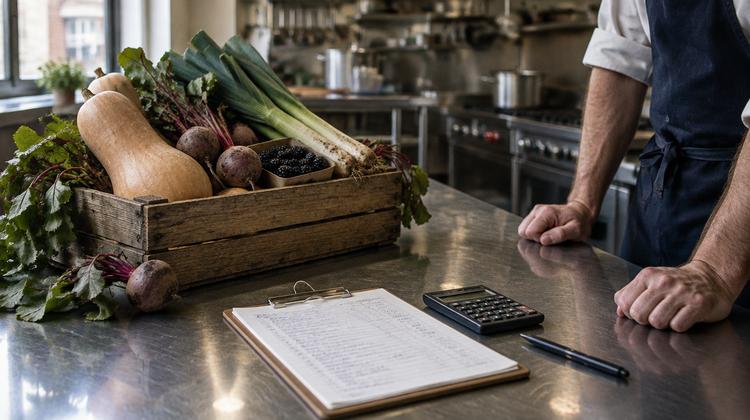
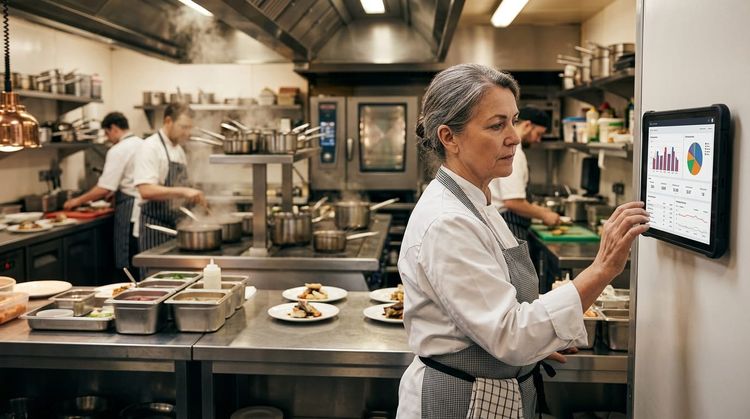
The first is admin. Ordering, stock counts, allergen logs, temperature records, rota building. This is the paperwork that eats a head chef's evening and never makes it onto a plate. AI-driven kitchen management tools can draft the order based on what you actually sold, pre-fill the compliance logs, and shape a rota around the cover you know is coming. Some operators report getting a meaningful chunk of their admin time back. Treat any specific percentage you read online with caution, but the direction is clear: less time on the laptop, more time on the section.
The second is forecasting. AI is good at spotting patterns in your own sales history that a busy manager simply doesn't have time to see. It can tell you that wet Tuesdays kill your covers, that a certain dish always over-orders, that your Sunday prep is consistently too heavy. That is not magic. It is your own data, read back to you clearly, so you can cut waste and protect your gross profit.
The third, and the one closest to my own work, is training. And this is where I think most operators are missing a trick.
Training is where AI in the kitchen earns its keep
Here is the situation almost every kitchen is in. You are down a chef. The person you've just taken on is keen but green. Your senior team is too slammed to stand over them for a fortnight showing them how you like things done. So the new starter learns in fragments, picks up bad habits, and either plateaus or leaves. Round and round it goes.
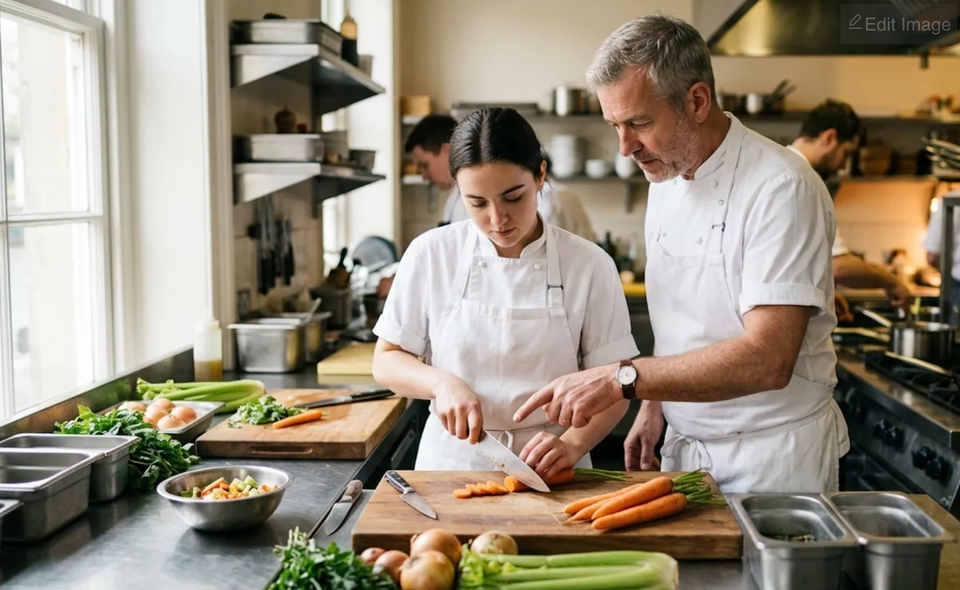
This is exactly where AI in the kitchen quietly changes the maths. Used well, it lets you build training that runs even when your best people are on the pass. Think of a new commis being able to pull up a clear, consistent explanation of your mise en place standard, your knife work, your plating spec, in plain language, at the moment they need it, without pulling a senior away from service. Think of your standards written down once and then made available on demand, in the kitchen's own words, rather than living only in the head of the sous chef who might leave next month.
That is the model I build with the catering clients I advise. AI-powered training is not about replacing a mentor. It is about cloning the patient bit of a good trainer so it is always available, and freeing your senior team to do the high-value coaching that genuinely needs a human. The chef still teaches the craft. The technology handles the repetition. A short-staffed kitchen cannot afford to teach the same basics from scratch, one distracted five minutes at a time. AI lets you scale the basics so your people can concentrate on the skill.
Get that right and two things happen. New starters get competent faster, so the pressure on your seniors drops. And people stay, because a kitchen that actually trains you is a kitchen worth staying in. In an industry haemorrhaging staff, that second point is worth more than any clever gadget.
The chef shortage is structural, not a blip
If you think you can simply wait this out, the numbers say otherwise. Hospitality vacancies across the UK are still running well above pre-pandemic levels, and the sector is widely reported to have lost somewhere in the region of 200,000 workers since 2019. Chefs are the hardest-hit role of the lot. These figures move around depending on the source, so take them as the shape of the problem rather than gospel, but every operator I speak to recognises the shape immediately.
The causes are not going to reverse quickly. Changes to immigration removed a large slice of kitchen labour. Training at home has not scaled to fill the gap. And the old perception problem, that a kitchen is a hard place to build a life, still puts young people off before they've even tried it. This is a structural shortage, not a seasonal wobble, and it is expected to stay tight well beyond this year.
That is the honest backdrop to every conversation about AI in the kitchen. You are not choosing between a full brigade and a bit of software. You are choosing how to get the most out of a brigade that is going to be smaller than you'd like for the foreseeable future. AI for hospitality is one of the few levers that actually helps with that, rather than just adding cost.
Where to start without blowing the budget
You do not need to rewire your whole operation. The operators who get value from this start small and specific. Pick the single most painful job in your week, the one that steals the most time for the least reward, and see whether a tool can take a first pass at it. For most kitchens that is either the ordering, the compliance paperwork, or onboarding a new starter.
Start with one. Give it a month. Measure it against something real, hours saved, waste reduced, or how quickly a new commis got up to speed. If it earns its place, keep it and add the next one. If it doesn't, you've lost a little time and learned something, not signed a five-year contract for a system nobody uses. That test-one-thing approach is exactly how I'd walk a client through it, because kitchen efficiency comes from fixing real bottlenecks, not from buying the shiniest platform at a trade show.
One practical note worth knowing: the same AI that helps inside your kitchen is also changing how customers find you outside it. More and more diners are asking AI assistants where to eat, and those systems favour clear, well-structured information over a PDF menu nobody can read. If your website is tidy and your details are consistent, you are more likely to be recommended. It is worth keeping half an eye on, because visibility is its own kind of survival right now.
What AI won't do, and why that's fine
Let me be even-handed, because you deserve the full picture. AI will not taste your sauce. It will not read the room on a chaotic Friday and know to pull a dish. It will not build the loyalty that keeps a young cook in your kitchen through a hard winter. It has no judgement, no palate, and no relationship with your regulars. Anyone selling it as a replacement for a real chef is selling you a story.
What it will do is take the dull, repetitive weight off your people so the human parts of the job get the attention they deserve. That is the whole case, and it is a good one. AI in the kitchen is a tool, not a team member. Used with a clear head it makes a small brigade feel bigger. Used badly it is just another subscription draining your margin. The difference is entirely in how you set it up, which is exactly the sort of thing worth getting a second opinion on before you commit.
The kitchens that will come through the next few tight years in good shape won't be the ones that automated their chefs away. There won't be many of those, and they'll have lost something in the trade. They'll be the ones that used the technology to train harder, waste less, and hold on to good people. That has always been the job. AI is just a sharper tool for doing it.
If you're weighing up where AI could genuinely help your kitchen, and where it's just noise, that's a conversation I have with operators every week. Book a free initial consultation with On The Pass Consultancy and let's look at your actual bottlenecks, not a sales pitch. No jargon, no hype, just 35+ years in hospitality pointed at your setup.