Pressed Pork Belly Recipe with Plums and Charred Fennel
By On The Pass Consultancy | Category: Weekly Recipe | Serves: 50 | Prep: 3 days, heaviest on day three | Cook: 4 hours | Skill Level: Advanced | Pork Belly recipe 50 covers, plum recipe restaurant UK, late summer menu recipe, pressed pork belly commercial kitchen, British plum season recipe
Why This Dish, and Why Now
Late August is the awkward stretch of the calendar. The summer menu has been on since May and everyone in the dining room has read it twice. Autumn is not here yet, so you cannot reach for game or root vegetables without the plate looking like it has turned up early. What you have instead is Victoria plums at their peak, British fennel in the middle of its season, and a dining room that has quietly started wanting something warm again.
Pork and plum is an old pairing, and I keep going back to it for one plain reason. Belly is fatty and rich, and it needs acid to cut through it. Plums bring sharpness and sweetness in the same mouthful, which is more than a vinegar or a citrus can do on its own. Add fennel, charred hard until the surface blackens and the aniseed mellows, and you have a plate that reads as late summer rather than autumn but still eats warm and generous.
I have written this the way I would write it for a client, which means the numbers are honest. It is a three-day build and day three is a full working day, not a light one. What you get for that is fifty portions of belly sitting cold and cut in the fridge, and a service that is a sear and a glaze. Here is how I do it.
Serves 50 | Prep: 3 days | Cook: 4 hours
Allergens: milk (butter in the jus and the roasted plums), sulphites (cider and cider vinegar). Check your stock for celery, gluten and soya.
Equipment: a combi or convection oven big enough for 16kg of belly in deep trays, a second low oven or dehydrator for the rind overnight, a blast chiller, three deep 1/1 gastronorms plus three to press with, a chargrill or plancha, a probe, and a deep pan for the crackling.
The chilling rule, stated once. Everything cooked in this recipe gets blast chilled to a core of 5°C within 90 minutes of coming out of the heat, then held below 5°C and date labelled. The legal chilled maximum in England and Wales is 8°C, and the FSA cooling window is 90 minutes. 5°C is my number and it gives you room. Everything reheated goes to a probed core of 75°C, or 82°C if you are in Scotland, where that is a legal minimum rather than guidance. I will not repeat this at every step.
Ingredients
All weights are as purchased unless stated.
The Pork
| Ingredient | Quantity |
|---|---|
| Boneless pork belly, rind on, in whole slabs | 16kg (approx. 4 bellies) |
| Fine sea salt | 430g |
| Demerara sugar | 215g |
| Fennel seeds, toasted and cracked | 55g |
| Black peppercorns, cracked | 25g |
| Thyme | 2 bunches |
| Bay leaves | 14 |
| Garlic bulbs, split across the middle | 3 |
The Braise
| Ingredient | Quantity |
|---|---|
| Dry cider | 2.5 litres |
| Unsalted or low-salt chicken or pork stock | 5.5 litres |
| Onions, sliced | 6 large |
| Carrots, sliced | 6 |
| Fennel bulbs, sliced | 2 |
| Star anise | 3 |
| Bay leaves | 6 |
Plum Ketchup
| Ingredient | Quantity |
|---|---|
| British plums, stoned weight | 3kg (approx. 3.2kg as purchased) |
| Caster sugar | 300g |
| Cider vinegar | 220ml |
| Root ginger, grated | 50g |
| Star anise | 2 |
| Cinnamon stick | 1 |
| Dried chilli flakes | 2.5g |
| Fine sea salt | 10g |
Yields approximately 1.9kg, which is 20g swiped on the plate plus 10g brushed on the pork, with a working margin.
Roasted Plums
| Ingredient | Quantity |
|---|---|
| British plums, firm-ripe, approx. 55g each | 3.5kg (approx. 64 fruit) |
| Unsalted butter | 120g |
| Demerara sugar | 100g |
| Cider vinegar | 50ml |
| Thyme sprigs | 6 |
Charred Fennel
| Ingredient | Quantity |
|---|---|
| Fennel bulbs, large | 20 (approx. 7kg) |
| Olive oil | 350ml |
| Fennel seeds | 20g |
| Lemons | 5 |
| Flaky sea salt | 20g |
Cider Jus
| Ingredient | Quantity |
|---|---|
| Reserved braising liquor, strained and de-fatted | approx. 6 litres |
| Cider vinegar | 100ml |
| Cold unsalted butter, diced | 350g |
| Cornflour | 20g per litre, only if needed |
Crackling and Finishing
| Ingredient | Quantity |
|---|---|
| Rind, reserved from the belly | from the 16kg above |
| Clean frying oil, high smoke point | 4 litres |
| Fennel fronds, picked | reserved from the bulbs |
| Flaky sea salt | to finish |
Method
Stage 1: Cure the Belly (Day One, evening)
- Toast the fennel seeds in a dry pan until they smell of aniseed and just start to colour, then crack them coarsely with the peppercorns. Mix with the salt and demerara. Toasting matters. Raw fennel seed tastes flat and dusty, and thirty seconds in a hot pan is the difference between a background note and an actual flavour.
- Cut the belly slabs down to fit your trays, keeping the pieces as large and as even in thickness as you can. A whole belly runs 60 to 70cm and will not sit flat in a gastronorm, so this happens now rather than later.
- Lay the slabs flesh side up in deep trays. Rub the cure over every surface, working it into the folds, and tuck the thyme, bay and split garlic above and below. Cover and refrigerate for 12 hours. At 2.7 per cent salt this is a seasoning cure, not a bacon cure. A dry cure of this strength barely gets past the surface in twelve hours, whatever anyone tells you about curing all the way through, and the braise does the rest.
- Next morning, scrape and wipe the cure off with a clean cloth rather than rinsing under the tap. Splashing cured pork juices around a sink at seven in the morning is the same habit the FSA has spent years trying to break people of with raw chicken. If a patch needs rinsing, do it in the raw prep sink and sanitise straight after. Pat the slabs dry.
Stage 2: The Braise (Day Two, morning)
- Preheat to 150°C conventional, fan 130°C, or 150°C on a combi. If the tray is covered, and it should be, the humidity setting is doing nothing, so leave it alone and do not drop the cabinet to compensate.
- Scatter the onions, carrots and sliced fennel across the base of deep trays and sit the belly on top, rind up. The vegetables keep the meat off the base of the tray as much as they flavour it, because anything sitting on hot metal for four hours scorches and turns the liquor bitter.
- Pour the cider and stock around the belly, not over it, until the liquid comes two-thirds up the meat and the rind stands clear. Top up with water if a tray runs short. Add the star anise and bay, cover tightly with a lid or double foil sealed at the edges, and braise for 3.5 to 4 hours.
- You want a core of 88 to 92°C and, more importantly, no resistance at all to a skewer through the thickest part. It should go in and out like it is going into soft butter. Any drag and it needs another thirty minutes. Undercooked belly is the most common failure with this cut and it cannot be rescued at service. Cook it until it gives.
Stage 3: Chill, Then Press (Day Two, midday)
- Lift the slabs out within thirty minutes of them leaving the oven and peel the rind away from the fat. It comes off soft and slightly gelatinous, which is correct, and on the thick end it usually needs a knife tip started under one corner and run flat against the fat. Do this warm. Cold rind tears and takes the fat with it.
- Lay the slabs fat side up on racks, uncovered and in a single layer, and blast chill them to a core of 5°C. Chill first, press second. Pressing warm under a lid and 10kg of weight gives a blast chiller no airflow to work with, which is exactly the condition you are trying to avoid, and it is the step most people get wrong.
- Once cold, lay the slabs fat side up across three lined deep 1/1 gastronorms, trimming so they sit in one even layer with no overlap. Cover each with greaseproof and an empty tray, weight with 8 to 10kg per tray spread evenly, and hold overnight in the fridge. Pressing cold bonds a little less than pressing warm, but it still compresses, and compression is what lets you portion cleanly and sear without the piece collapsing.
- Strain the liquor into shallow trays no more than 5cm deep and chill. Six litres in one deep container will not cool in time and will drag everything around it up while it tries. The fat sets in a cap overnight and lifts off in one piece. Keep it. That is seasoned pork fat and it is far too good to bin.
- The rind goes straight to the next stage or into the fridge with everything else. Do not leave it sitting out on a bench for the afternoon.
Stage 4: Crackling (Day Two, evening into Day Three)
- Lay the rind fat side up and scrape it hard with the back of a heavy spoon until almost all the soft fat is gone and the skin looks thin and translucent. Across four bellies this is a solid half hour of greasy work, not the ten minutes people promise you, and it is the whole job. Leave fat on the underside and the rind fries to a chewy sheet instead of puffing.
- Lay flat on lined trays and dry overnight at 80 to 90°C, six to eight hours minimum. It is ready when the whole sheet is rigid, rattles on the tray and has no flex anywhere. Two or three hours is nowhere near enough, which is where this usually goes wrong.
- Break into shards and fry in small batches at 190 to 200°C for 15 to 20 seconds, until each piece puffs and blisters. Use a dedicated pan no more than a third full, keep a fire blanket to hand, and do not do this on a service line with people passing behind you. Drain, salt while hot, cool and store airtight at room temperature. Never in the fridge, the humidity softens it quickly.
Stage 5: Plum Ketchup (up to four days ahead)
- Put the plums, sugar, vinegar, ginger, star anise, cinnamon, chilli and salt into a heavy pan. Simmer for 45 minutes to an hour, stirring often, until the plums have broken down completely and the mixture darkens and thickens enough to hold a line when you draw a spoon across the base.
- Remove the star anise and cinnamon, blend and pass through a fine sieve. Taste it hot and sharpen with more vinegar if it is leaning sweet. It will taste noticeably sharper cold than it does hot, so aim for a shade sweeter than you think you want. It is better on day two than day one.
Stage 6: Charred Fennel (blanch Day Two, char before service)
- Trim the fennel, reserving the fronds, and peel away the tough outer layer of each bulb, which never softens properly. Cut each bulb through the root into six wedges, keeping the core intact so they hold together. Twenty bulbs gives 120 wedges, which covers two a plate with a sensible allowance for breakage.
- Blanch in batches in heavily salted boiling water for 6 to 8 minutes, until just tender at the base, then refresh straight into iced water. Batching matters. Tip 120 wedges into one pot and it drops off the boil and you steam them. The ice bath stops the carryover, holds the colour and takes them through the danger zone in one move. Drain and spread on trays to steam dry properly, because wet fennel will not char.
- Toast the fennel seeds, then toss the wedges with the olive oil, seeds and salt. Char hard on a chargrill, plancha or very hot dry pan, cut side down, until you have proper blackened stripes on both flat faces. You want char, not colour. Fennel is not a sugary vegetable, whatever gets said about caramelising it. It is a wet one, and until the surface moisture has gone you get steam rather than browning, which is why timid grilling leaves a pale wedge that still tastes raw. Squeeze over the lemon. Char in batches in the hour before service and hold hot above 63°C, or char to order if you are running smaller numbers.
Stage 7: Roasted Plums (on the day)
- Halve the plums and remove the stones. Melt the butter in a wide pan, add the demerara and let it bubble, then add the plums cut side down in batches, in a single layer, with a few thyme sprigs. Cook 2 to 3 minutes without moving them, until the cut faces take colour, then deglaze with a splash of the vinegar.
- Transfer to trays cut side up and finish at 180°C, fan 160°C, for 5 to 8 minutes, just until they yield to a light press but still hold their shape. Use firm-ripe fruit, not soft. A soft plum turns to jam in the pan and you lose the whole point of having a piece of actual fruit on the plate. Hold at room temperature for a maximum of four hours and log the time they came out.
Stage 8: Cider Jus (Day Three)
- Lift the set fat off the chilled liquor and reserve it. Taste the liquor before you reduce anything. This has held sixteen kilos of cured pork for four hours, and if it is already well seasoned, a threefold reduction gives you a sauce nobody can eat. If it tastes seasoned, reduce by half rather than two-thirds and let it back down with unsalted stock. Never add salt to this sauce until it is at final volume.
- Boil in a wide pan, skim for the first few minutes, and reduce until it coats the back of a spoon. There is a lot of gelatine in a belly braise, so it should thicken on reduction alone. If your stock was light and it still refuses to coat, 20g of cornflour slaked in cold water per litre, added off the boil and simmered two minutes, is a better answer than over-reducing, because a cider liquor pushed too far turns bitter.
- Sharpen with the cider vinegar, taste again, then off the heat whisk in the cold butter a few cubes at a time until glossy. Do not let it boil once the butter is in or it will split. Mount in small batches to order, or hold no more than 45 minutes before remounting.
Stage 9: Portion and Service
- Turn the pressed belly out and trim the edges square. Cut into 50 portions of roughly 165g, a piece around 10cm by 7cm at a pressed thickness of 2.5cm. Portion cold with a long sharp knife, wiped between cuts. Cold and pressed, it cuts like a terrine. At any other temperature it will not. Keep the trim for staff food or croquettes, because there will be close to a kilo of it.
- To fire: sear fat side down in a hot pan with a little of the reserved pork fat until deep golden and crisp, 3 to 4 minutes. Turn fat side up onto a rack, brush the crisp face with plum ketchup loosened with a spoonful of jus, and finish at 200°C, fan 180°C, for 8 to 10 minutes to a probed core of 75°C. Glaze at the end, not the start, or the sugar catches and turns bitter.
- On timing: twelve portions is two or three pans plus a rack, so a section cycle runs 12 to 14 minutes. Thirty-six covers is three cycles, and the last plate leaves roughly twenty-five minutes after the first. Par-sear a first tranche before the doors and hold it above 63°C, or cap the dish on the board. Do not find this out on the night.
Plating
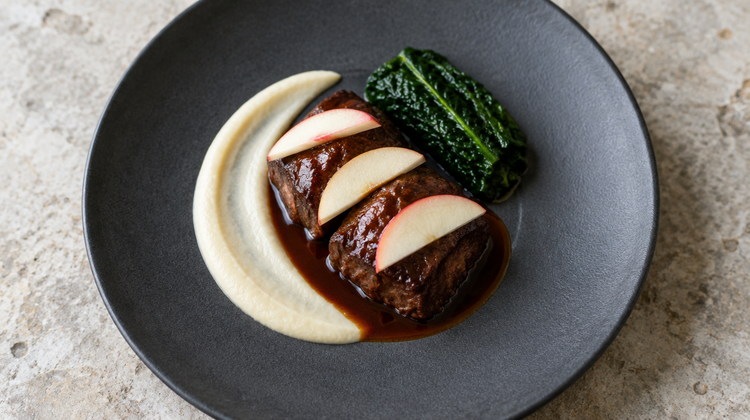
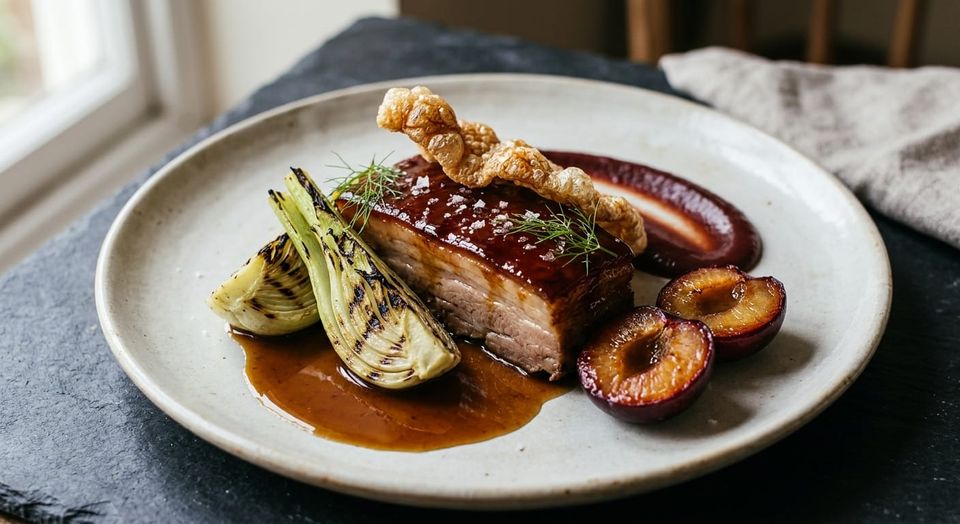
Sit the belly slightly off-centre, glazed fat side up, with two charred fennel wedges leaning against it and two halves of roasted plum, cut side up so the colour shows. Spoon the ketchup beside the pork rather than under it, and pour the jus around on the other side, so nothing crisp ends up sitting in something wet. Lay a shard of crackling across the top of the belly, not down on the plate. Finish with fennel fronds and a pinch of flaky salt.
Chef's Notes
On sourcing the pork: ask for boneless belly, rind on, in whole slabs and even in thickness. Uneven bellies cook unevenly and portion badly. If you are upgrading the spec, be careful with the words. Outdoor-bred means born outside and finished indoors, free-range means outdoors throughout, and they are not the same thing or the same price. Whatever you buy, the menu wording has to match the delivery note.
On the plums: late August is Victoria at its peak, from Kent or the Vale of Evesham. Buy firm-ripe for roasting and take the softer fruit for the ketchup, where texture does not matter. For a sharper ketchup, hold back some under-ripe Victoria, or use the first Merryweather damsons if your grower has started picking. Marjorie's Seedling and the later damsons are a month off yet, so save those for the September version.
On the fennel: this is British fennel season, roughly July to November, so buy home-grown rather than the Italian crop that covers us from October through to spring. Look for big, heavy, tight bulbs, and expect to lose the outer layer of every one. Wide flat bulbs cut better wedges than tall narrow ones.
On running it at volume: day two morning ties up your combi for four hours and the rind wants a second oven overnight. Three gastronorms under weight take a full shelf bay each, plus shallow trays for six litres of liquor, so if you are tight for fridge space on a Friday in August this will not fit alongside your normal mise. Day three needs four to five hours of hands-on work from one person. After that it is a sear and a glaze.
On the GP: what I like here is the yield story, not the headline price. The rind becomes the crackling, the vegetables and liquor become the sauce, and the trim becomes staff food. But cost it on yield rather than purchase weight, because you lose 45 to 50 per cent of the belly between the delivery note and the plate, and close to 30 per cent of every fennel bulb. Divide each line in the tables by fifty, multiply by your own prices this week, and you have a real food cost in ten minutes instead of a guess.
Make-ahead summary: cure day one evening. Braise, chill, press and blanch the fennel on day two, with the rind drying overnight. Everything else lands on day three: ketchup, plums, jus, charring and portioning. Service is a sear and a glaze.
Enjoyed this recipe? Subscribe below and get a new professional recipe delivered every Friday, built for commercial kitchens and written from 35 years in hospitality.