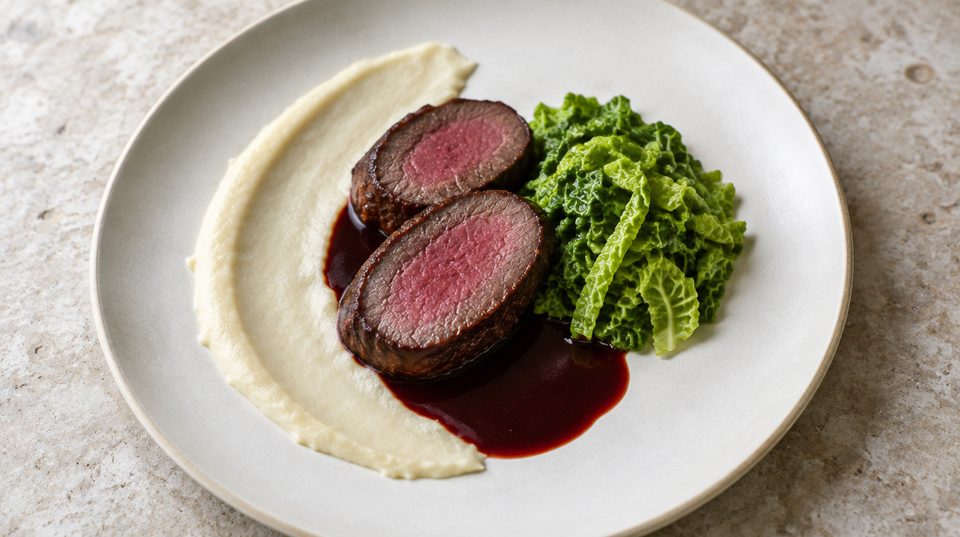
Seared Venison Loin, Celeriac Purée, Damson Sauce and Savoy Cabbage
Game season is here. This is how you serve venison loin at fifty covers and get the finish right every time.
Why This Dish and Why Now
The red deer rut begins in late September and runs through October. This is not just wildlife biology. It is the signal that wild venison loin is at its most available, most flavourful and most competitively priced. The muscle is lean and firm from an active animal. The flavour is darker and more complex than farmed deer, with no trace of the liver notes you can get outside the season. Buy wild if you can source it. Farmed red deer loin works too, the technique is the same, but the eating is different.
Venison loin does not forgive. It is one of the leanest game meats on the market, with almost no intramuscular fat to buffer the cooking window. Go past medium and you have expensive, dry, chewy meat on fifty plates. Stay too cautious and you have cold, undercooked protein going back to the kitchen. The write-up here deals with that tension directly, because pretending it is not there does nobody any favours.
The damson is the right sauce fruit for October. It has the acidity and depth to hold its own against strong game without disappearing into sweetness. If fresh damsons have gone from your supplier by the time this posts, they freeze well and most good wholesale greengrocers will have frozen British damsons through October and November. The celeriac is hitting its stride this week and will be on every commercial kitchen's radar for the next three months. The Savoy cabbage adds colour and something to chew between bites of venison.
At fifty covers this is a well-managed service dish. The sauce and purée both batch and hold. The venison is seared to order in batches. The cabbage is buttered to order in two minutes. The plate assembles in under ninety seconds.
Serves 50 | Prep: 60 minutes | Cook: 50 minutes
Ingredients
Venison Loin
| Ingredient | Quantity |
|---|---|
| Venison loin, trimmed (as prepared weight) | 9kg |
| Rapeseed oil | 100ml |
| Unsalted butter | 200g |
| Thyme sprigs | 8 |
| Garlic cloves, unpeeled, halved | 6 |
| Flaked sea salt | 30g |
| Black pepper, coarsely ground | 10g |
Celeriac Purée
| Ingredient | Quantity |
|---|---|
| Celeriac (as purchased) | 5kg |
| Whole milk | 1 litre |
| Unsalted butter | 300g |
| Double cream | 200ml |
| Fine salt | to taste |
| White pepper | to taste |
Damson Sauce
| Ingredient | Quantity |
|---|---|
| Fresh or frozen damsons, stoned | 1.2kg |
| Shallots, finely sliced | 300g |
| Red wine | 750ml |
| Game stock or well-reduced veal stock | 2 litres |
| Redcurrant jelly | 80g |
| Thyme sprigs | 4 |
| Bay leaves | 2 |
| Unsalted butter, cold, cubed | 80g |
| Rapeseed oil | 30ml |
| Caster sugar | to taste |
| Fine salt | to taste |
Savoy Cabbage
| Ingredient | Quantity |
|---|---|
| Savoy cabbage (as purchased) | 5kg |
| Unsalted butter | 150g |
| Thyme sprigs | 4 |
| Chicken or vegetable stock | 150ml |
| Fine salt | to taste |
Method
Stage 1: Damson Sauce (the day before, or morning of service)
-
Heat the rapeseed oil in a wide, heavy-based saucepan over medium heat. Add the shallots with a pinch of salt and cook slowly for 12 to 15 minutes until deeply golden and beginning to caramelise. Do not rush this. Undercooked shallots give the sauce a raw sweetness that does not round out properly.
-
Add the damsons and cook for 5 minutes, stirring, until they begin to break down and release their juice. The skins will remain and need to be strained out later.
-
Pour in the red wine and increase the heat to medium-high. Reduce by half, scraping the base of the pan. Add the thyme, bay leaves, redcurrant jelly and game stock. Bring to a gentle simmer and reduce until the sauce coats the back of a spoon and has concentrated to approximately 1.2 litres. This takes 30 to 40 minutes. Skim as needed.
-
Pass through a fine-mesh sieve, pressing on the solids to extract all the damson flesh and shallot. Discard the solids. Taste and adjust with salt and a small amount of caster sugar if the acidity is too sharp. The sauce should be deep, fruit-forward and savoury, not sweet. At this point it can be cooled and refrigerated for up to two days.
-
To finish at service, bring the sauce back to a gentle simmer and whisk in the cold butter, a few cubes at a time, to give it body and gloss. Do not boil once the butter is in or the sauce will split. Hold in a bain-marie between 65°C and 70°C.
Stage 2: Celeriac Purée (morning of service or the day before)
-
Peel and dice the celeriac into 2cm cubes. Work quickly and keep the cut celeriac in cold water with a splash of lemon juice to prevent browning. Celeriac oxidises quickly and brown purée is not a good look.
-
Drain and combine the celeriac with the milk and 200g of the butter in a wide saucepan. The milk prevents the celeriac from turning grey and adds a mild sweetness. Bring to a simmer over medium heat, cover and cook for 20 to 25 minutes until the celeriac is completely tender and a knife passes through with no resistance.
-
Transfer to a blender in batches and blitz until smooth, adding the cooking liquid gradually until you reach a consistency that holds its shape on a spoon but is not stiff. Add the remaining butter and the double cream with the blender running. Season generously with salt and white pepper. White pepper avoids dark flecks in the finished purée.
-
Pass through a fine-mesh sieve for a restaurant-smooth finish. Adjust seasoning. Refrigerate if making ahead. Reheat in a bain-marie or in a saucepan over very low heat, stirring frequently. The purée holds for two days refrigerated.
Stage 3: Savoy Cabbage (at service)
-
Remove the outer leaves and core of each cabbage. Separate the leaves and cut out the thick central rib from each. Roll the leaves into a tight cylinder and slice into 1cm ribbons. This is chiffonade. Blanch in heavily salted boiling water for 45 seconds, then transfer immediately to iced water. This sets the colour. Drain and squeeze out excess water. Refrigerate until service.
-
At service, heat the butter in a wide pan over medium-high heat until foaming. Add the cabbage and thyme and toss to coat in the butter. Add a splash of stock and cook for 2 to 3 minutes, seasoning as you go. The cabbage should be tender with a little bite remaining. Serve immediately.
Stage 4: Searing the Venison (at service)
-
Divide the venison loin into individual portions of 180g. Season generously on all sides with salt and coarse black pepper no more than 5 minutes before cooking. Seasoning too far ahead draws moisture to the surface, which hinders the sear.
-
Work in batches of eight to ten portions at a time in a wide, heavy-based pan over high heat. Heat the rapeseed oil until smoking before adding the venison. This is not optional. A pan that is not hot enough will steam the meat rather than colour it and venison at fifty covers does not have time to wait for colour to catch.
-
Sear for 2 minutes on the first side without moving. Flip, sear for 90 seconds, then add a generous knob of butter, a sprig of thyme and a halved garlic clove. Baste continuously for 60 seconds, tilting the pan and spooning the foaming butter over the meat. Remove and rest on a wire rack in a warm place, not covered, for at least 4 minutes before carving. Carryover cooking will raise the core temperature by 3 to 5°C during rest.
-
Target core temperature after resting: 54 to 56°C for medium-rare. Pull the venison from the pan at 50 to 52°C. If your service is under pressure and timing is tight, pull at 50°C and the rest will do the work. Do not serve above 60°C core. Above that point the loin loses its texture and the dish loses its point.
Plating
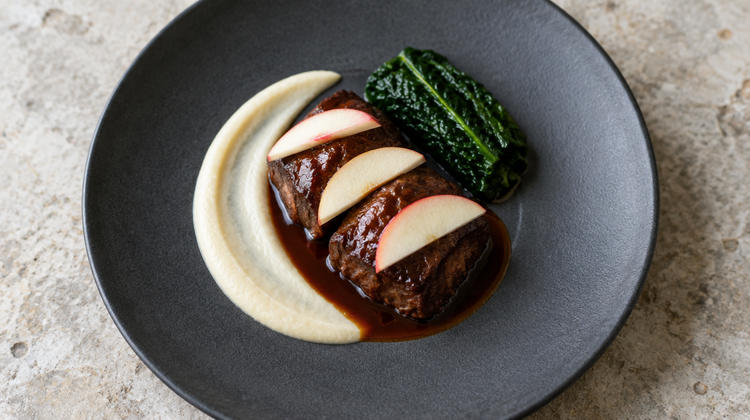
Spoon a generous portion of celeriac purée onto the centre of a warm plate and use the back of the spoon to pull it to one side. Carve the venison loin at a slight angle into two or three neat slices and lay them against the purée, cut face up. Place a neat pile of Savoy cabbage beside the venison. Sauce generously over and around the meat, not over the cabbage. The damson sauce should pool slightly on the plate rather than coat every element. The dish should read dark, rich and autumnal.
Chef's Notes
On sourcing: Wild venison loin is sold as saddle off the bone, sometimes labelled backstrap. For fifty covers, order trimmed loin, not saddle on the bone, the butchery time is not worth it at volume. Confirm with your supplier how many days hung. Four to seven days is right for loin. Less than four and the flavour is mild. More than ten and you are taking a risk on a fifty-cover service.
On carryover: Lean meat carries over hard. The temperature continues rising for four to five minutes after you pull the loin from the pan, faster if you cover it. Rest on a rack, not a plate and keep the resting area above 60°C ambient temperature so the exterior does not cool while the core is still rising. A temperature probe on the pass is not optional with this dish.
On the damsons: If fresh damsons have finished for the year, frozen British damsons work well in the sauce. They are softer than fresh but the flavour is intact and the sauce is strained anyway. Do not substitute with plums. Plums lack the sourness that makes the sauce work against venison.
On running it at volume: The sauce and purée can be completed the day before. This leaves only the venison and cabbage for service, which is manageable. Sear in batches of no more than eight portions at a time. A crowded pan drops temperature and you will get colour on the outside of the batch and steaming in the middle. Two pans running simultaneously is the right approach for fifty covers.
On the GP: Venison loin at wholesale runs between £18 and £28 per kg depending on source and whether it is wild or farmed. At 180g trimmed per portion, food cost on the protein alone is £3.25 to £5.05 per plate. The sauce and purée components add around £1.50 to £2.00 per cover. Total food cost sits at £4.75 to £7.05 per plate. At a £24 to £28 main course price, with the VAT taken out first, this is a GP of 65 to 80 per cent. Venison earns its place on the menu not just for the margin but for what it communicates to the customer about the kitchen's sourcing. It is a statement dish that the margin supports rather than undermines.
Make-Ahead Summary
- Damson sauce → make the day before, refrigerate, reheat and mount with butter at service
- Celeriac purée → make the day before, refrigerate, reheat in bain-marie at service
- Savoy cabbage → blanch and refresh the day before, butter-finish at service
- Venison loin → portion and season just before service, sear to order in batches
Corrected on the 11th of October 2026. The GP range in this recipe has been recalculated on net sales, with the VAT taken out first, across the full cost and price band. It now reads 65 to 80 per cent.
Enjoyed this recipe? Subscribe below and get a new professional recipe delivered every Friday, built for commercial kitchens and written from 35 years in hospitality.