Roast Squash Starter, Goat's Curd and Sage Brown Butter
A roast squash starter for your autumn menu. Twenty covers, low food cost, prepped the day before and plated in a minute.
Why This Roast Squash Starter and Why Now
If you are building an autumn menu this month, start with what is coming off British fields. Crown Prince squash is harvested through late September and October. This is when it comes into its own. The skin is blue-grey and firm. The flesh is deep orange, dense and dry, which is exactly what you want for roasting. Leave the skin on. It holds each wedge together through the roast and the reheat. It is also what makes the plate look like autumn. It caramelises at the edges instead of collapsing into the tray.
The trick with this plate is knowing when to stop. Four elements, each doing one job. The squash brings sweetness and colour. The whipped goat's curd brings sharpness and a cool base for the hot squash. The hazelnuts bring crunch. The sage brown butter ties it together, with a splash of sherry vinegar so it cuts instead of coats.
The commercial argument is just as simple. No protein on the plate means no protein cost. The curd and nuts are made the day before, the squash is roasted in the morning and the butter is made once before service. At the pass it is a reheat and a plate.
Where This Autumn Starter Fits on Your Menu
Most autumn menus in UK pubs and restaurants lean hard on slow-cooked, heavier mains from October onwards. That is right for the mains. It also leaves a gap at the front of the menu for something lighter that still tastes of the season. It is also where a vegetarian starter should be more than an afterthought.
This roast squash starter fills that gap. It reads as seasonal British produce on the menu card, it suits vegetarian guests without being labelled as the vegetarian option and it sits comfortably ahead of a rich main course. Put it on your October menu and carry it through November. Crown Prince stores for weeks, so the dish runs from the first cold evenings through to Bonfire Night bookings and harvest suppers without a change of supplier.
It also earns its place on the numbers. When you engineer an autumn menu, the starters are where you can hold a strong margin while the mains carry the protein cost. A seasonal starter with no protein, made from one of the cheapest vegetables on the order sheet, is exactly the kind of dish that pulls your overall GP up.
Serves 20 | Prep: 45 minutes | Cook: 40 minutes
Ingredients
Squash weights are given as purchased and as prepared. Everything else is as purchased.
Roast squash
| Ingredient | Quantity |
|---|---|
| Crown Prince squash, as purchased | 3.2kg |
| (Prepared weight after deseeding, skin on, about 80 per cent yield) | (2.6kg) |
| Rapeseed oil | 80ml |
| Fine sea salt | 15g |
| Black pepper, freshly ground | 3g |
Whipped goat's curd
| Ingredient | Quantity |
|---|---|
| Goat's curd, pasteurised | 750g |
| Double cream | 175ml |
| Unwaxed lemon, zest only | 1 |
| Fine sea salt | 3g |
Toasted hazelnuts
| Ingredient | Quantity |
|---|---|
| Blanched hazelnuts | 250g |
Sage brown butter
| Ingredient | Quantity |
|---|---|
| Unsalted butter | 250g |
| Fresh sage leaves, picked | 75 leaves (about 38g) |
| Sherry vinegar | 30ml |
To finish
| Ingredient | Quantity |
|---|---|
| Sea salt flakes | 10g |
Per cover, for costing: 130g prepared raw squash (about 100g once roasted), 40g whipped curd, 12g hazelnuts, about 10g brown butter and three sage leaves.
Method
Stage 1: Whipped goat's curd and hazelnuts (the day before)
1. Put the goat's curd, double cream, lemon zest and fine sea salt into a stand mixer. Whisk on medium speed for 1 to 2 minutes, until it holds soft peaks. Stop there. Goat's curd is lower in fat than cream cheese and turns grainy if you keep going. You want something that holds a swoosh, not a rosette.
2. Scrape into a lidded container, label and refrigerate below 5°C. It holds for two days, or to the curd's use-by date if sooner. This gives about 930g, enough for 40g a plate with some over for bowl losses.
3. Toast the hazelnuts on a tray at 170°C (fan 150°C) for 10 to 12 minutes, shaking halfway, until golden right through. Cool, then crush roughly with the base of a pan into halves and quarters, not dust. Store airtight at room temperature for up to three days.
Stage 2: Roast squash (the morning of service)
4. Scrub the squash under cold running water and dry it, because the skin goes on the plate. Halve it with a heavy knife on a damp cloth so it cannot roll. Scoop out the seeds and the stringy fibres. Leave the skin on and cut into long wedges about 1cm thick at the skin side, so every wedge weighs roughly 30 to 35g. Trim off any scarred or damaged patches of skin as you go. Thin wedges matter here. They let the skin start to soften in the oven while the flesh roasts through. The chill and the reheat finish the job.
5. Weigh the prepared squash. You are looking for about 2.6kg, which is 130g or four wedges per cover. If your yield is lower, order more next time rather than cutting the portion.
6. Toss the wedges with the rapeseed oil, fine sea salt and black pepper. Lay them in a single layer on lined gastronorms with space between each one. Crowded squash steams. Spaced squash roasts.
7. Roast at 200°C (fan 180°C), or in a combi on dry heat at 180°C, for 20 to 25 minutes, turning once, until a knife goes through flesh and skin with no resistance and the edges are caramelised. Colour is flavour, so let it go darker than feels comfortable.
8. If roasting close to service, hold at 63°C or above and use within two hours. Otherwise spread on cold trays and blast chill to below 5°C within 90 minutes, then cover, label and refrigerate. Use within 24 hours.
Stage 3: Sage brown butter (before service)
9. Melt the butter in a light-coloured pan over a medium heat so you can see the colour change. It will foam, then go quiet. When the solids on the base turn hazelnut brown and it smells of toffee, after 5 to 7 minutes, add the sage leaves for 30 seconds until they stop sizzling and turn crisp.
10. Take the pan off the heat. Lift the sage out onto kitchen paper. Add the sherry vinegar, standing back, because it will spit. The vinegar stops the browning and cuts the fat, so the butter seasons the plate instead of weighing it down.
11. Hold the brown butter at 63°C or above in the bain-marie and stir it every time you spoon it, because the browned solids sink and they carry most of the flavour. Make it fresh each service and discard what is left. Keep the crisp sage in a dry container for the service only. It goes soft in the fridge.
Stage 4: Service
12. Reheat the squash to order at 200°C (fan 180°C), or a combi on dry heat, for 6 to 8 minutes, to at least 75°C in the centre of the thickest wedge. Reheat once only and discard any reheated squash that is not sent.
13. Stir the whipped curd before service to bring it back together. Keep it in the fridge between plates, not on the pass.
14. Plate each cover with 40g of whipped curd, four wedges of squash, about two teaspoons of brown butter, 12g of crushed hazelnuts, three crisp sage leaves and a pinch of sea salt flakes, as below.
Plating
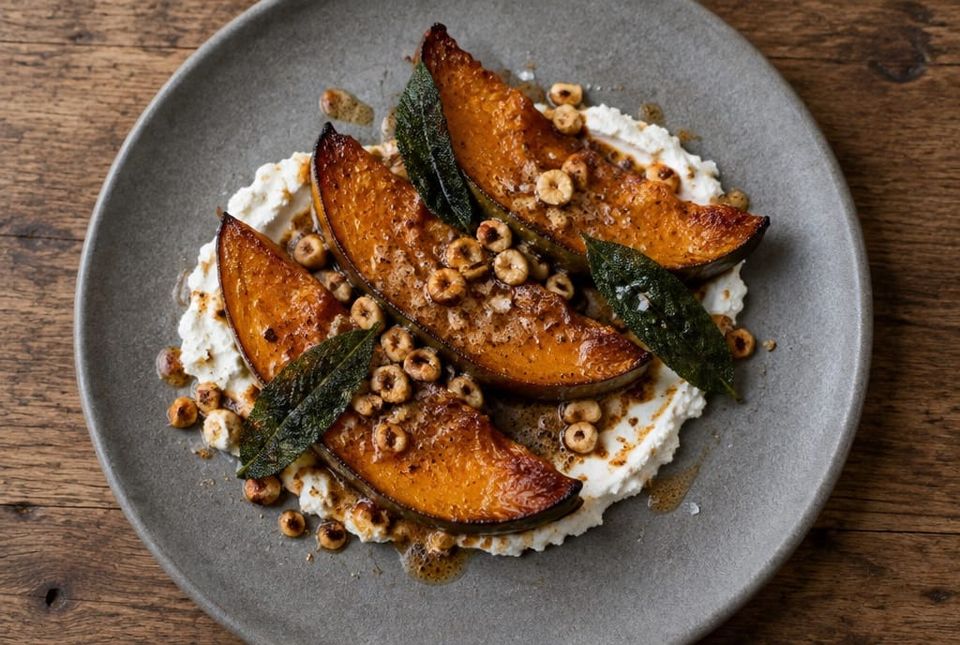
Spoon the curd onto a warm plate and drag it into a swoosh with the back of the spoon. Lay four hot wedges of squash across it, skin side out, leaning on each other. Stir the brown butter and spoon it over the squash, letting a little run into the curd. Scatter the hazelnuts over the top, then the sage leaves and a pinch of sea salt flakes.
Chef's Notes
On the squash: Ask your greengrocer for Crown Prince by name. The dense, dry flesh is what lets it roast and hold its shape. A wetter squash gives you a tray of mush. Keep the skin on and the wedges thin. The skin softens in the roast, then softens again through the chill and the reheat, so by the time it reaches the plate it is tender enough to eat. Skin on also means less waste, so you buy about 3.2kg of squash for 20 covers instead of 4kg peeled. Store whole squash somewhere cool and dry, not in the walk-in. It keeps for weeks.
On the curd: Whip it cold and stop early. A split curd cannot be rescued by more whisking. Check the label if you want to sell the dish as vegetarian, because not every cheese uses a vegetarian rennet.
On running it at volume: By service, everything is done except the reheat. Under a minute a plate once the squash is hot. Twenty covers is comfortable for one person on the starter section. Reheat in small batches as tables land, so nothing is reheated twice.
On the GP: This is one of the strongest margin starters you can put on an autumn menu. The squash is cheap in season, there is no protein and the curd goes further once it is whipped. Cost it against your own supplier prices using the per-cover weights above. Price it on the plate, not on the ingredients, because it eats like a more expensive dish.
On allergens: Contains milk (goat's curd, cream and butter), tree nuts (hazelnuts) and sulphites (sherry vinegar). There are no gluten-containing ingredients as written, but check supplier labels for cross-contact, especially any may-contain warning on the hazelnuts. Declare all three on your allergen matrix and tell front of house about the nuts.
Roast Squash Starter FAQs
What is the best squash for roasting on a restaurant menu? Crown Prince. Its dense, dry flesh roasts and caramelises without collapsing, so it holds its shape on the plate and through a reheat.
Can I prepare this autumn starter the day before? Most of it. The whipped goat's curd and toasted hazelnuts are made the day before. The squash is roasted on the morning of service, blast chilled and reheated to order. Only the brown butter is made fresh before each service.
Is this a vegetarian starter? It can be. Check that your goat's curd is made with a vegetarian rennet before you mark it as vegetarian on the menu. It is not vegan, because the curd, cream and butter all contain milk.
How do I scale this recipe for 50 covers? Multiply every quantity by 2.5. Roast the squash in more trays rather than crowding them, because crowded squash steams instead of colouring.
How long does Crown Prince squash keep? Whole and uncut, for weeks, somewhere cool and dry. Once it is cut, treat it like any prepared vegetable and use it within a day or two.
Make-Ahead Summary
- Whipped goat's curd → day before, refrigerate below 5°C, holds two days
- Toasted hazelnuts → day before, airtight at room temperature, holds three days
- Roast squash → morning of service, blast chill, refrigerate, reheat once to order to 75°C
- Sage brown butter and crisp sage → before each service, hold butter at 63°C or above, discard leftovers
Enjoyed this recipe? Subscribe below and get a new professional recipe delivered every Friday, built for commercial kitchens and written from 35+ years in hospitality.