Is Your Menu Actually Making You Money?
The Profitability Audit Every UK Catering Business Needs to Do Right Now
By On The Pass Consultancy | Category: Industry Tips & Facts | Reading time: 7 min | Keywords: menu profitability UK, catering gross profit margin, menu engineering, commercial kitchen profitability, restaurant menu costing UK
Here's an uncomfortable truth that most catering consultants won't say out loud: a full restaurant doesn't mean a profitable one. We've walked into busy kitchens — tables packed every night, glowing reviews online, chefs working flat out — and found businesses quietly haemorrhaging money. The culprit, more often than not, is a menu that was never properly engineered for profitability.
It's a question we hear constantly from restaurant and café owners across South Wales. Whether you're running a busy city centre venue in Cardiff, a hotel restaurant in Newport, or a café in Swansea, the pressure on margins has never been higher — and a menu that looked profitable two years ago may quietly be draining your business today.
After more than 30 years working across the UK catering industry — from independent cafés in Cardiff to large-scale central production kitchens in Bristol and beyond — we've seen this pattern more times than we can count. And in the current climate, with food costs volatile, energy bills still elevated, and labour increasingly expensive, the margin for error has never been smaller.
So if you haven't done a proper menu profitability audit recently — or ever — this article is for you. We're going to walk you through exactly how to identify where your menu is leaking money, what the numbers should look like, and what to do about it.
💡 The Numbers Don't Lie
A 1% improvement in gross profit margin across a UK catering operation turning over £500,000 per year is worth £5,000. A 3% improvement — which is entirely achievable through menu engineering alone — is worth £15,000. No extra covers. No price increases. Just better menu design.
What Is Menu Profitability — And Why Does It Matter?
Menu profitability isn't just about knowing what each dish costs to make. It's about understanding the relationship between food cost, selling price, volume sold, and the labour required to produce each item — and then using that data to make smarter decisions about what you put on your menu and how you position it.
In professional menu engineering, dishes are typically classified into four categories:
- Stars: High profit margin, high popularity. These are your golden dishes — protect them, promote them, never remove them without good reason.
- Plough horses: Low profit margin but high popularity. Customers love them but they're not doing your GP any favours. The goal here is to engineer the cost down or subtly reposition the price.
- Puzzles: High profit margin but low popularity. These dishes are making you money when they're ordered — the challenge is getting more customers to choose them.
- Dogs: Low margin, low popularity. These are the dishes quietly draining your kitchen's time, your prep costs, and your food waste budget. They need to go.
Most UK catering businesses have a rough idea of which dishes are popular. Very few have the data to know which ones are actually profitable. That gap is where the problem lives.
The UK Catering Gross Profit Benchmark — Where Should You Be?
Before you can audit your menu, you need a benchmark. Gross profit margin in the UK catering industry varies by sector, but here are the ranges most experienced operators and consultants work to:
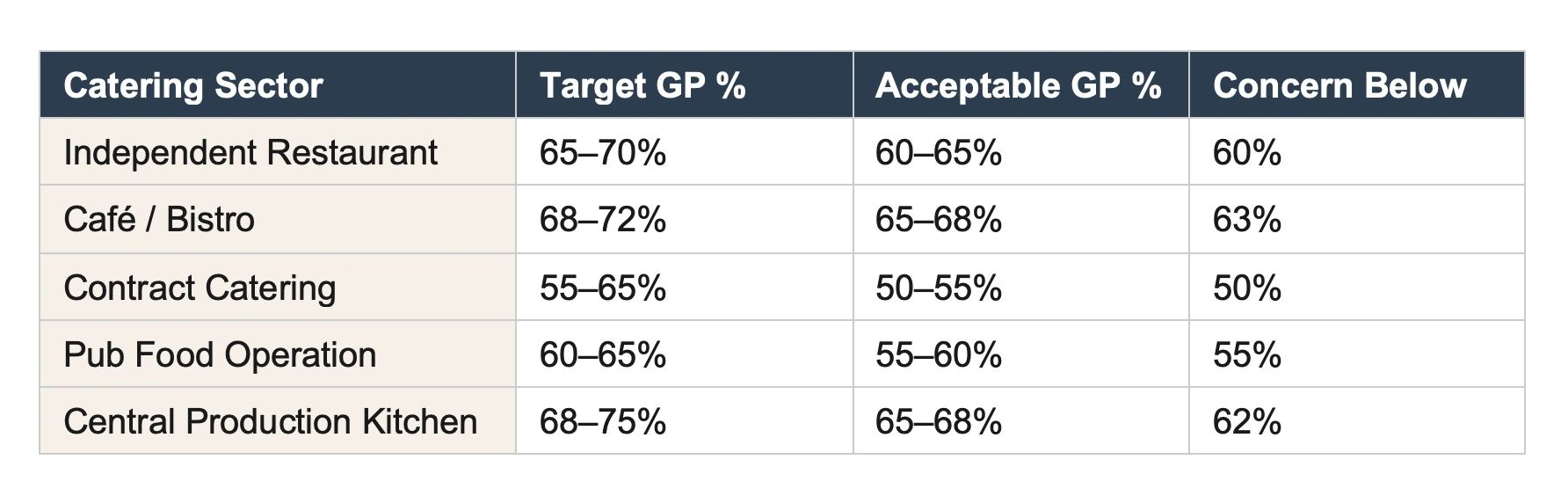
Treat these as benchmarks, not targets. Your GP comes from your food cost, and your running costs decide how high it has to be.
If your overall menu GP is sitting below these benchmarks, there's almost certainly a menu engineering problem at play — and the good news is, it's fixable without raising prices across the board.
Step 1: Run a Dish-Level Cost Analysis
The starting point of any menu profitability audit is calculating the true cost of every dish on your menu. Not just the main ingredient — every component, including garnishes, sauces, bread, and condiments that are served as standard.
For each dish, calculate:
- Raw ingredient cost (based on actual purchase prices, not theoretical — use your supplier invoices)
- Portion yield after prep (a 1kg chicken breast doesn't produce 1kg of cooked meat — account for trim and cooking loss)
- Allergen and substitute costs if relevant
- Packaging costs for takeaway or delivery items
Once you have the true food cost per dish, divide it by the selling price (excluding VAT) to get your food cost percentage. The inverse of this is your gross profit percentage.
Example: A pasta dish with a true food cost of £3.20 selling at £14.95 (ex VAT) has a food cost % of 21.4% and a GP of 78.6%. A burger with a true cost of £5.80 selling at £14.95 has a food cost % of 38.8% and a GP of 61.2%. Both are on the same menu. Both are priced the same. The difference in profitability is enormous.
Step 2: Cross-Reference Cost with Popularity
Cost data alone doesn't tell you the full story. A high-margin dish that nobody orders is less useful than a slightly lower-margin dish that's your bestseller. This is why you need to cross-reference your food cost analysis with actual sales data.
Pull your EPOS or till data for the last 90 days and identify your top and bottom sellers by volume. Then map each dish against its GP margin and ask:
- Which high-volume dishes have poor margins? (Plough horses — priority for cost engineering)
- Which high-margin dishes are underperforming on sales? (Puzzles — priority for repositioning or description rewrites)
- Which dishes have both poor margins AND low sales? (Dogs — strong candidates for removal)
- What percentage of your total revenue is coming from your top 5 dishes? (If it's above 50%, you may be over-reliant on a narrow range)
📊 From Our Experience
One of the most consistent findings in our menu audits is that operators are surprised by which dishes are their biggest profit contributors. The dishes guests rave about and the dishes that actually make you money are often not the same thing. Data removes the guesswork.
Step 3: Analyse Your Menu Layout and Psychology
Menu engineering isn't just about numbers — it's also about how information is presented. How you design your menu has a direct and measurable impact on what customers choose to order, which means it directly affects your profitability.
Key principles to audit in your current menu layout:
- The 'Golden Triangle': Research consistently shows that the eye naturally moves to the top-right, then top-left, then the bottom-centre of a menu. Are your most profitable dishes positioned in these zones?
- Anchor pricing: Is your most expensive dish doing its job? A high-price item on a menu makes the items around it feel more reasonably priced by comparison — this is an intentional technique, not just a listing.
- Descriptive language: Dishes with evocative, specific descriptions (provenance, preparation method, key flavour notes) consistently outsell genericly-named alternatives. 'Slow-braised Herefordshire beef brisket' performs better than 'beef brisket' in studies and in practice.
- Category structure: Are your sections logically organised? Do you have too many categories, creating decision fatigue? Most menu engineering experts recommend no more than 7 items per category.
Step 4: Tackle Your Top Three Profit Leaks
After running this audit with hundreds of UK catering businesses, we've identified the three most common menu profitability issues — and the fixes are often simpler than operators expect.
1. The high-waste ingredient problem
Many menus feature dishes that require ingredients used in only one or two recipes. When those dishes don't sell well, the ingredient spoils. Audit your menu for ingredient overlap — high-performing menus use the same core ingredients across multiple dishes, reducing waste and simplifying ordering.
2. The price anchoring gap
If the difference between your cheapest and most expensive main course is less than £6–8, you may be leaving revenue on the table. Customers instinctively avoid the most expensive item but often choose the second-most expensive. If that item isn't one of your highest-margin dishes, you've got a pricing structure problem.
3. The 'specials board' margin trap
Specials are a great way to manage seasonal produce and reduce waste — but in our experience, they're frequently underpriced. Because they're off-menu, operators often don't apply the same cost scrutiny. Treat your specials board as part of your core menu audit, not a separate category.
The UK Food Cost Reality in 2025
It's worth addressing the context we're all operating in. UK food inflation has moderated compared to the 2022–2023 peaks, but input costs remain structurally higher than pre-pandemic levels across most commodity categories. According to the Caterer and industry bodies, average food costs in UK hospitality rose by 15–25% over the 2021–2023 period — and while prices have stabilised, they haven't meaningfully reversed.
At the same time, the National Living Wage increase to £12.21 per hour from April 2025 has added further pressure on labour cost ratios. For UK catering businesses, the only sustainable response is a relentless focus on menu profitability — because the levers of pricing and footfall are harder to control than the structure of your menu.
🍽️ Real-World Example
We recently worked with a Bristol-based restaurant group that had not reviewed their menu costing in 18 months. In that time, the GP on their most popular main course had dropped from 68% to 54% due to supplier price increases that hadn't been reflected in the selling price. A single conversation about menu pricing strategy recovered approximately £2,200 per month in margin. The food and the service hadn't changed. The numbers had.
When to Bring in a Catering Menu Consultant
Some businesses can run this audit internally — especially if they have a strong head chef with commercial awareness and a decent EPOS system. But there are several situations where bringing in an external catering consultant delivers a significantly better return:
- You've never done a structured dish-level cost analysis before
- Your GP has declined over the past 12 months but you can't identify the cause
- You're planning to relaunch, rebrand, or expand — and want the new menu to be commercially sound from day one
- You're operating multiple sites and need consistency in food cost across the estate
- You want to use AI-powered menu engineering tools to model different pricing and dish combinations before committing to a menu change
At On The Pass Consultancy, menu development and profitability analysis is one of our core services. With over three decades of hands-on experience across independent restaurants, contract catering, café operations, and central production kitchens, we work with UK catering businesses to identify margin opportunities and implement them practically — not just theoretically.
Your Next Steps
If you've read this and recognised your business in any of the scenarios above, here's what we'd recommend you do this week:
- Pull your GP figures for the last 3 months. If you don't know them off the top of your head, that's already useful information.
- Identify your 5 highest-volume dishes and calculate their true food cost % using your current supplier prices.
- Compare those figures against the benchmarks in the table above. Are you where you should be?
- Book a no-obligation consultation with On The Pass Consultancy. We'll do an initial review of your menu and give you a straightforward assessment of where the biggest opportunities are.
At On The Pass Consultancy, menu profitability analysis is one of the most common starting points for our work with clients across Cardiff, Newport, Swansea, and the wider South Wales region. If you'd like us to take a look at how your current menu is performing — and identify where the real margin opportunities are — get in touch for a free initial conversation.
👉 Coming Up Next Week
Next week, we'll be looking at commercial kitchen layout — and the five signs your kitchen design is costing you time, labour, and money every single service. If you want to make sure you don't miss it, sign up to our newsletter below.
About On The Pass Consultancy
On The Pass Consultancy brings over 30 years of hands-on UK catering industry experience to independent restaurants, café operations, contract caterers, and food service businesses across Wales, Bristol, Gloucester, and beyond. Our services span menu development, kitchen design, staff training, catering equipment supply, and AI-powered operational tools. Get in touch: onthepassconsultancy.com
The answer is usually sitting in two or three dishes. I go through this properly when I cost a menu dish by dish.