Stock Control in Catering: The Waste You Can't Account For
By On The Pass Consultancy | Category: Kitchen Efficiency | Reading time: 5 min | Keywords: how to reduce food waste in commercial kitchen, stock control catering UK, food waste commercial kitchen
Walk into a commercial kitchen mid-week and count the number of containers at the back of the fridge with no label, no date, and no clear purpose. In most operations, you'll find more than you expect. Some of that food will be used. A fair amount won't. And the cost of what doesn't get used will never appear on a single line of any report — it'll just quietly erode the margin you worked hard to build.
Food waste in catering is usually talked about in terms of what ends up in the bin at the end of service. That's the waste you can see. The waste you can't see is more expensive, more persistent, and far harder to tackle without a proper stock control system behind you.
The Two Types of Food Waste
Visible waste is plate waste, trim waste, spoilage, and end-of-service throw-away. It's uncomfortable to look at, but at least it's countable. You can pull a bin at the end of a shift, assess what's in it, and trace most of it back to a decision — an over-portioned dish, a prep batch that was too large, an ingredient that sat one day too long.
Invisible waste is harder. It's the ingredient that gets used, but at a higher quantity than the recipe requires because nobody checked. It's the product that goes into a dish other than the one it was bought for, at a cost that never gets reallocated. It's the delivery that was accepted short — fewer units than invoiced, smaller weights than specified — and never queried because the check wasn't done at the door. And it's the over-ordering that happens when you buy by habit rather than by need, leaving you carrying more stock than you turn over, with the cash tied up in a fridge rather than working for the business.
In my experience, invisible waste is typically worth more than visible waste in most UK catering operations. It's also the part that a proper stock control system eliminates.
Why Most Kitchens Don't Have a Stock Control System
The honest answer is time. Stock control feels like an administrative task, and in a kitchen that's focused on service, it keeps getting deprioritised in favour of things that feel more urgent.
The second reason is that the link between stock control and profitability isn't felt in any single moment. Missing a stock count one week doesn't cause an immediate crisis. Neither does accepting a short delivery without querying it, or failing to label a container. The impact accumulates slowly and shows up in GP figures that are consistently a few points lower than they should be, with no obvious single cause.
The third reason is that many operators have tried to implement stock systems that were too complex for their operation — full inventory management software, multiple count sheets, daily reconciliations — and abandoned them because the administrative overhead was unsustainable. The right system isn't the most sophisticated one. It's the most consistent one.
What a Working Stock Control System Actually Looks Like
For most independent and small-group catering operations, a practical stock control system covers four things.
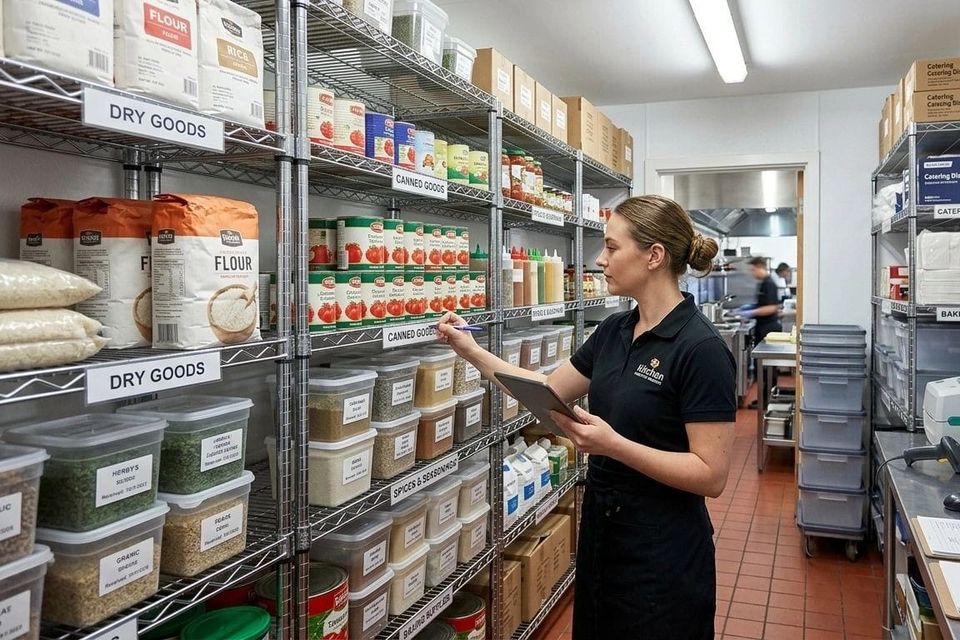
A weekly stock count. Same day each week, same person doing it, same order every time. It doesn't need to cover every item in the kitchen — focus on your high-value ingredients first. Protein, dairy, specialist items. Once you can count those consistently, you have enough data to identify where your stock is going and whether it aligns with your sales.
FIFO — First In, First Out — as a non-negotiable standard. New stock goes to the back, older stock comes to the front. Every team member, from the most senior chef to the newest kitchen assistant, follows the same rule. This single discipline, applied consistently, eliminates a significant proportion of spoilage waste in most kitchens.
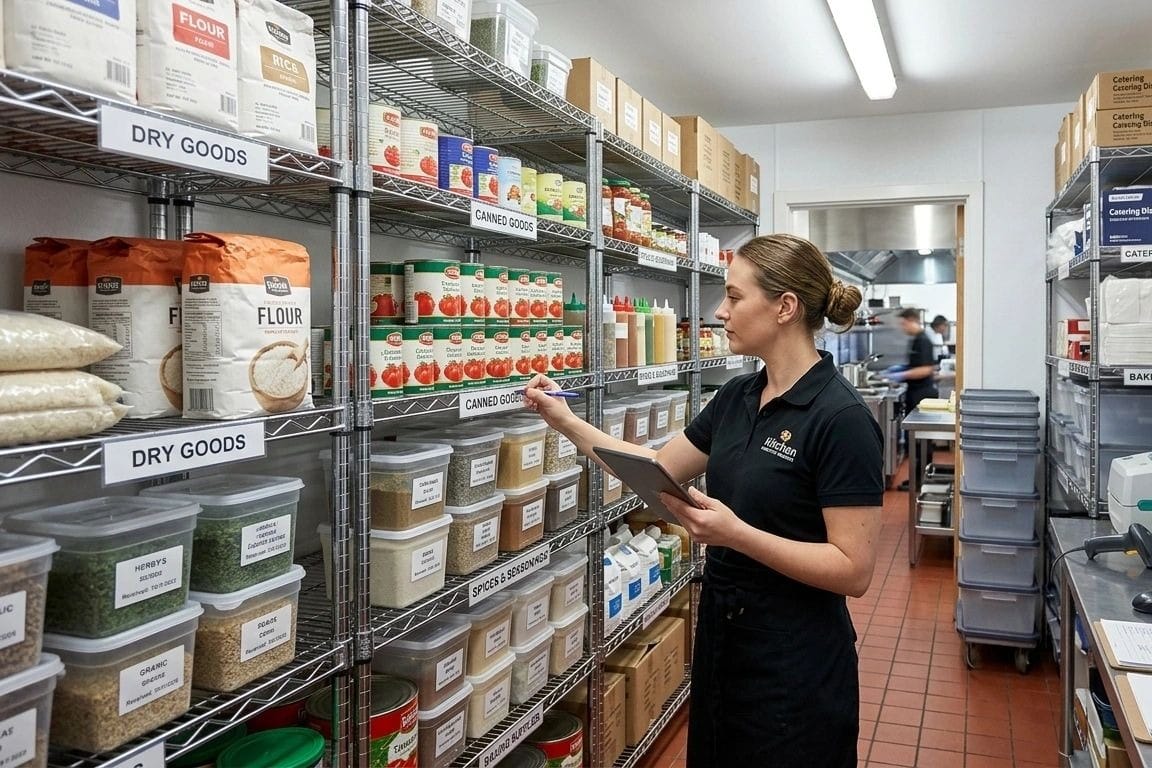
Labelling and dating at the point of preparation. Every container, every prep batch, every portioned ingredient that goes into storage gets a label with the contents, the date prepared, and the use-by date. This isn't bureaucracy — it's the difference between a fridge that functions as a controlled resource and one that functions as a guessing game at the start of every shift.
Ordering against usage, not against habit. Before every order goes in, check what's actually in stock. A standing order might feel efficient — and for commodity items with long shelf lives it can be — but for fresh produce, protein, and dairy, ordering against what you've actually used in the last service cycle is the discipline that keeps your stock holding tight and your waste low.
The Delivery Door: Your First Line of Defence
One of the most consistently underused cost controls in UK catering is a proper delivery check process. This means checking what arrives against what was ordered — quantities, weights, grade, and condition — before it goes into storage.
A supplier that regularly delivers short, or substitutes products without notification, is a supplier whose invoices don't match what's arriving in your kitchen. Over a year, the cumulative effect of accepting shortfalls without challenge can be significant. Most operators don't challenge them not because they've decided not to, but because they've never built the check into the delivery routine.
The check doesn't need to take long. For most deliveries, five to ten minutes is sufficient. What it does require is that someone is designated to do it, knows what to look for, and has a clear process for recording and querying discrepancies. That process — straightforward to put in place — is worth more than most of the other cost controls you can implement at zero cost.
Connecting Stock Control to Your Recipe Costing
Stock control and recipe costing aren't separate disciplines — they're two parts of the same system. Your recipe costing tells you what your ingredients should cost per portion. Your stock control tells you what your ingredients are actually costing per week. If those two numbers are significantly out of alignment, the gap is waste — visible or invisible.
Running both together gives you a complete picture of where your food margin is going and what's driving any movement in your GP. It also gives you early warning when something changes — a supplier price increase, a portion drift, a spoilage problem — before it shows up as a meaningful hit to your bottom line.
The operators who manage their GP most consistently aren't doing anything complicated. They know what they should be using, they track what they're actually using, and they close the gap when the two diverge. That's stock control. It's unglamorous, it requires discipline to maintain, and it reliably protects more margin than almost anything else you can do operationally.
How We Approach Stock Control at On The Pass Consultancy
When we work with a client on their food costs, stock control is always part of the conversation. We look at what's currently in place — or not in place — and build a system that fits the operation rather than imposing a generic solution. For most clients, the improvements are operational rather than technical, and the GP recovery is measurable within a few weeks of consistent application.
If your stock feels like it manages you rather than the other way around, that's worth addressing. The margin it's costing you is already there — it just needs a system to capture it.
Want to get your stock under control? Get in touch for a free initial consultation — we'll look at your operation honestly and show you where the opportunities are.
Free Consultation — onthepassconsultancy.com/contact-us