Fresh Linguine with Brown Crab, Chilli, Lemon and Samphire

By On The Pass Consultancy | Serves: 20 | Pasta: 45 min + 1 hr rest | Sauce & Finish: 30 min | Intermediate
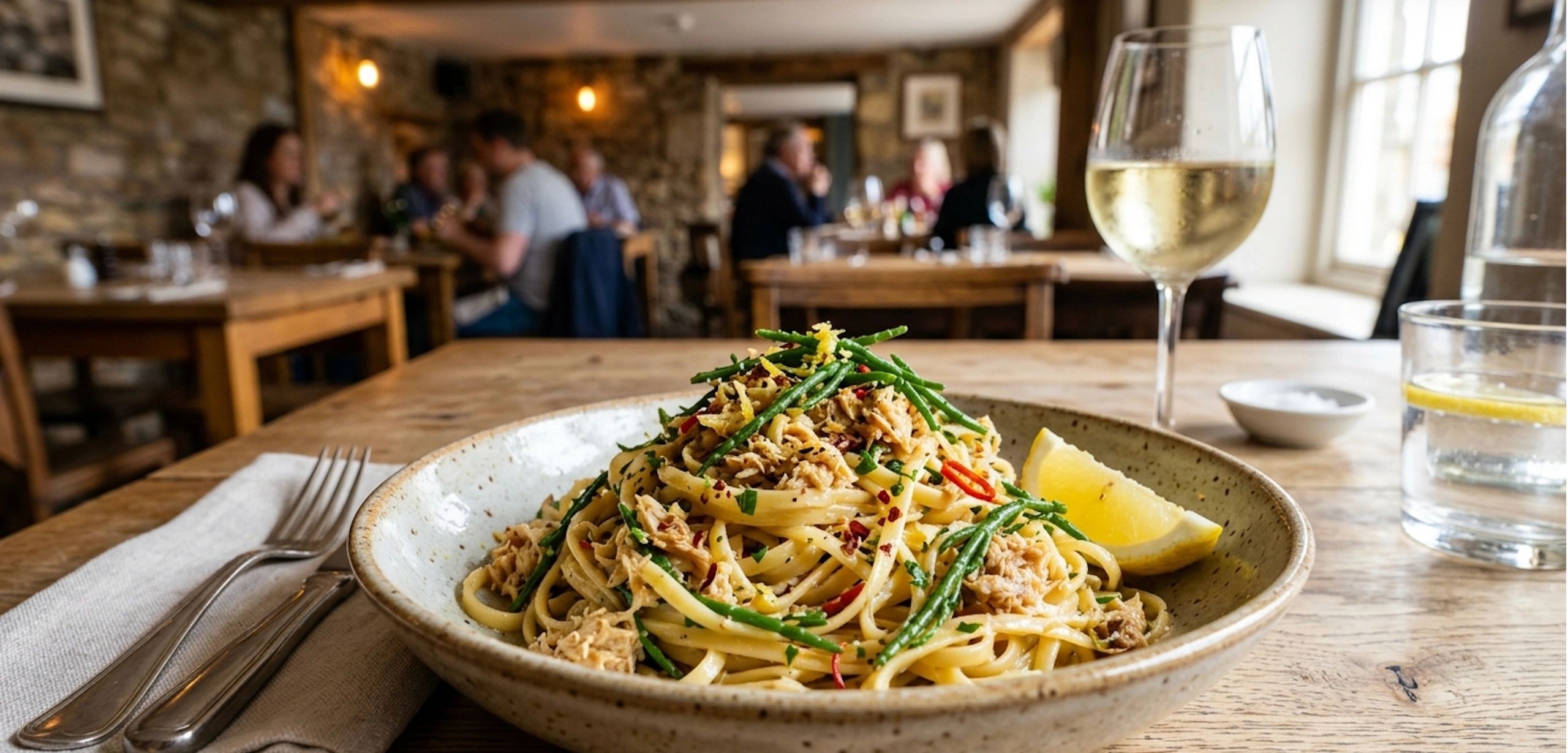
Why This Dish — and Why Now
Brown crab season opens properly in late April. Samphire starts appearing at the same time — earlier on the south coast, a little later along the Welsh coastline and the Severn Estuary. The two have a window of about three to four weeks where they're both at their best and both in season simultaneously. This is that window.
The dish is deceptively simple. Fresh pasta, crab, chilli, lemon, a handful of coastal green. What makes it stand out on a spring menu is the decision to make fresh linguine rather than reach for the dried. A quality dried linguine will do the job, but fresh pasta and crab have a texture relationship that dried pasta can't replicate — the sauce clings differently, the bite is softer, and the whole plate reads as considered rather than convenient.
This recipe is written for 20 covers. The pasta dough can be made the day before service and held overnight in the fridge, tightly wrapped. The sauce base — brown crab, garlic, chilli and wine reduction — can be built and held off the heat before service. From that point, each portion finishes in under three minutes at the pass. That's the operational argument for fresh pasta in a busy kitchen: the prep is front-loaded, and service is fast.
Brown crab is also one of the best-value ingredients you can put on a spring menu. Whole dressed crabs are more economical than pre-picked meat if you have the kitchen hours to use them. For a 20-cover service on a tight margin, that trade-off is worth knowing.
Ingredients
Fresh Linguine:
- 1kg tipo 00 flour, plus extra for dusting
- 200g fine semolina, plus extra for the trays
- 10 large free-range eggs, whole
- 3 egg yolks
- 30ml extra virgin olive oil
- 8g fine salt
- Water — a few drops only if needed
For the Sauce:
- 2kg white crab meat, picked clean of all shell
- 600g brown crab meat
- 800g samphire, washed
- 12 garlic cloves, finely sliced
- 6–8 red chillies, finely sliced (seeds in for heat, out for mild)
- 500ml dry white wine or dry vermouth (Noilly Prat)
- 250g unsalted butter, cold, diced
- 120ml extra virgin olive oil, plus extra to finish
- 5 lemons — zest and juice
- 2 large bunches flat-leaf parsley, roughly chopped
- Sea salt and white pepper
Method
PART ONE: THE PASTA
1. Build the dough. Combine the 00 flour, semolina and salt on a clean bench or in a large bowl. Make a well in the centre. Crack in the whole eggs and yolks, add the olive oil, and beat lightly with a fork, gradually drawing the flour in from the edges. Once it comes together enough to handle, work it by hand — knead firmly for 10–12 minutes until smooth, supple and elastic. The dough should spring back slowly when pressed with a thumb. If it's cracking, it's too dry; add water a few drops at a time. If it's sticky, flour your hands, not the dough. The semolina is doing two things here: adding structure to help the linguine hold its shape during cutting and service, and giving the finished pasta a slight bite that dried pasta achieves through drying time. Don't skip it.
2. Rest the dough. Wrap tightly in cling film and rest at room temperature for a minimum of one hour. Resting relaxes the gluten — try to roll pasta that hasn't rested and you'll understand immediately why this step exists. The dough fights back. Overnight in the fridge is ideal; bring it back to room temperature for 30 minutes before rolling.
3. Divide and roll. Divide the dough into 10 equal pieces. Work with one piece at a time, keeping the rest wrapped. Dust lightly with 00 flour and begin rolling through your pasta machine, starting at the widest setting. Fold the sheet in thirds after the first two passes — this improves the texture and straightens the edges. Progressively tighten the setting, rolling through each setting twice, until you reach setting 5 or 6. You want a sheet that's roughly 2–2.5mm thick — substantial enough to hold during finishing, thin enough that it doesn't feel heavy in the bowl.
4. Cut the linguine. Dust each sheet lightly with semolina and fold loosely before cutting by hand into strips approximately 3mm wide, or pass through the linguine attachment if your machine has one. Shake the nests loose, dust again with semolina, and lay on semolina-dusted trays. Hold in the fridge if made in advance — they'll keep well for up to 24 hours.
PART TWO: BLANCH THE SAMPHIRE
5. Blanch and refresh. Bring a large pot of water to the boil — no salt. Drop the samphire in for 45 seconds, then lift immediately into iced water. Drain and set aside. Samphire carries significant natural salinity. Blanching and refreshing knocks that back to a level where it seasons the dish rather than dominating it. Taste a strand before and after — the difference is marked. If you're going to make any mistake with samphire in a professional kitchen, over-salting from not blanching first is the most common one.
PART THREE: THE SAUCE
6. Sweat the aromatics. In a wide, heavy-based sauté pan or rondeau over a medium-low heat, warm the olive oil. Add the garlic and chilli in batches if needed — don't crowd the pan. Cook gently for 3–4 minutes. Soft, fragrant, no colour. The moment garlic takes on colour it turns bitter, and there's no correcting it at service.
7. Deglaze and reduce. Pour in the wine or vermouth and increase the heat to medium. Let it reduce by half — approximately 3–4 minutes. This builds the acidity that will balance the richness of the butter and the intensity of the brown crab. Don't rush the reduction or you'll carry raw alcohol into the finished sauce.
8. Build with brown crab. Add the brown crab meat and stir it through. Brown meat is where the depth lives — richer, more intensely savoury and more umami than the white. Let it break down into the liquid over 2–3 minutes over a low heat, stirring occasionally. It becomes part of the sauce rather than sitting in it. This is the base you can hold and reheat to order.
9. Mount with butter. Drop the heat right down. Add the cold butter a few pieces at a time, swirling or stirring constantly to emulsify it into the sauce rather than letting it separate. This is the same technique as finishing any pan sauce — cold butter, low heat, constant movement. If the sauce breaks, a tablespoon of hot pasta water will bring it back together.
PART FOUR: SERVICE
10. Cook the pasta to order. Bring a large pot of well-salted water to a rolling boil. Fresh linguine will cook in 2–3 minutes. Cook in batches of 3–4 portions at a time to maintain the water temperature. Before draining each batch, scoop out a ladle of pasta water and keep it to hand.
11. Finish each portion. Working in a hot sauté pan for each batch: ladle the sauce base in, add white crab meat proportionally and fold in gently — white crab needs 60 seconds of heat, nothing more. Add the drained fresh pasta and a splash of starchy pasta water. Toss to coat — you're after a loose, glossy sauce that clings rather than pools. If it tightens, add more pasta water; if it's soupy, another 20 seconds on the heat.
12. Plate. Add the blanched samphire, lemon zest and a good squeeze of lemon juice. Toss once more. Taste — go carefully on the salt; the crab and samphire are already doing work. A few turns of white pepper. Divide into warm bowls, finish with chopped parsley and a drizzle of good extra virgin olive oil. Serve immediately.
Chef's Notes
- Sourcing the crab: Whole dressed crabs are more economical than pre-picked catering-grade meat if you have the labour hours. A 1.5–2kg brown crab yields roughly 30–35% of its bodyweight in usable meat between the white and brown. For 20 covers at these quantities, you're looking at approximately 10–12 dressed crabs. Buy from a supplier you trust — crab deteriorates quickly and the difference between a fresh-picked and a tired one is immediately obvious in the finished dish.
- Fresh pasta vs. dried at volume: The upfront labour is offset at service — fresh linguine cooks in 2–3 minutes versus 9–10 for dried, giving you more control at the pass. Make the dough the day before, hold the nests on semolina-dusted trays in the fridge. Build that prep into your day plan.
- Scaling beyond 20: The pasta dough scales directly — maintain the ratio of 100g flour (80g 00 + 20g semolina) to 1 whole egg plus a fraction of yolk. Above 40 covers, split the sauce into two batches rather than trying to hold one large pan; consistency is harder to maintain at scale.
- Wine or vermouth: Dry vermouth has more herbal depth than a standard dry white and holds better in a working kitchen — an open bottle of vermouth keeps far longer than an open bottle of wine. If you're buying specifically for this dish, buy vermouth.
- Samphire timing: In the UK, samphire peaks from late April through to July. Welsh coastal sources, the Norfolk coast, and the Severn Estuary all supply good quality. Your fishmonger is the most reliable source in-season — they'll tell you when it's actually good rather than just available.
Enjoyed this? Subscribe below and get a new recipe every Friday — written for professional kitchens, grounded in more than 35 years of real experience.
For gross profit calculations, please see our recent blog here.
Written by our in-house Chef René Chapman