AI in the Kitchen: What It Actually Means for Catering Businesses

AI IN THE KITCHEN — SERIES PART 1 OF 3
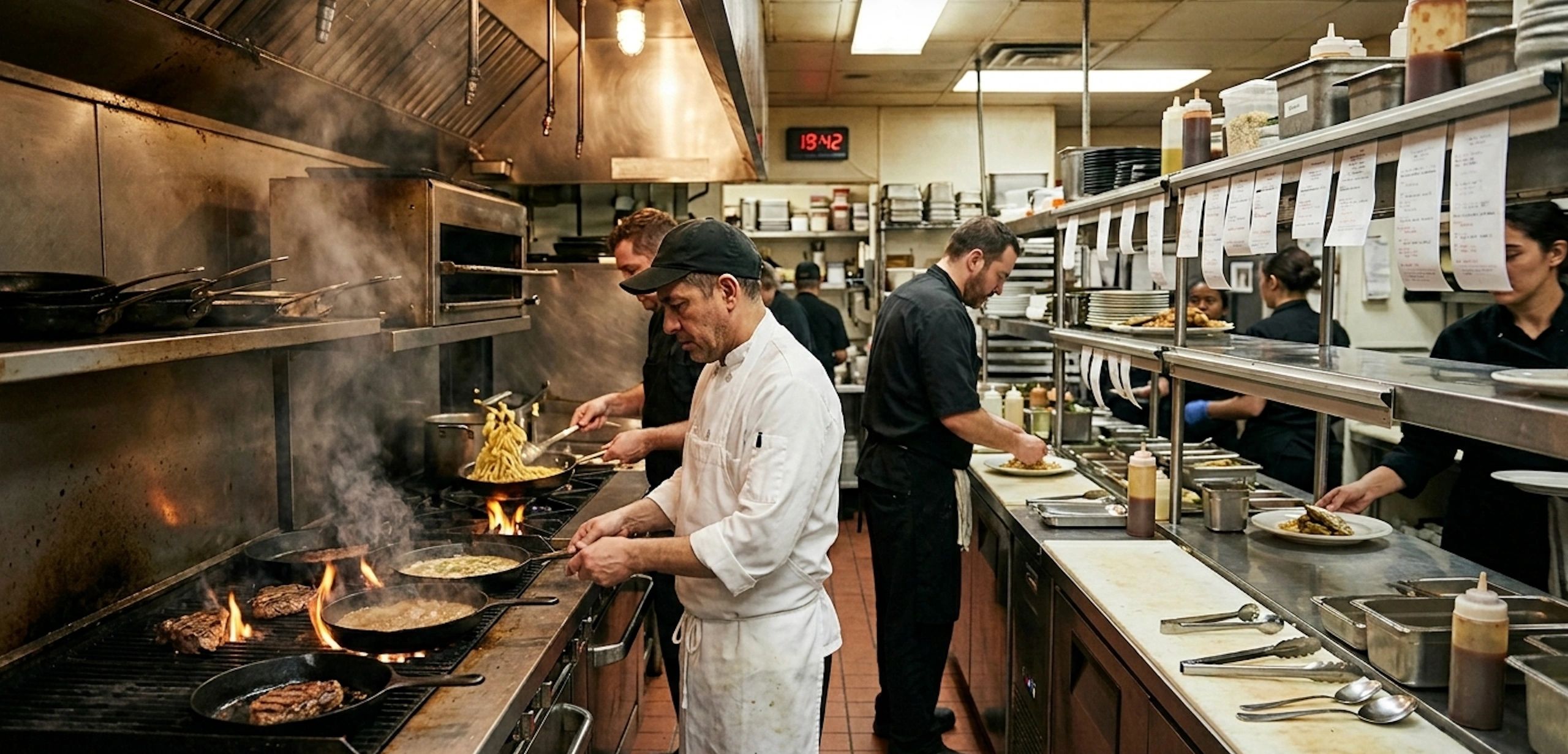
2026 is the year AI stops being a buzzword and starts showing up in real commercial kitchens. Here's
what AI kitchen technology actually looks like for independent catering operators — not hotel chains.
Everyone in hospitality is talking about AI. The conferences are full of it. The trade press runs it on
the front page every other week. And when you get past the headline, almost all of it is written for
hotel chains, national restaurant groups, and quick-service giants with six-figure tech budgets, a
dedicated IT function, and the kind of infrastructure most of us will never have.
If you're running a café, a contract catering operation, a central production kitchen, or a small
independent restaurant, you'd be forgiven for switching off. It can feel like the AI conversation has
nothing to do with the reality of your kitchen on a Tuesday morning.
It does. But not in the way most of the coverage suggests, and not in a way that requires you to rip
out everything you've already built. In this post — the first in a three-part series on AI tools for
catering businesses — I want to cut through the noise and talk practically about what AI kitchen
technology looks like at the scale most of us actually operate at.
Why 2026 Is the Year Things Change for Independent Operators
AI in hospitality is not new. The tools have been circling for the past three or four years, and plenty
of larger operators have been running pilots. But pilots are not the same as operational reality, and
for smaller catering businesses, the practical and financial barriers were real: high costs, complex
integration, and software designed for enterprise, not for a kitchen manager who also does the
ordering, the rota, and the bank reconciliation.
That's changing in 2026. Industry analysts and hospitality technology specialists are consistently
describing this year as the first genuine integration year — the point at which AI moves from
experiment to everyday operation. The infrastructure has matured. The costs have come down
significantly. And for the first time, AI tools for commercial kitchens are starting to be built with
independent operators in mind, not just the Marriotts and the McDonald's of the world.
That matters. Because the operators who start engaging with these tools now — even cautiously,
even on a small scale — will be better placed than the ones who wait another three years and try to
catch up quickly.
What AI in Commercial Kitchens Actually Looks Like
Before we go further, I want to be clear about what I mean and what I don't mean. When the tech
press covers AI in hospitality, they're often talking about robotic arms flipping burgers,
AI-generated menus, or customer-facing chatbot systems. That's not this conversation. For small
to mid-size catering operations in the UK, AI kitchen technology is showing up in three practical,
operational areas — and none of them require a robotics engineer or a Silicon Valley budget.
1. Demand Forecasting and Smarter Production Planning
This is probably the most immediately valuable application of AI for independent catering
businesses, and also the one most people haven't considered because it sounds more complicated
than it is.
Traditional production planning in most kitchens relies on experience — a head chef who's been
doing the job long enough to know roughly how many covers come in on a wet Wednesday versus
a sunny Friday, and who adjusts prep accordingly. That instinct is genuinely valuable, and nothing
in this post should be read as undermining it. But instinct has limits, particularly when you're
managing multiple sites, running a complex menu, or dealing with the kind of unpredictable trading
environment the UK hospitality sector has had for the past few years.
AI demand forecasting tools draw on historical sales data, booking patterns, local events, and even
weather data to build a more accurate picture of what you'll need and when. The output is a
production plan — how much to prep, of which dishes, and at what points in the day — that is built
on data rather than gut feel alone. The head chef still makes the final call. But they're starting from
a better position.
For catering businesses where food waste is a direct hit on an already tight gross profit, this is not
a marginal gain. The Food and Drink Federation has warned that UK food inflation could reach 9%
by the end of 2026. In that environment, over-production is money you cannot afford to lose.
AI-assisted demand forecasting for catering operations is one of the most direct ways to reduce it.
2. Automated Stock Control and Purchasing
Connected to forecasting, but distinct enough to deserve its own section: AI-driven stock
management for commercial kitchens.
Most catering businesses still run their stock control in one of two ways. Either someone physically
counts the walk-in every morning and raises purchase orders on the back of what they find, or
orders are placed on habit — same suppliers, same quantities, week after week — with
adjustments made reactively when something runs out. Neither of these approaches is wrong
exactly, but both are time-consuming and both leave room for waste, over-ordering, and missed
savings.
AI stock management systems for hospitality work by integrating your sales data, your production
forecasts, and your current stock levels to generate accurate purchase orders automatically. You
On The Pass Consultancy | onthepassconsultancy.com Page 3
still approve them. You still make judgement calls about supplier relationships and quality. But the
administrative load of stock control — which in a busy kitchen can eat hours every week — is
significantly reduced.
For operators managing multiple sites or a central production kitchen supplying several outlets, this
is particularly significant. Reconciling stock across locations manually is one of those jobs that
nobody does as well as they need to because nobody has the time. An AI-assisted system does it
continuously, in the background, without needing to be asked.
The secondary benefit is the data. When your purchasing is being driven by a connected system
rather than habit, you start to see patterns you didn't know were there — which lines you're
consistently over-ordering, where your waste is concentrated, which supplier relationships are
actually delivering value. That visibility changes the conversations you have when it's time to
renegotiate.
3. Kitchen Display Systems and Workflow Optimisation
The third area is perhaps the least glamorous but among the most practically impactful for
day-to-day operations: AI-integrated kitchen display systems (KDS) and order flow management.
Traditional kitchen management relies on printed dockets, shouted calls, and the kind of hard-won
choreography that takes years to build into a team. It works, up to a point. But it depends heavily
on experienced people being present, and in a year when UKHospitality research shows one in
three hospitality businesses has cut operating hours because they can't staff the kitchen, that
dependency is a vulnerability.
AI-assisted KDS platforms do more than display orders. They learn your kitchen's workflow —
which stations are bottlenecks, how long specific dishes actually take versus how long they should
take, where service is consistently breaking down — and they optimise order routing accordingly.
They can flag when a table's tickets are building faster than the kitchen can realistically turn them
around, before it becomes a problem on the floor. And they allow a less experienced team to
perform more reliably, because the system carries some of the coordination load that would
otherwise sit with your head chef.
This is important in 2026. The National Living Wage has risen to £12.71 per hour this month,
employer National Insurance contributions have increased, and business rates have been
revalued. Every catering business in the UK is being asked to do the same or more with tighter
margins and, in many cases, leaner teams. AI kitchen workflow tools are one of the ways operators
are making that work without simply running their chefs into the ground.
The Honest Caveat
I want to be straightforward about something, because I've seen too many technology
conversations in this industry go wrong when nobody is not forward thinking.
AI tools for catering businesses are not a substitute for skill, experience, or good kitchen culture. A
demand forecasting system that tells you to prep 60 covers on a Thursday evening still needs a
head chef who knows that the local theatre has a matinée that day and the early evening will be
slower than the data suggests. An automated purchasing system still needs someone who
understands quality, who knows their suppliers personally, and who can spot when the data is
giving a misleading picture.
AI is a tool. Like a Rational combi oven, like a good EPOS system, like a calibrated blast chiller —
it does what it's designed to do, and it does it well. But the judgement, the experience, and the
relationships still have to come from the people in the kitchen. What these tools do is take the
repetitive, data-heavy, administrative tasks off the table so that your best people can spend their
time on the things that actually require them.
How to Evaluate an AI Tool Before You Commit
If you're starting to look at AI kitchen technology, a few practical questions to ask before you sign
anything:
Does it integrate with what you already have?
A demand forecasting tool that can't talk to your EPOS system is going to create more work, not
less. Ask specifically about integration with your existing point of sale, booking, and purchasing
platforms before you get past the demo stage.
Who is this product actually built for?
Read the case studies carefully. A product designed for a 300-cover hotel restaurant and retrofitted
for smaller operators is a very different proposition from one built with independent catering
businesses in mind from the start.
What does the data requirement look like?
Most AI tools improve significantly with more historical data. If you're a newer business, or you've
recently changed EPOS systems and lost your history, ask the supplier how the product performs
during the early period before it has enough data to be genuinely useful. Some are more honest
about this than others.
What does support look like in practice?
Not in the brochure — in practice. Get on a call with an existing customer in a similar business
before you commit.
Where to Start ?
The most common mistake I see operators make with new technology is trying to change too much
at once. Pick one problem. Where are you losing the most time to manual admin? Where is your
On The Pass Consultancy | onthepassconsultancy.com Page 5
food waste highest? Where is service breaking down most consistently? That's your first
conversation with any AI tool supplier.
You don't need a full digital transformation strategy to start exploring whether AI kitchen
management software could work for your operation. You need one clear problem and the
willingness to test a solution properly before rolling it out.
In Part 2 of this series, I'll be looking at demand forecasting tools specifically — what's available for
independent catering operators in the UK, what to look for in a product, and what the realistic cost
and return looks like for a small to mid-size operation.
If you'd like to talk through what AI tools might look like for your specific operation — whether you run a
café, a contract catering unit, or a central production kitchen — get in touch. That first conversation is
always free, and it won't cost you a sales pitch. Contact Us
#SmallBusinessHospitality #OnThePassConsultancy