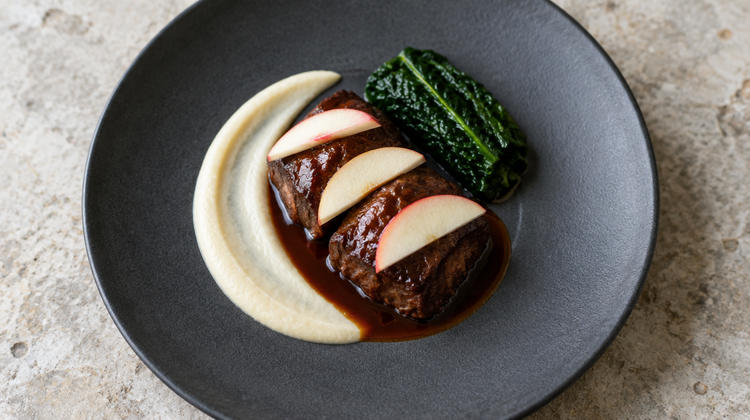
Smoked Chocolate Delice with Quince and Meringue for 20
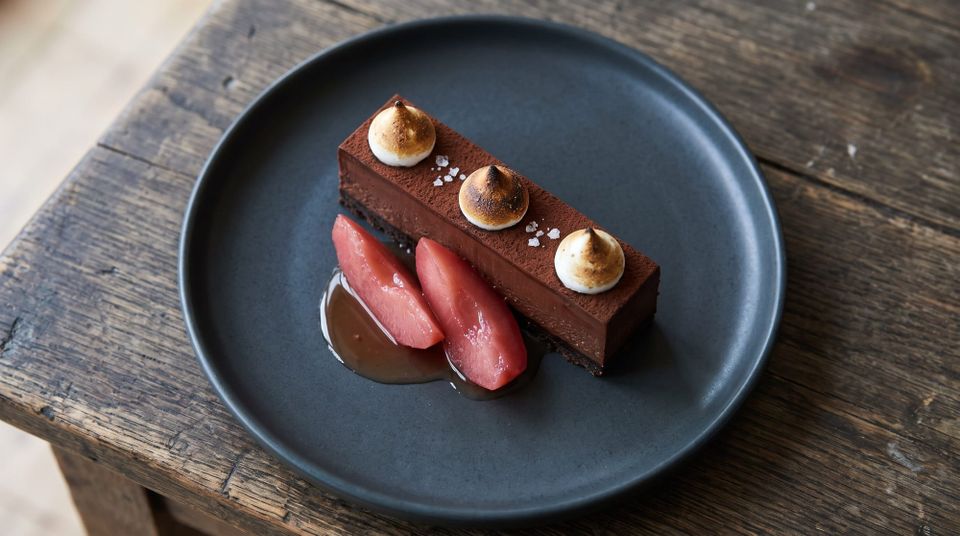
Dark chocolate with a breath of oak smoke, rose-pink quince and a torched meringue. A winter dessert that does its work the day before.
Why This Chocolate Delice and Why Now
This chocolate delice recipe is built for the weeks when most kitchens are writing their Christmas party menus. Christmas is six weeks away. The dessert on that menu has to look like fine dining and run like a production line. A delice does both. It is a set chocolate mousse on a crisp base, cut into neat bars from a frame. Every bar comes out the same.
The smoke is the twist. Bonfire Night was last week and smoke is still the flavour of the season. Cold smoking the cream over oak gives a background warmth that guests notice without being able to name. Overdone, it tastes of an ashtray, so the method keeps it light.
Quince is the British produce at its best this week. Its season runs from October into December. Hard and sour when raw, it turns soft, fragrant and rose-pink when poached slowly. Its sharpness is exactly what rich chocolate needs.
The chocolate is Callebaut 70-30-38, a 70.5 per cent dark couverture that most UK catering suppliers carry. It is bitter enough to stand up to the smoke and it sets firm for a clean cut.
Where This Dessert Fits on a Seasonal Menu
On a Christmas party menu this sits as the alternative to the hot pudding. Not every table wants something steamed and heavy in November. A set menu that offers only that loses the guests who want chocolate. On an à la carte winter menu it works from now until the quince runs out in December. On a tasting menu, cut the bars in half for a smaller portion.
It also balances a seasonal menu for restaurants that leans on game, braises and roasts. After a heavy main, a cold, sharp dessert lands better.
Serves 20 | Prep: 3 hours over three days | Cook: 3 hours, mostly the quince
Ingredients
Everything is weighed as purchased unless it says otherwise. The frame is a 30cm by 20cm stainless steel frame, 4cm deep, lined with acetate. A 30cm by 20cm baking tin lined with acetate also works, lifting the set slab out by the acetate. The acetate gives clean edges, so no trim is needed.
Smoked cream
| Ingredient | Quantity |
|---|---|
| Double cream | 300ml |
| Oak smoking chips, food grade | 5g (a small handful) |
Chocolate base
| Ingredient | Quantity |
|---|---|
| Plain flour | 150g |
| Cocoa powder | 25g |
| Caster sugar | 60g |
| Unsalted butter, cold and diced | 125g |
| Fine sea salt | a pinch |
| Callebaut 70-30-38 dark chocolate callets, melted | 60g |
| Unsalted butter, melted | 40g |
Smoked chocolate delice
| Ingredient | Quantity |
|---|---|
| Callebaut 70-30-38 dark chocolate callets | 500g |
| Smoked cream, from the table above | 300ml |
| Double cream, for whipping | 700ml |
Poached quince
| Ingredient | Quantity |
|---|---|
| English quince | 6 (about 2kg, about 330g each) |
| Water | 2 litres |
| Caster sugar | 800g |
| Lemon, juice and peeled zest | 1 |
| Vanilla pod, split | 1 |
Italian meringue
| Ingredient | Quantity |
|---|---|
| Egg whites, British Lion or pasteurised | 120g (about 4 medium eggs) |
| Caster sugar | 240g |
| Water | 80ml |
To finish
| Ingredient | Quantity |
|---|---|
| Cocoa powder, for dusting | 10g |
| Sea salt flakes | 5g |
| Quince glaze, reduced from the poaching syrup | 250ml (from 500ml of syrup) |
Per cover: one bar of delice 10cm by 3cm, two wedges of quince, three torched meringue kisses, about 10ml of quince glaze and a few flakes of sea salt. The quince gives 48 wedges, so there are eight spare.
Method
Steps are numbered straight through. The quince and the smoked cream are done two days before, the delice the day before and only the meringue is made on the day.
Stage 1: Poached quince (two days before)
1. Put the water, sugar, lemon juice, lemon zest and vanilla pod in a wide, heavy pan and bring to a simmer until the sugar dissolves.
2. Rub the grey down off the quince under cold water. Peel each one, quarter it, cut out the core and cut each quarter into two wedges, so each quince gives eight. Drop the wedges straight into the syrup as you go, because cut quince browns fast.
3. Tie the peel and cores in a square of muslin and drop it into the pan. They carry the pectin and the rose-pink colour.
4. Cover the fruit with a cartouche and a lid. Poach at the barest simmer for 2 to 3 hours until the wedges are tender to the point of a knife and have turned rose-pink. A rolling boil breaks the wedges before they colour.
5. Lift out the muslin bag and squeeze it back into the pan. Transfer the quince and syrup to a shallow gastronorm, set it over ice and cool to below 8°C within 90 minutes, then refrigerate below 5°C. Log the cooling time and temperature. A digital hygiene app such as Leafe keeps that record for you. Kept covered in its syrup, the quince holds for four days.
Stage 2: Smoked cream (two days before)
6. Pour the 300ml of double cream into a shallow stainless tray set over ice and cover it with cling film, leaving one corner open. Light the oak chips in a smoking gun and fill the space under the film with smoke. Seal the corner and leave for 10 minutes. The cream stays cold throughout, which is why this is cold smoking.
7. Taste it. It should smell of a distant fire, not a near one. If it is faint, smoke it once more for 5 minutes. Cover and refrigerate below 5°C overnight, when the smoke softens and spreads through the cream.
Stage 3: Chocolate base (the day before)
8. Rub the flour, cocoa powder, caster sugar, salt and cold diced butter together until it looks like breadcrumbs. Spread it over a lined tray and bake at 170°C (fan 150°C) for 15 minutes, stirring halfway, until it smells toasted and feels dry. Leave it to cool.
9. Blitz the cooled crumb briefly in a food processor. Mix in the 60g of melted chocolate and the 40g of melted butter. Set the lined frame on a flat tray lined with baking parchment. Press the crumb evenly across the base, about 6mm deep, with the bottom of a small pan. Chill for 20 minutes to firm up.
Stage 4: Smoked chocolate delice (the day before)
10. Put the 500g of chocolate callets in a heatproof bowl. Bring the smoked cream to 85°C, just below a simmer. Pour it over the chocolate. Leave for one minute, then stir from the centre outwards until you have a smooth, glossy ganache. Let it cool to 40 to 45°C.
11. Whip the 700ml of cold double cream to soft peaks. It should just hold its shape and fold over at the tip. Over-whipped cream gives a grainy delice that weeps.
12. Fold a third of the cream into the ganache to loosen it, then fold in the rest in two batches. Work quickly and gently. If the ganache is too warm the cream collapses. If it is too cold it seizes into streaks.
13. Pour the mousse into the frame over the base and level it with a palette knife. It should sit about 3cm deep. Chill below 5°C for at least 6 hours, ideally overnight. Label it with the date it was made and its use-by. A kitchen label printer such as Labl.it prints the label for you. The delice keeps for three days in the fridge.
Stage 5: On the day
14. Strain 500ml of the quince poaching syrup into a small pan and reduce it by half to about 250ml, until it coats the back of a spoon. Cool it, cover it and keep it in the fridge. The rest of the syrup stays with the quince.
15. For the cleanest edges, give the slab 30 minutes in the freezer first. Run a hot, dry knife round the frame, lift it off and peel away the acetate. Cut the slab into 10 strips 3cm wide along the 30cm side, then cut each strip in half to give 20 bars of 10cm by 3cm. Dip and wipe the knife between every cut. Return the bars to the fridge, covered.
16. For the meringue, put the water and 240g of sugar in a small pan and heat to 118°C on a sugar thermometer. When the syrup reaches 110°C, start whisking the egg whites in a stand mixer until they hold soft peaks.
17. With the mixer running on medium speed, pour the syrup in a thin stream down the side of the bowl, keeping it off the whisk. Turn the speed up and whisk for 8 to 10 minutes until the meringue is thick, glossy and cool. Spoon it into a piping bag fitted with a plain nozzle, cover and chill. It holds for four hours.
18. Just before service, pipe 60 small meringue kisses onto a tray lined with baking parchment and toast them with a blowtorch until the tips are deep brown. Torching on the tray keeps the heat off the delice.
19. Plate each cover to order with one bar of delice dusted with cocoa powder, two drained quince wedges, three torched meringue kisses, about 10ml of quince glaze and three or four sea salt flakes, as below.
Plating
Lay a bar of delice slightly off centre on a cold dark plate and dust the top lightly with cocoa powder through a fine sieve. Dusting at the pass keeps it dry. Lift two wedges of quince from the syrup and let them drain, then set them along one side of the bar. Lift three torched meringue kisses onto the delice with a palette knife. Spoon about 10ml of the quince glaze around the fruit. Finish with three or four flakes of sea salt on the chocolate. The salt sharpens the smoke.
The Make-Ahead Workflow
| When | Job | How long |
|---|---|---|
| Two days before | Poach the quince, cool below 8°C within 90 minutes, chill | 30 minutes hands on, 2 to 3 hours poaching |
| Two days before | Smoke the cream and chill overnight | 20 minutes |
| The day before | Bake and press the chocolate base | 40 minutes |
| The day before | Make the delice and set it overnight | 30 minutes |
| On the day | Reduce the glaze, cut the bars | 40 minutes |
| On the day | Italian meringue, chilled in the bag | 20 minutes |
| Just before service | Pipe and torch the kisses | 15 minutes |
| Service | Dust and plate | Under 1 minute a plate |
Chef's Notes
On the chocolate: I'd use Callebaut 70-30-38. It is a 70.5 per cent dark couverture made for exactly this work, bitter enough for the smoke and firm enough to cut cleanly once set. Whatever chocolate you use, keep it at around 70 per cent so the set and the balance stay as written.
On the smoke: You can always smoke the cream again. You cannot take smoke out of it. Use oak chips sold for food smoking, never offcuts from a joinery. Smoke under the extraction, where it will not set off the detectors.
On the quince: Ask your greengrocer for English quince, firm and yellow with a strong perfume. Green fruit will never colour properly.
On running at volume: Twenty covers is one frame, so run two or three side by side for a bigger party night. Everything but the torching is done before service, so one person on pastry can plate twenty desserts in under twenty minutes.
On using the whole ingredient: The quince peel and cores go into the poaching syrup to give the colour and set. The eight spare wedges are chopped and warmed in a little of their syrup for staff food. Strain the leftover poaching syrup, bring it back to the boil, cool it, cover and label it. It keeps for one week below 5°C and the bar can use it to sweeten drinks. If you separate British Lion eggs for the meringue, the four yolks keep covered in the fridge for two days for the next pastry job.
On allergens: This dish contains milk (cream and butter), eggs (meringue), cereals containing gluten (wheat flour in the base) and soya (soya lecithin in the chocolate). Check every chocolate delivery label for all 14 allergens and declare them on your allergen matrix.
Make-ahead summary:
- Quince and smoked cream: two days before
- Base and delice: the day before, keeps three days
- Glaze, cutting and meringue: on the day, kisses torched just before service
Chocolate Delice Recipe FAQs
What is a chocolate delice? A set chocolate mousse on a crisp base, made in a frame and cut into neat portions. It is firmer than a standard mousse, which is why it cuts cleanly.
Can I make a chocolate delice ahead of time? Yes. Made the day before, it keeps for three days in the fridge, which makes it one of the best make-ahead desserts for Christmas party menus.
When are quince in season in the UK? English quince are in from October to December. They cannot be eaten raw, so they are almost always poached, baked or made into a paste.
Enjoyed this recipe? Subscribe below and get a new professional recipe delivered every Friday, built for commercial kitchens and written from 35+ years in hospitality.