Pan-Seared Halibut with Spring Pea Velouté, Broad Beans
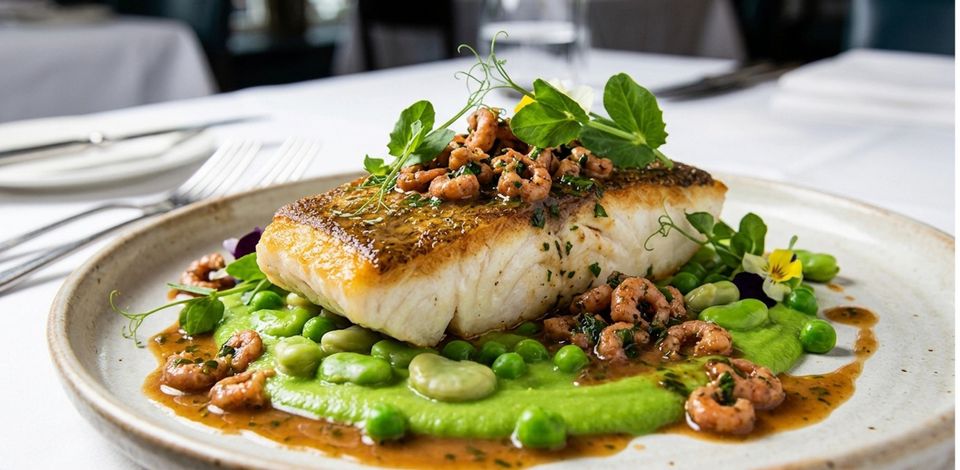
S/W, Shrimp Butter — Catering Recipe for 20
By On The Pass Consultancy | Category: Weekly Recipe | Serves: 20 | Prep: 45 min | Cook: 35 min | Skill Level: Intermediate | Keywords: halibut recipe commercial kitchen UK, spring pea velouté, brown shrimp butter, broad beans recipe catering, seasonal fish recipe May UK, Morecambe Bay brown shrimps
May in a British kitchen is a turning point. The heavy braises and root vegetable dishes that served you through winter finally feel redundant — not because they were wrong, but because something better has arrived. The first broad beans are appearing. Petits pois are at their sweetest. And Atlantic halibut — the largest, meatiest flatfish in British and Norwegian waters — is coming into prime season just as the light returns and menus need to shift.
This dish was built for exactly this moment. The halibut gives you a thick, substantial fillet with a clean, sweet flavour that takes a hard sear beautifully. The pea velouté is vivid, verdant, and immediately tells every diner that the kitchen is paying attention to the season. The double-podded broad beans give texture and colour. And the brown shrimp butter — a technique borrowed from the great English potted shrimp tradition, usually confined to breakfast toast in Southport — does something remarkable when it meets a hot, rested halibut fillet at the point of service. This is a May plate, and it earns its place on any serious menu.
Why This Dish Is Right for May
Atlantic halibut is the premium flatfish of the British fishing calendar. Unlike Dover sole or turbot — both excellent, both priced to match — halibut offers thick, meaty portions that work with real practicality in a volume setting. The flesh is dense, white, and sweet, with a clean flavour that doesn't overwhelm and takes seasoning well. In May, halibut from Scottish and Norwegian waters is at peak condition: the fish have fed through spring and the flesh is at its firmest and most flavoursome. For a kitchen that wants a serious fish on the menu without the complexity of whole-fish fabrication, halibut portions are one of the most commercially viable premium proteins you can put on the section.
Fresh peas and petits pois are arriving in the UK across May, but the honest commercial reality is that frozen petits pois — harvested and frozen within hours of picking — consistently outperform fresh peas in a catering environment. Prep time is negligible, quality is consistent throughout service, and there is no wastage from old or yellowing pods. For a velouté, the vivid flavour comes from rapid blanching and immediate chilling — not from the age of the pea. What you get is a sauce that is intensely green, genuinely sweet, and light enough to let the halibut do the talking. The addition of fresh mint — present, but restrained — ties the velouté to the season without overwhelming the fish.
Broad beans require a little commitment — the double-podding process, which removes the grey inner skin after blanching to reveal the vivid green bean beneath, adds approximately twelve minutes of prep time for twenty covers. That time is worth it without question. The visual transformation is dramatic: what arrives in the kitchen as a grey, slightly dull legume becomes a jewel-bright ingredient that elevates a plate instantly. Visually, texturally, and in terms of menu storytelling, double-podded broad beans belong on a May plate.
Brown shrimps from Morecambe Bay are one of the most underused restaurant ingredients in England. Small, extraordinarily sweet, intensely flavoured from cold northern coastal waters, they have a natural brininess and depth that no farmed prawn can replicate. The technique of building a seasoned shrimp butter — warm butter, shrimps, ground mace, a pinch of cayenne, lemon zest — comes directly from the potted shrimp tradition that has existed on the Lancashire coast for centuries. Applied as a finishing butter in a fine dining or premium casual context, it gives a dish a sense of place, a sense of history, and a flavour that guests will specifically remember and remark on. It also costs almost nothing to produce compared to what it delivers on the plate.
Why This Dish Works in a Commercial Kitchen
This is a precise dish, but not a complicated one. Every component can be prepared before service, and the halibut itself is fast once the section is set up correctly.
The pea velouté is made ahead. Unlike a beurre blanc, which requires constant temperature management during service, the velouté is blended, seasoned, and chilled before service begins. It reheats in a small pan or bain-marie to order, holds its colour for two hours, and requires no technical maintenance during service. If the colour fades, a tablespoon of freshly blanched peas blended in restores it immediately.
The broad beans are prep-only. Double-pod them, toss in butter and season, and hold covered at room temperature. During plating, a thirty-second warm-through in a small pan is all that's needed. There is no cook-to-order element for the beans at all.
The brown shrimp butter is made once. Prepare, chill, and portion into 30g quenelles before service. Each quenelle goes directly onto the hot rested halibut during plating and melts in the residual heat of the fish — no additional heat required, no timing pressure.
The halibut is fast and predictable. A skin-on 180g portion takes four to five minutes total: three minutes skin-side down in a smoking-hot pan, one minute flesh-side, one minute resting. With two pans running, twenty covers is a fifteen-to-eighteen minute operation. The critical steps are scoring the skin before service to prevent curl, and ensuring the pan is at true smoking point before the fish makes contact. A pan that isn't hot enough produces grey, steamed skin instead of the deeply golden, crisp result this dish depends on. There is no shortcut here.
Food cost at May 2026 UK wholesale pricing sits at approximately 30–34% per cover, depending on halibut source. Farmed Atlantic halibut from Norwegian or Scottish MSC-certified aquaculture brings the cost toward the lower end. Wild-caught halibut from Scottish dayboats adds provenance and a genuine menu story — which has real value in the current market — but will push food cost up by around 8–10%. The decision depends on your GP target and what the rest of the menu is carrying.
Ingredients — Serves 20
For the Halibut
| Quantity | Ingredient |
|---|---|
| 20 x 180g | Atlantic halibut fillets, skin-on, pin-boned (farmed MSC-certified or wild Scottish where budget allows) |
| 80ml | Cold-pressed rapeseed oil |
| To season | Flaked sea salt and white pepper |
For the Spring Pea Velouté
| Quantity | Ingredient |
|---|---|
| 1.2kg | Frozen petits pois (or fresh peas, podded weight) |
| 1.2L | Hot chicken or vegetable stock (good quality — this is the base of the sauce) |
| 4 | Banana shallots, peeled and finely sliced |
| 60g | Unsalted butter |
| 200ml | Crème fraîche |
| 20g | Fresh mint leaves, picked |
| 2 | Lemons, juice only |
| To season | Fine sea salt and white pepper |
For the Double-Podded Broad Beans
| Quantity | Ingredient |
|---|---|
| 2kg | Frozen broad beans (or 4kg fresh in pod — weight after podding approx 1.8kg) |
| 40g | Unsalted butter |
| 1 | Lemon, juice only |
| To season | Fine sea salt and white pepper |
For the Brown Shrimp Butter
| Quantity | Ingredient |
|---|---|
| 400g | Cooked, peeled brown shrimps (Morecambe Bay or equivalent — MSC-certified) |
| 300g | Unsalted butter, softened to room temperature |
| ½ tsp | Ground mace |
| Pinch | Cayenne pepper |
| 1 | Unwaxed lemon, zest and juice |
| To season | Fine sea salt |
To Finish
| Quantity | Ingredient |
|---|---|
| 20 small | Pea shoot tendrils or picked mint tips (garnish) |
| 2 | Unwaxed lemons, cut into wedges for service |
| As needed | Flaked sea salt |
Method
Step 1 — Brown Shrimp Butter (make ahead — can be prepared the day before)
- Place the softened butter in a mixing bowl. Add the ground mace, cayenne, lemon zest, and a generous pinch of fine salt. Beat with a wooden spoon or spatula until fully combined and the butter is smooth and uniform in seasoning.
- Fold the brown shrimps through the butter — you want them distributed evenly but not crushed. The shrimps should retain their shape and provide texture in the finished quenelle.
- Taste carefully. Brown shrimps carry natural salt from the sea; you may need less seasoning than expected. Add lemon juice a little at a time until the butter has brightness without sharpness.
- Roll the butter in cling film into a log, twist the ends to seal, and refrigerate until firm — a minimum of two hours, overnight if possible. Before service, slice the log into 30g rounds or portion into quenelles using two dessertspoons. Return to the fridge until needed. The butter can be made up to three days ahead.
Step 2 — Spring Pea Velouté (make ahead, 25 minutes before service or that morning)
- Melt the butter in a wide, heavy-based saucepan over a medium heat. Add the sliced shallots and a pinch of salt. Sweat gently for eight to ten minutes, stirring occasionally, until the shallots are completely soft, translucent, and sweet — not browned at all. Browning the shallots will muddy the colour of the finished sauce.
- Add the hot stock and bring to a rapid simmer. Add the frozen peas directly from the bag. Cook for exactly three minutes — no longer. The speed is the point: you are fixing the green colour and sweetness into the sauce, not stewing the peas.
- Remove from the heat immediately. Add the crème fraîche and fresh mint leaves. Blend in batches using a high-speed blender — fill the jug no more than half full to avoid pressure build-up. Blend each batch for a full sixty seconds until the sauce is completely smooth and vivid green.
- Pass through a fine sieve, pressing firmly to extract all the liquid. Season with lemon juice, fine salt, and white pepper. The sauce should be smooth, glossy, and intensely green. If the colour is dull, a handful of freshly blanched peas blended through the finished sauce will restore it.
- Chill immediately over ice if making ahead. For service, reheat gently in a small pan or bain-marie — do not boil, which will dull the colour. Hold at 65°C.
Step 3 — Double-Podded Broad Beans (prep ahead, 30 minutes of work)
- Bring a large pan of well-salted water to a rolling boil. Add the broad beans and cook for three minutes if frozen, four minutes if fresh. Drain immediately and plunge into a large bowl of iced water — this stops the cooking and preserves the green colour.
- Once cooled, squeeze each bean gently between thumb and forefinger to pop it from its grey outer skin. The vivid green inner bean slips out cleanly. This is time-consuming but straightforward work — it can be delegated to kitchen porters or prep staff. Discard the skins.
- Toss the double-podded beans in the butter and lemon juice. Season with salt and pepper. Cover and hold at room temperature for service. To reheat, a thirty-second toss in a warm pan is all that's required — the beans are already cooked and need only to be warmed through.
Step 4 — Halibut (cook to order)
- Before service, score the skin of each halibut fillet three times diagonally with a sharp knife. This is not optional — without scoring, the skin contracts in the pan, curling the fillet away from the heat and producing uneven cooking. Season the flesh side with flaked salt and white pepper. Leave the skin side unseasoned until it goes into the pan.
- Heat a heavy-based stainless steel or cast iron frying pan over the highest heat available. Add a thin film of rapeseed oil and allow it to reach smoking point — the pan must be genuinely hot. A medium-warm pan produces a grey, steamed fillet. A properly hot pan produces a deeply golden, crisp-skinned result that looks and tastes entirely different.
- Lay the fillets skin-side down in the pan. Press each fillet gently with a fish slice for the first fifteen seconds to ensure full skin contact across the surface. Do not move them once they're down.
- Cook skin-side for two and a half to three minutes, until the skin is deeply golden and the flesh has turned opaque approximately two-thirds of the way up the fillet. The colour change in the flesh tells you exactly when to turn — there is no guesswork required.
- Flip and cook flesh-side for one minute. The fillet should feel just firm under gentle pressure — fully cooked through, with no raw give at the centre. Remove from the pan and rest for one minute on a warm tray before plating. Do not cover during resting, which steams the skin and destroys the texture you have just worked to build.
Plating
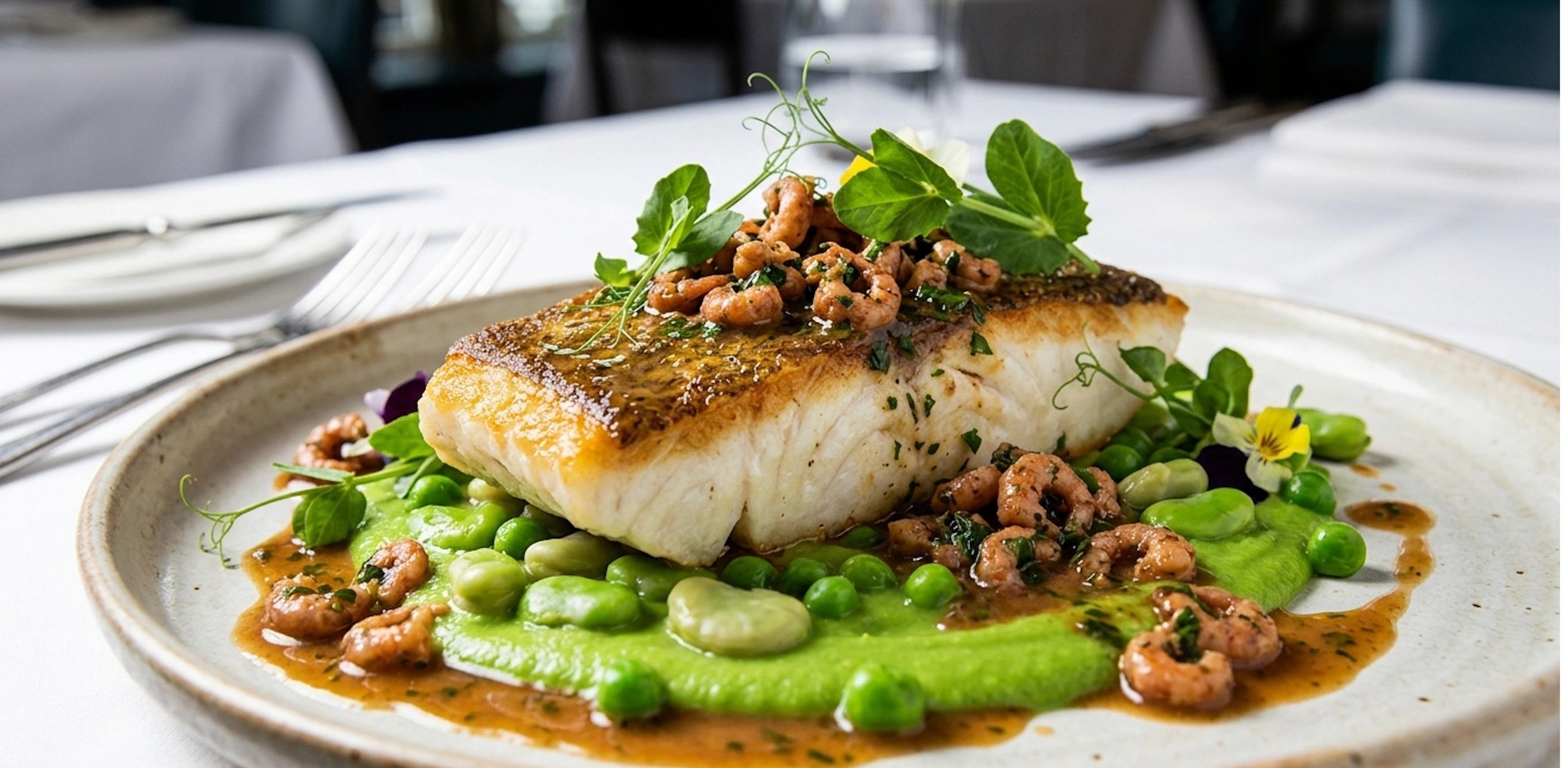
- Spoon approximately 80ml of the warm pea velouté into the centre of a wide, shallow bowl or warm plate. Arrange a portion of double-podded broad beans to one side of the velouté.
- Place the halibut fillet skin-side up on the velouté — never sauce over the skin, which will soften it immediately. Place a quenelle or round of brown shrimp butter directly on top of the hot fillet, where it will begin to melt across the surface.
- Finish with a pea shoot tendril or a few picked mint tips, a pinch of flaked sea salt on the skin, and a wedge of lemon to the side.
Chef's Notes
On halibut sourcing: The difference between a well-sourced farmed halibut and a cheap import is significant and visible on the plate. Look for MSC-certified Norwegian or Scottish farmed Atlantic halibut from a wholesaler you trust. Ask about the kill method — ikejime-processed halibut is available from a small number of UK suppliers and produces noticeably better flesh texture and colour for a premium product.
On the pea velouté colour: If the sauce is made ahead and loses its vivid green before service, do not add more mint or herbs — this will affect the flavour balance. Instead, blanch a small handful of fresh or frozen peas for sixty seconds, cool immediately, and blend them into the finished sauce. The colour will be restored within thirty seconds of blending.
On substitutions: If halibut is over budget, thick-cut, skin-on cod loin or hake portions are the closest substitutes and carry the same commercial technique. The pea and shrimp butter combination works equally well with either. The food cost drops significantly — approximately 18–22% per cover for cod at current UK wholesale — without compromising the quality of the dish from a diner's perspective.
On brown shrimp availability: Morecambe Bay brown shrimps are available through most UK specialist fish wholesalers, and increasingly through broader food service distributors. They are typically supplied cooked and peeled, which removes all prep from the kitchen. If unavailable, North Sea brown shrimps from a Dutch or Belgian source are a comparable alternative. Do not substitute cold-water prawns — the flavour profile and size are entirely different and the dish will not work in the same way.
Advance prep summary for a 20-cover service:
- Day before: Brown shrimp butter made and chilled
- Morning of: Pea velouté made, chilled, and ready to reheat; broad beans double-podded and buttered; halibut portions scored and refrigerated skin-side up on trays
- During service: Reheat velouté, warm beans, cook halibut to order
Enjoyed this recipe? Subscribe above and we'll send a new professional recipe to your inbox every Friday — built for commercial kitchens, tested at service volume.
Menu Development