Minted Pea and Ham Hock Velouté with Crispy Ham and Pea Shoots
By On The Pass Consultancy | Category: Weekly Recipe | Serves: 20 | Prep: 40 min | Cook: 2 hrs 30 min (hock) + 25 min (velouté) | Skill Level: Intermediate | Keywords: pea and ham soup recipe commercial kitchen UK, Great British Pea Week, ham hock velouté, seasonal soup recipe May UK, British pea recipe catering
There is a moment every May — usually around the last week of the month — when British peas hit their absolute peak. The pods are full, the colour is vivid, and the flavour has a natural sweetness that nothing grown out of season can touch. This is that week. Great British Pea Week runs from 25 to 31 May, and if you're not doing something deliberate with British peas on your menu right now, you're missing the best version of one of this country's finest ingredients.
This dish is built around that moment. Pea and ham is one of the oldest flavour pairings in British cooking — there's a reason it's survived for centuries, and it's not sentiment. The sweetness of a fresh or well-frozen pea against the deep, salty richness of a braised ham hock is a combination that works at every level: flavour, colour, texture, and cost. What I've done here is give it the treatment it deserves. The velouté is smooth, vivid, and intensely green. The ham hock is braised until it falls, then the liquor becomes part of the soup's backbone. The crispy ham adds a textural moment that elevates the whole plate. This is proper British cooking, done properly, for twenty covers.
Why This Dish Is Right for May
British peas are the star here, and they should be treated as such. The commercial reality — which I was honest about in the halibut recipe — is that frozen petits pois harvested and frozen within hours of picking consistently outperform fresh peas in a catering environment. Quality is consistent, prep time is negligible, and there is no wastage. For a velouté, the flavour comes from fast blanching and immediate chilling. If you have access to fresh-podded British peas in late May, use them — the flavour difference is real and the menu story is worth telling. If you're running a high-volume kitchen, frozen petits pois will serve you just as well.
Ham hock is one of the most undervalued cuts in the British wholesale market. It is inexpensive, deeply flavoured, and produces two things simultaneously: falling, silky braised meat and a stock that is rich, savoury, and packed with natural gelatin. That braising liquor is the secret to this velouté. A pea soup made on water or a weak vegetable stock is a thin, flat thing. One made on ham hock liquor has depth, body, and a savouriness that makes the pea flavour sing louder, not quieter. Never discard the braising liquid from a hock — it is worth more than the meat in this context.
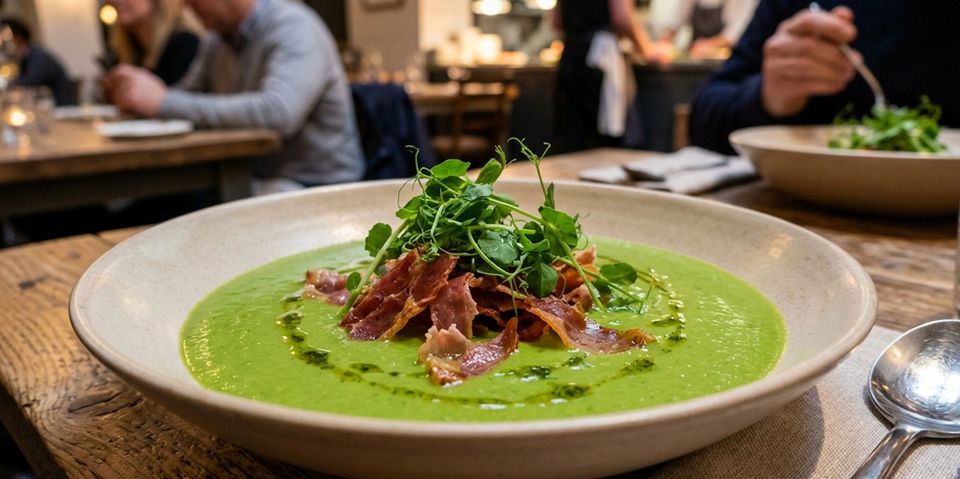
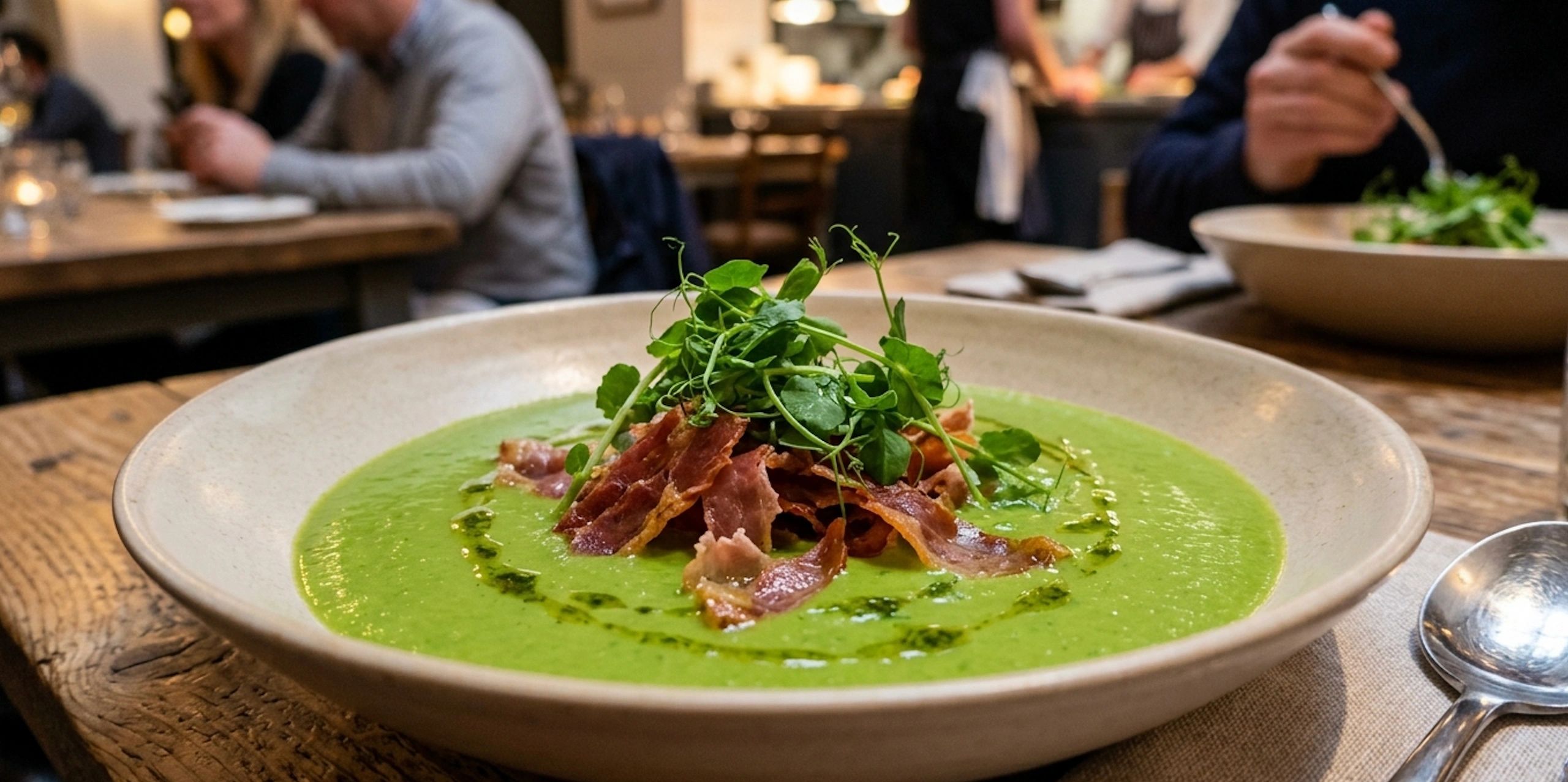
The crispy ham is a three-minute technique that transforms leftover hock meat into a textural garnish that justifies the dish as a restaurant plate rather than a canteen bowl. Pull a handful of the braised meat into coarse shreds, press it flat in a dry non-stick pan, and leave it alone until it crisps on one side. That contrast — silky smooth velouté, sharp pea shoot freshness, and a shard of crispy, intensely savoury ham — is what makes this dish memorable rather than merely good.
Food cost at May 2026 UK wholesale pricing sits at approximately 18–22% per cover, depending on hock source and whether you use fresh or frozen peas. This is one of the most commercially favourable dishes you can put on a spring menu — strong margin, high quality, seasonal story.
Why This Dish Works in a Commercial Kitchen
The hock is the only long element, and it can be braised the day before without any loss of quality — in fact the meat is easier to pick and the liquor is better chilled and defatted overnight. Everything else is straightforward mise en place.
The hocks braise unattended. Two and a half hours in a low oven or covered on the stove requires no active cooking time. The kitchen gets on with everything else. Pull, cool, and refrigerate overnight.
The velouté is made ahead. Like the pea velouté in the halibut recipe, this is blended and chilled before service begins. It reheats in a bain-marie, holds its colour for two hours, and requires no technical management during a busy service. If the colour fades, blanch a handful of fresh peas and blend them through — the vivid green is restored immediately.
The crispy ham is a service garnish. Made from the pulled hock meat, it takes three minutes per batch in a dry pan. It can be prepared in advance and held on a rack at room temperature — it stays crisp for up to ninety minutes. Do not cover it or it will steam and soften.
The pea shoot salad dresses itself in seconds. Pea shoots, a squeeze of lemon, a few drops of cold-pressed rapeseed oil, a pinch of sea salt. Kept in the fridge until the last moment and dropped on the soup at the pass. No holding time, no complexity.
Service is fast. The bowls go out warm. The velouté is ladled to order from the bain-marie. The crispy ham and pea shoots go on at the pass. Twenty covers is a ten-minute operation once the section is set up correctly.
Ingredients — Serves 20
For the Ham Hock and Braising Stock
Quantity & Ingredients
| 4 | Smoked or unsmoked ham hocks (approximately 800g–1kg each) |
| 3 | Carrots, peeled and halved |
| 3 | Celery sticks, roughly chopped |
| 2 | Onions, peeled and halved |
| 1 | Whole bulb of garlic, halved across the equator |
| 4 | Bay leaves |
| 1 tsp | Whole black peppercorns |
| As needed | Cold water to cover |
For the Minted Pea Velouté
| Quantity | Ingredient |
|---|---|
| 1.5kg | Frozen petits pois (or fresh peas, podded weight — see Chef's Notes) |
| 1.5L | Ham hock braising stock (strained, defatted — from above) |
| 5 | Banana shallots, peeled and finely sliced |
| 80g | Unsalted butter |
| 200ml | Double cream |
| 30g | Fresh mint leaves, picked |
| 2 | Lemons, juice only |
| To season | Fine sea salt and white pepper |
For the Crispy Ham Garnish
| Quantity | Ingredient |
|---|---|
| 400g | Pulled ham hock meat (from above — coarse shreds) |
| 1 tbsp | Rapeseed oil |
| To season | Black pepper |
For the Pea Shoot Salad
| Quantity | Ingredient |
|---|---|
| 100g | Fresh pea shoots |
| 1 | Lemon, juice only |
| 2 tbsp | Cold-pressed rapeseed oil |
| To season | Flaked sea salt |
To Finish
| Quantity | Ingredient |
|---|---|
| 60ml | Double cream, lightly loosened (to drizzle) |
| As needed | Flaked sea salt and cracked black pepper |
| 2 | Unwaxed lemons, cut into wedges for service (optional) |
Method
Step 1 — Braise the Ham Hocks (day before, or morning of — 2.5 hours unattended)
1. Place the ham hocks in a large stockpot or deep roasting tray. Add the carrots, celery, onion, garlic, bay leaves, and peppercorns. Cover completely with cold water — the hocks should be fully submerged. Do not add salt at this stage; smoked hocks carry significant salt already and the liquor will concentrate as it reduces.
2. Bring to a gentle simmer over a medium heat. Skim any grey foam that rises in the first ten minutes — this is coagulated protein and will cloud the stock if left in. Once clear, reduce the heat to a very gentle simmer: the surface should barely move. Cover and cook for two and a half hours until the meat is completely tender and beginning to fall from the bone.
3. Remove the hocks carefully and set aside to cool. Strain the braising stock through a fine sieve into a clean container. Discard the vegetables — they have done their job. Allow the stock to cool, then refrigerate overnight. The fat will rise and set on the surface, making it straightforward to lift off and discard before use. You want a clean, deeply savoury, lightly jellied stock.
4. Once the hocks are cool enough to handle, pull the meat by hand into coarse shreds. Discard the skin, fat, and bones. Refrigerate the pulled meat until needed. Reserve 400g for the crispy ham garnish; the remainder can be served separately or used for another purpose.
Step 2 — Make the Minted Pea Velouté (25 minutes, ahead of service)
5. Melt the butter in a wide, heavy-based saucepan over a medium heat. Add the sliced shallots and a pinch of fine salt. Sweat gently for eight to ten minutes, stirring occasionally, until completely soft, translucent, and sweet. Do not allow them to colour — any browning will muddy the vivid green of the finished velouté.
6. Pour in 1.5 litres of the defatted, strained ham hock stock. Bring to a rapid simmer. Add the frozen peas directly from the bag. Cook for exactly three minutes. Speed is the point here — you are locking in the colour and the sweetness, not stewing the peas into grey submission.
7. Remove from the heat immediately. Add the double cream and the picked fresh mint leaves. Blend in batches in a high-speed blender — fill the jug no more than half full at a time to avoid pressure build-up and scalding. Blend each batch for a full sixty seconds until the velouté is completely smooth, glossy, and vivid green.
8. Pass through a fine sieve, pressing firmly to extract all liquid. Season carefully with lemon juice, fine salt, and white pepper. Taste critically — the ham stock carries salt, so the velouté may need less seasoning than you expect. The balance you are looking for is sweet pea forward, backed by the deep savoury note of the ham stock, lifted by the mint and sharpened by the lemon.
9. Chill immediately over ice if making ahead. For service, reheat gently in a bain-marie at 70°C — do not boil, which dulls the colour. A portion is approximately 200ml per cover.
Step 3 — Crispy Ham Garnish (15 minutes, can be made up to 90 minutes before service)
10. Take the reserved 400g of pulled hock meat. Season lightly with black pepper — no salt is needed; the hock carries its own.
11. Heat a large, heavy-based non-stick frying pan over a medium-high heat. Add the rapeseed oil. Working in batches, place small mounds of shredded ham (approximately 20g each) into the pan, pressing flat with a palette knife or fish slice to maximise surface contact.
12. Leave completely undisturbed for two to three minutes until deeply golden and crisp on the underside. Flip carefully and crisp for a further thirty seconds on the second side. Remove to a wire rack and season with a pinch of flaked salt. The garnish should be flat, golden, and shatteringly crisp. If it steams rather than crisps, the pan is not hot enough — increase the heat before the next batch.
13. Hold on the rack at room temperature. Do not cover or stack — the steam will destroy the texture you have worked to build.
Step 4 — Pea Shoot Salad (dress at service)
14. Keep the pea shoots refrigerated until the moment they are needed. Just before service begins, place them in a bowl and dress lightly with lemon juice, cold-pressed rapeseed oil, and a pinch of flaked sea salt. Toss gently. The shoots should be bright, lightly dressed, and dressed only at the last moment — they wilt quickly once the acid hits them.
Plating
15. Warm the soup bowls — this is not optional for a velouté. A cold bowl kills a silky soup within seconds of service.
16. Ladle approximately 200ml of the hot velouté into the centre of each warm bowl.
17. Place one piece of crispy ham garnish on the surface of the velouté — set slightly off-centre, resting half in the soup and half above the surface so the crisp texture is visible and retained as long as possible.
18. Add a small, loose nest of dressed pea shoots alongside the ham. The contrast of vivid green soup, golden crispy ham, and bright pea shoots should be immediate and striking.
19. Finish with a thin drizzle of loosened double cream across the surface (use a squeeze bottle at service for speed and consistency), a pinch of cracked black pepper, and flaked sea salt.
Chef's Notes
On fresh versus frozen peas: If you have access to freshly podded British peas in the last week of May, use them for this dish. The flavour difference at peak season is genuine and noticeable — sweeter, brighter, more aromatic. The prep time is longer, but if you're making a menu point of Great British Pea Week, it's worth it. For any other week, frozen petits pois are the correct commercial choice: consistent, fast, no waste.
On the ham hock stock: Do not substitute shop-bought chicken stock. The entire depth and savouriness of this velouté comes from a proper ham hock braising liquor. If the hocks have been braised correctly and the stock has been defatted, it will be rich enough to eat as a soup on its own. That is the baseline you are cooking from.
On colour: If the velouté loses its vivid green before service, do not add more mint — this disrupts the seasoning balance. Instead, blanch a handful of fresh or frozen peas for sixty seconds, cool immediately, and blend them into the finished velouté. The colour is restored within thirty seconds of blending.
On substitutions: If ham hock is not available or over the portion budget, smoked bacon lardons can be rendered and used to build the base of the velouté instead. The flavour is less deep but the principle is the same. Alternatively, the velouté can be made on a good vegetable stock and served as a vegetarian dish — omit the crispy ham garnish and finish with a few drops of good extra virgin olive oil and some crispy shallots instead.
On scaling: This recipe scales cleanly. For forty covers, double all quantities and braise four additional hocks. The velouté can be made in one large batch in a sixteen-litre stockpot. Blending time increases — ensure the blender is worked in small batches throughout, and factor in an additional fifteen minutes for the larger volume of velouté to be passed through the sieve.
Advance prep summary for a 20-cover service:
- Day before: Ham hocks braised, stock strained and chilled, meat pulled and refrigerated
- Morning of: Stock defatted; velouté made, blended, and chilled; crispy ham portions prepped and ready to fry
- 90 minutes before service: Crispy ham garnish cooked and held on rack
- During service: Reheat velouté in bain-marie; dress pea shoots at the pass; plate to order
Enjoyed this recipe? Subscribe below and we'll send a new professional recipe to your inbox every Friday — built for commercial kitchens, tested at service volume.
SUBSCRIBE ABOVE
Seasonal Recipe's In May