Old Equipment vs. Modern Catering Tech
By On The Pass Consultancy | Category: Industry Tips & Facts
What's the Real Cost of Not Upgrading Your Commercial Kitchen Equipment?
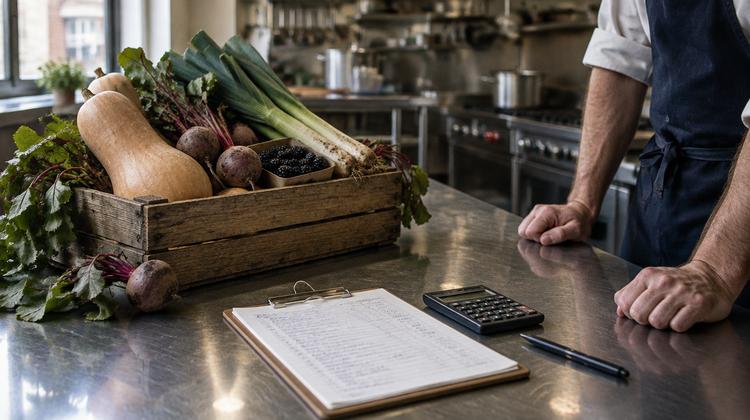
There's a piece of kit in almost every commercial kitchen we walk into that nobody talks about. It's the combi oven that's been there since the last tenant. The undercounter fridge with the slightly-off door seal. The range that takes twenty minutes to come up to temperature. The dishwasher that runs a full cycle but needs two passes to actually clean properly.
These machines get the job done — just about. And because they're not broken, nobody replaces them. The cost of not replacing them, though, is being paid every single day in energy bills, food waste, labour inefficiency, inconsistent output, and maintenance call-outs that quietly add up to a figure most operators have never actually calculated.
The UK commercial catering equipment market is changing faster than at any point in the past decade. Modern kit is genuinely transformative — not in a marketing brochure sense, but in the very literal sense that it transforms the economics of running a kitchen. The question isn't really whether to upgrade. It's whether you can afford not to.
In this article, we'll walk through the four categories of commercial kitchen equipment where the gap between old and new is most significant — and give you a clear framework for calculating whether an upgrade makes financial sense for your operation.
💡 The Scale of the Opportunity
According to the Carbon Trust, UK catering businesses could collectively save over £250 million a year simply by switching to more energy-efficient equipment. That's not a projection based on best-case assumptions — it's a conservative estimate of the savings available right now, in kitchens already operating.
Why the Upgrade Conversation Is Different in 2025
For most of the past decade, the business case for upgrading commercial kitchen equipment was clear but not urgent. Energy was relatively cheap, equipment financing was straightforward, and the performance gap between old and new kit, while real, wasn't dramatic enough to force the issue.
That calculation has shifted significantly. UK energy prices, despite moderating from the extreme peaks of 2022, remain structurally higher than pre-pandemic levels. The National Living Wage increase to £12.21 per hour from April 2025 has intensified pressure on labour cost ratios. And the technology in modern catering equipment — particularly combi ovens, refrigeration, and induction cooking — has advanced to the point where the efficiency differential between a ten-year-old machine and a current model is genuinely substantial.
At the same time, the financing landscape has evolved. Equipment leasing, rent-to-own, and energy-performance contracting models mean that many upgrades can be cash-flow neutral or positive from day one — the monthly saving on energy and maintenance can exceed the monthly finance payment. This is a fundamentally different conversation from writing a capital cheque.
📊 Market Context
The UK commercial catering equipment market was valued at approximately £980 million in 2025 and is growing at around 4.4% annually — driven largely by operators replacing ageing kit with energy-efficient, technology-enabled alternatives. The operators investing now are positioning themselves ahead of those who'll be forced to upgrade reactively in two or three years.
The Four Equipment Categories Where Upgrading Has the Biggest Impact
EQUIPMENT 1 - Combi Ovens
The combi oven is the single piece of equipment where the performance gap between old and new is most dramatic — and where the ROI case for upgrading is strongest. If there's one category to prioritise in any kitchen equipment review, this is it.
A modern combi oven from a leading manufacturer such as Rational, Unox, or Falcon isn't just more energy efficient than a ten-to-fifteen-year-old model. It's a fundamentally different category of machine. Current generation combi ovens offer:
- Adaptive cooking logic that adjusts temperature, humidity, and airflow in real time based on the load — eliminating the overcooking and undercooking that ageing equipment produces
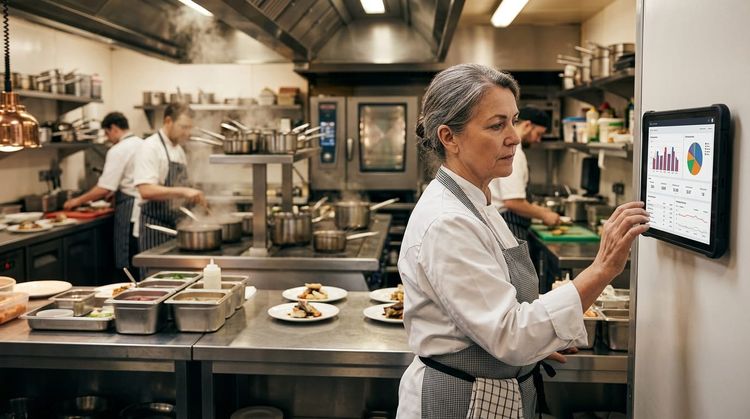
- IoT connectivity allowing remote monitoring of cooking programmes, energy consumption, and maintenance alerts — accessible from a phone or tablet during or after service
- Programmable recipe storage that allows consistent results regardless of which team member is operating the oven — a significant advantage in a high-turnover staffing environment
- Energy consumption up to 28% lower than predecessor models from the same manufacturers, and significantly more than that compared with older equipment from different eras
The numbers behind the upgrade
Research into commercial kitchen energy use has found that combination ovens represent approximately 12% of total kitchen electricity consumption in a typical UK catering operation. For a mid-sized restaurant kitchen running a combi for 8–10 hours daily, that translates to a meaningful annual energy bill contribution.
Modern combi-steam ovens are 25–50% more energy efficient than older conventional cooking appliances, and some models use waste heat recovery to preheat water — saving a further 16–30% of energy in that process alone. Across a typical kitchen operating 52 weeks a year, the cumulative saving on energy from a single combi oven upgrade can run into thousands of pounds annually.
Factor in the reduction in labour time from programmable cooking cycles, the food waste reduction from consistent output, and the elimination of maintenance costs on ageing equipment, and the payback period on a modern combi oven is frequently under three years — and often considerably less.
EQUIPMENT 2 - Refrigeration
Refrigeration is the single largest energy consumer in most commercial kitchens, accounting for approximately 41% of total kitchen electricity use according to research across UK pub-restaurants. It's also the category where ageing equipment is most reliably underperforming — because refrigeration efficiency degrades gradually and invisibly, and most operators don't notice until a unit fails entirely.
The technology in modern commercial refrigeration is significantly more efficient than equipment from even five to seven years ago. Current-generation units feature:
- Eco compressors that draw substantially less power than older models while maintaining more consistent temperatures
- LED interior lighting (which generates less heat than fluorescent alternatives, reducing the cooling load)
- Smart defrost functions that defrost on demand rather than on a fixed cycle — eliminating energy waste from defrost cycles running when they're not needed
- Door seals and closing mechanisms that maintain integrity across a working life — one of the most common sources of energy loss in older units
- Natural refrigerants (R290) in current models, which are both more environmentally compliant and more energy efficient than the refrigerants used in older equipment
The hidden cost of a failing door seal
One of the most underappreciated sources of energy waste in commercial kitchens is deteriorating door seals on refrigeration units. A fridge with a compromised seal doesn't just use more energy — it works its compressor harder, shortening the unit's life and increasing the risk of temperature variance that creates food safety compliance exposure.
In our kitchen audits, we regularly find refrigeration units running 15–30% less efficiently than their rated specification due to seal degradation, coil fouling, or compressor wear. Before committing to a full replacement, it's always worth having a refrigeration specialist assess whether a service intervention can recover efficiency — but if a unit is more than eight to ten years old, the economic case for replacement is usually stronger than for repair.
🔧 From Our Audit Experience
We audited the refrigeration across a Bristol-based catering operation with eight units of varying ages. Four of them were running above the 3–5% of turnover energy benchmark we use as a reference point. One unit — a ten-year-old undercounter model — was consuming nearly double its rated energy load due to coil fouling and a failed door seal. Replacing it with a current-specification model paid back in under fourteen months.
EQUIPMENT 3 - Induction Cooking
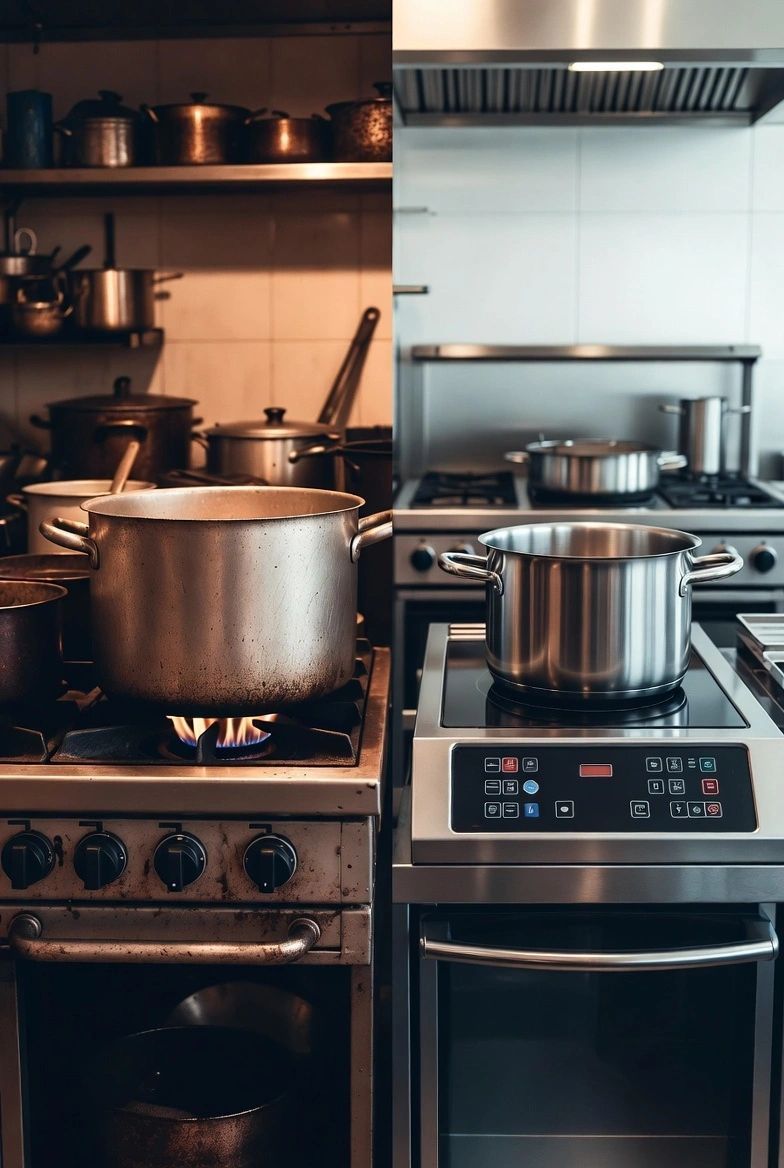
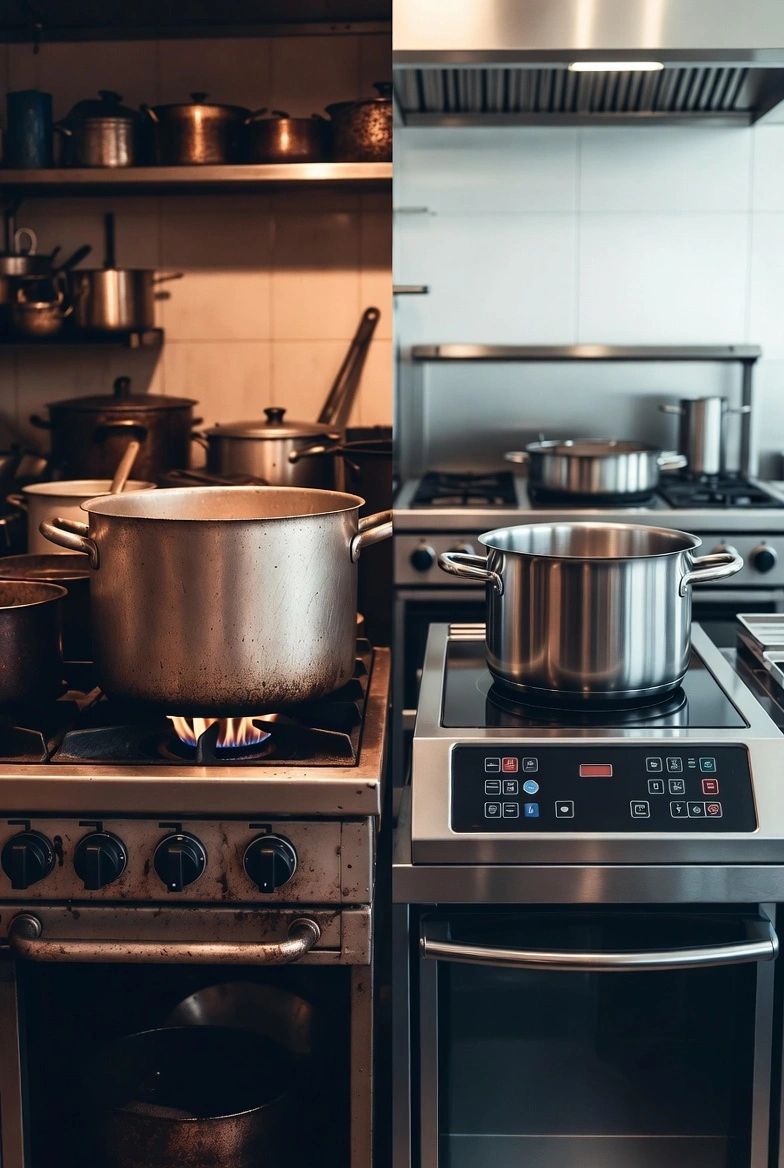
Gas cooking has been the default in UK commercial kitchens for generations — and for many operations, it remains the right choice. But the case for induction, particularly for specific stations and applications, is now compelling enough to be part of any serious kitchen equipment review.
Modern commercial induction hobs are not the underpowered domestic appliances that gave induction a mixed reputation in kitchen circles a decade ago. Current commercial-grade induction cooking surfaces deliver power outputs comparable to gas, with several operational advantages that matter in a professional kitchen context:
- Energy is only used when a pan is in contact with the surface — eliminating the standing energy loss of gas burners at low flame or on standby
- Surface temperature stays significantly lower than gas or ceramic alternatives, reducing ambient kitchen heat — which in turn reduces extraction load and makes the working environment more manageable
- Precise temperature control that's genuinely comparable to gas for most applications, with the advantage of instant adjustment
- Easier cleaning — a flat, cool surface versus burner grates and drip trays — which reduces cleaning time and improves hygiene
Where induction makes most sense
Induction isn't the right answer for every application — high-output wok cooking, for example, is still better served by gas in most cases. But for sauce work, precise temperature cooking, breakfast and brunch stations, and any application where standing heat is a particular problem, induction is worth serious consideration.
For UK catering businesses operating under increasing pressure on energy costs, the ability to use power only when it's needed — rather than maintaining a gas flame — represents a genuine structural saving. Industry guidance consistently identifies induction as among the most impactful single equipment changes for reducing commercial kitchen energy consumption.
EQUIPMENT - 4 Warewashing
The commercial dishwasher and glasswasher are rarely the first things that come up in a kitchen equipment conversation — but they should be. Warewashing is one of the most energy, water, and chemical-intensive processes in a commercial kitchen, and the performance gap between older and modern equipment is significant.
Modern commercial warewashers feature heat recovery systems that capture and reuse energy from the wash and rinse cycles — reducing both energy consumption and the heat output into the kitchen environment. They use less water per cycle than older models, require less chemical dosing due to better wash mechanics, and dry more effectively — reducing the labour time associated with manual drying and re-racking.
- Heat recovery warewashers can reduce energy consumption by 20–40% compared with older models without heat recovery
- Modern machines use 20–35% less water per cycle than equipment from ten or more years ago
- Reduced chemical usage lowers both operating cost and environmental impact
- Better wash performance means fewer re-washes and less staff time on warewashing
For high-volume operations — particularly those running multiple sittings or with significant glassware throughput — the savings from warewasher upgrades can be substantial. And because this equipment runs continuously during service, even marginal efficiency improvements compound quickly across a full operating year.
How to Build the ROI Case for an Equipment Upgrade
The most common reason UK catering operators delay equipment upgrades isn't cash — it's uncertainty about the numbers. How do you know if an upgrade will actually pay back? How do you make the case to a business partner, a board, or a bank?
Here's the framework we use with clients at On The Pass Consultancy:
Step 1: Calculate the true cost of your current equipment
Don't just look at the energy bill for the whole kitchen. Wherever possible, isolate the energy consumption of individual units — a clamp-on current meter from any electrical supplier will give you this. Add maintenance costs over the past two to three years. Add the estimated cost of food waste or inconsistent output attributable to equipment performance.
Step 2: Get a like-for-like specification from a current equipment supplier
Ask for the rated energy consumption of the equivalent current model and calculate the annual energy saving. Ask about warranty terms and typical maintenance costs for the first five years. Ask about smart monitoring capabilities that will allow you to verify the savings in practice.
Step 3: Model the financing options
Compare the monthly finance cost (lease or hire purchase) against the projected monthly energy saving. If the saving exceeds the finance payment — which it often does for older, inefficient equipment — the upgrade is cash-flow positive from day one. Factor in the reduction in maintenance costs and the avoidance of an emergency replacement if the current unit fails.
Step 4: Consider the wider operational benefits
Energy savings are the most quantifiable benefit, but they're not the only one. Improved output consistency, reduced training burden from programmable equipment, better staff working conditions, and reduced food safety risk all have financial value — even if it's harder to put a precise number on them.
A Practical Equipment Priority Matrix
Not every kitchen can upgrade everything at once. Here's the prioritisation framework we use when advising UK catering operations on phased equipment investment:
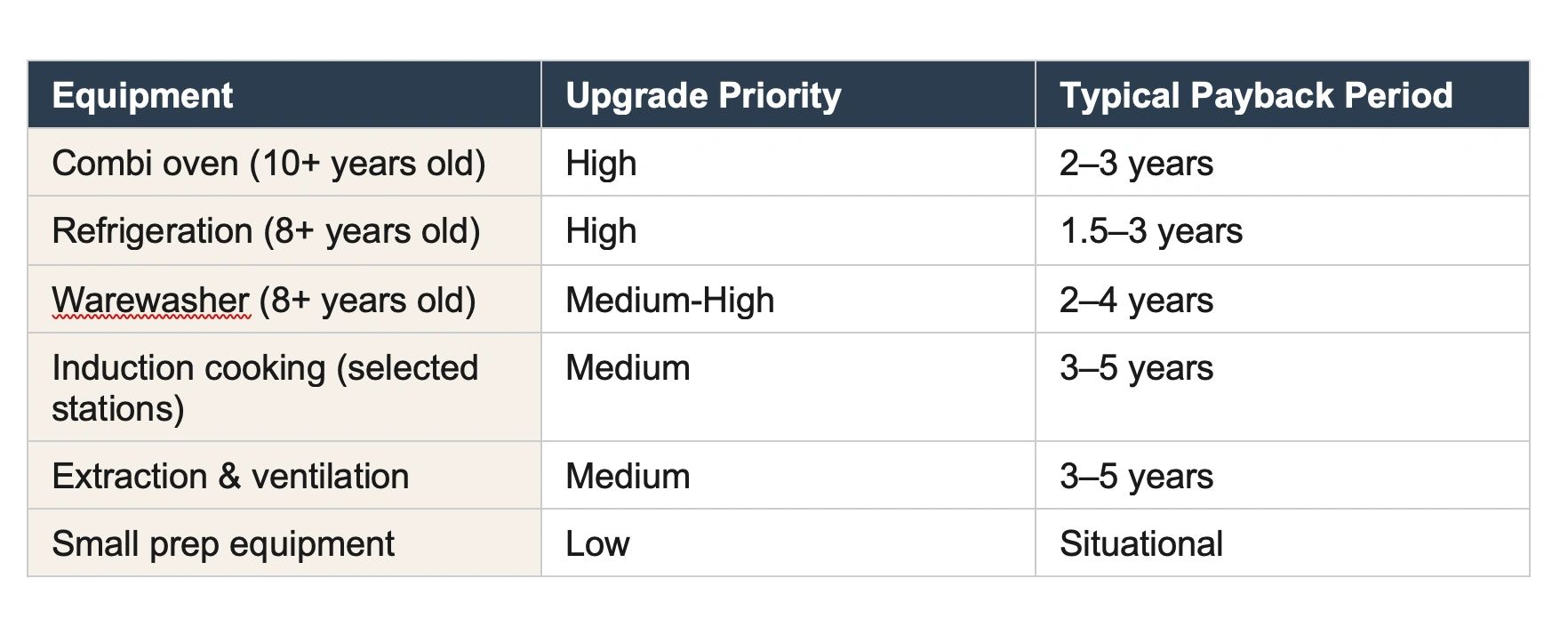
These payback periods are based on typical UK energy costs and operational patterns. Actual figures will vary depending on your usage volumes, current equipment condition, and the specific models you're replacing.
💬 The Conversation Worth Having
One of the most frequent conversations we have with UK catering operators is about the difference between the capital cost of new equipment and the true cost of keeping old equipment running. When you add up energy waste, maintenance, food quality inconsistency, and staff inefficiency, the 'cheap' option of keeping ageing kit is often the most expensive choice available.
How On The Pass Can Help
At On The Pass Consultancy, our catering equipment service goes beyond specification and supply. We work with operators to audit their current equipment estate, identify the highest-impact upgrade opportunities, build the ROI case, and source the right equipment at commercial pricing through our supplier network.
We're independent — which means we're not tied to any particular manufacturer or brand. Our recommendation is always based on what's right for your operation, your menu, and your growth plans. And because we combine equipment knowledge with 30 years of kitchen design and operations experience, we can ensure that any new equipment is integrated into your workflow effectively — not just installed and left.
If you're running equipment that's more than eight to ten years old, or if your energy bills have been creeping upward without an obvious explanation, a no-obligation equipment review is a logical first step. Get in touch through the website and we'll tell you honestly what we find.
Your Action Plan This Week
- Identify the three oldest pieces of equipment in your kitchen and note when they were last serviced. If you don't know when they were last serviced, that's already a useful data point.
- Pull your last three energy bills and calculate your kitchen energy cost as a percentage of turnover. If it's above 5%, flag it for investigation — equipment efficiency is one of the first things to audit.
- Ask your head chef which single piece of equipment causes the most frustration or inconsistency during service. Their answer will often point directly to the highest-priority upgrade.
- Get in touch with On The Pass Consultancy for a no-obligation equipment review. We'll assess your current estate, identify the most impactful upgrade opportunities, and give you the numbers to make an informed decision.
👉 Coming Up Next Week
Next week, we're turning our attention to one of the most undervalued competitive advantages in the UK catering industry — team alignment. Specifically, why your front-of-house and back-of-house teams are probably working against each other, and the practical steps that turn that around. Sign up to the On The Pass newsletter so you don't miss it.
About On The Pass Consultancy
On The Pass Consultancy brings over 30 years of hands-on UK catering industry experience to independent restaurants, café operations, contract caterers, and food service businesses across Wales, Bristol, Gloucester, and the wider UK. Our services include catering equipment supply and specification, commercial kitchen design, menu development, staff training, and AI-powered operational tools. Visit: onthepassconsultancy.com