What Does a Catering Consultant Actually Do?
A Complete Guide for UK Hospitality Businesses
By On The Pass Consultancy | Newport, South Wales
Based in Newport and working across South Wales — including Cardiff, Swansea, and the wider Bristol and Gloucester region — I bring 35+ years in hospitality, across kitchens, front of house and wholesale. Whether you run an independent café in Cardiff city centre or manage a hotel kitchen in Swansea, the role of a catering consultant is to come in, assess what's working and what isn't, and give you a clear, practical plan to improve it.
If you've ever wondered whether hiring a catering consultant is worth it — or you're not entirely sure what one actually does — you're not alone. It's one of the most common questions we hear from hospitality business owners across Wales, Bristol, and Gloucester.
The honest answer is that a good catering consultant does far more than advise on menus or recommend kitchen equipment. They bring a breadth of independent, practical experience across every aspect of a catering operation — from the design of your commercial kitchen and the profitability of your menu, to the performance of your team and the technology you use.
This guide covers everything you need to know — what a catering consultant does, how they work, what they cost, and how to know whether your business could benefit from one.
What Is a Catering Consultant?
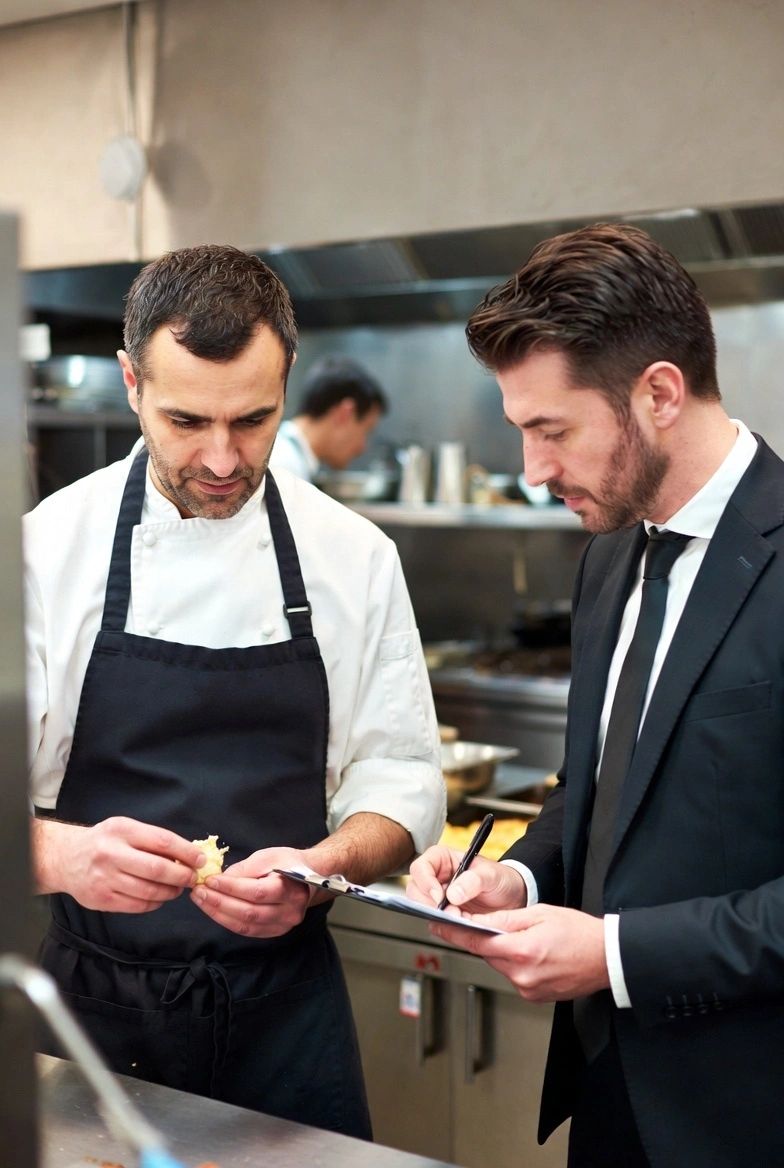
A catering consultant is a specialist who advises hospitality businesses and stays involved while the work is carried out. The job is to look at the whole operation, the kitchen, the menu, the equipment and the team, and recommend what the covers justify. On a project I specify the equipment and manage the supply and installation through to commissioning.
Catering consultants typically work with a wide range of hospitality businesses including restaurants, hotels, pubs, care homes, schools, contract caterers, stadiums and event venues, and new business start-ups. The best consultants bring experience across multiple sectors — which means they can apply lessons learned in one type of operation to solve problems in another.
The 7 Core Services a Catering Consultant Provides
While every consultancy is different, the core services offered by a full-service catering consultant typically cover the following areas:
1. Commercial Kitchen Design
A commercial kitchen is one of the most significant investments a hospitality business makes. Getting the design right from the outset saves enormous amounts of time, money, and operational headache for years to come.
A catering consultant will assess your specific requirements — the type of food you produce, your expected covers, your team size, your budget, and your building constraints — and design a kitchen layout that maximises workflow efficiency, meets all regulatory requirements, and accommodates the right equipment in the right places.
Good kitchen design addresses:
- Workflow and movement between stations to minimise unnecessary steps
- Separation of raw and cooked food preparation areas for food safety compliance
- Ventilation design to meet UK regulations and protect your team
- Refrigeration zoning and cold storage capacity
- Equipment specification matched to your menu and service model
- Future-proofing for capacity growth or menu changes
2. Menu Development and Engineering
Menu development is one of the most commercially impactful things a catering consultant can do for your business. A well-engineered menu doesn't just read well — it actively drives profitability by maximising gross profit on every dish while maintaining quality and guest satisfaction.
Menu development services typically include:
- Full gross profit analysis on every dish — including waste, trim loss, and portion costs
- Menu pricing strategy to hit your target GP% across the whole menu
- Identification of high-cost, low-margin dishes that are draining profitability
- Seasonal menu planning using current supplier pricing
- Menu design consultation — layout, descriptions, upsell positioning
- New concept development for seasonal menus, special events, or new openings
3. Staff Training and Development
Generic hospitality training courses have a poor track record in changing real behaviour. The most effective training is bespoke — built around your specific team, your menu, your service style, and your standards.
A catering consultant will design and deliver training programmes tailored to your operation, covering front of house, back of house, or both. This includes identifying real skill gaps through observation during live service — not just questionnaires — and addressing the root causes of underperformance rather than just surface symptoms.
Training areas typically covered include:
- Kitchen skills and mise en place standards
- Food safety and allergen management in practice
- Service standards and guest interaction
- Team communication during service
- Management and supervisory skills for kitchen leads
- New equipment operation and maintenance
4. Kitchen Process Audits
A kitchen process audit is an independent review of how your kitchen operation actually performs — not how you think it performs. Even well-run kitchens contain hidden inefficiencies, compliance risks, and cost leaks that are invisible to the people working in them every day.
Audits typically examine equipment performance and maintenance status, food safety and HACCP compliance in practice, workflow and movement efficiency, waste levels and stock management, energy consumption and running costs, and team performance under service conditions. The output is a clear, prioritised action plan — not a generic report full of industry jargon.
5. Catering Equipment Supply and Specification
Buying catering equipment without independent advice is a significant financial risk. Equipment suppliers — however reputable — have a commercial interest in selling you their products. An independent consultant specifies the right equipment for your operation first, and then sources it.
A full-service consultancy like On The Pass Consultancy works with leading equipment manufacturers including Rational AG, Foster Refrigeration, Atosa, and Winterhalter — giving clients access to industry-leading equipment with the confidence that what they're buying is the right choice for their specific needs.
6. Profitability Consulting
Many hospitality businesses operate with a limited understanding of where their money is actually going. Labour cost, food cost, and overheads interact in complex ways — and small inefficiencies compound into significant margin loss over time.
A catering consultant can review your full P&L in the context of your operation, identify where cost is leaking, and develop practical strategies to improve profitability without compromising quality or guest experience. This includes GP management, labour scheduling, supplier benchmarking, and waste reduction.
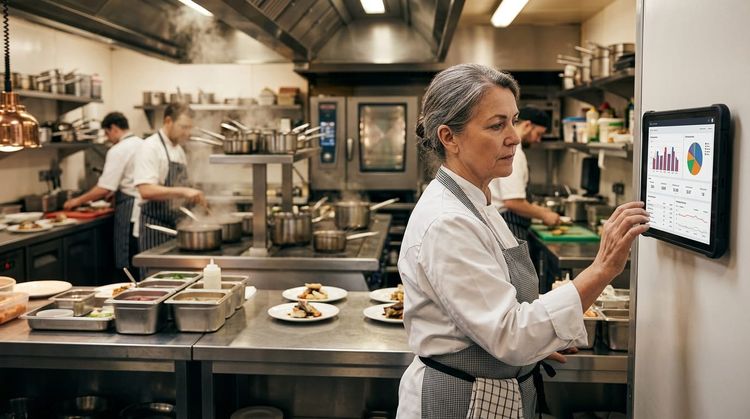
7. AI and Technology Consulting
AI and smart kitchen technology is changing the way commercial catering operations manage inventory, labour, food safety, and ordering. But for most hospitality businesses, navigating what's genuinely useful versus what's expensive and overhyped is genuinely difficult.
An experienced catering consultant can provide independent, practical advice on which technology investments are appropriate for your operation — based on your size, your menu, your team's capability, and your budget. This is an area where independent advice has particularly high value, because technology vendors rarely give objective guidance on their own products' limitations.
Which Hospitality Businesses Benefit Most from a Catering Consultant?
Catering consultants add value across a wide range of hospitality businesses. In our experience working across South Wales, Bristol, and Gloucester, the businesses that benefit most tend to fall into one of these categories:
- New openings and start-ups — where getting kitchen design, menu, and team right from day one avoids the costly mistakes that frequently undermine new hospitality businesses
- Established businesses experiencing declining margins — where a fresh pair of experienced eyes can identify cost leaks and operational inefficiencies that have become invisible over time
- Businesses planning a significant equipment upgrade or kitchen refurbishment — where independent specification advice is essential before committing large capital expenditure
- Care homes, schools, and contract caterers — where compliance requirements, budget pressure, and nutritional obligations create specific operational challenges that benefit from specialist input
- Businesses that have grown rapidly — where systems, processes, and team capability haven't kept pace with the scale of operation
- Hospitality businesses facing staffing and retention challenges — where kitchen design, training, and management processes may be at the root of the problem
Independent Consultant vs Equipment Supplier — What's the Difference?
This is one of the most important distinctions in the industry. Many businesses believe they're getting consultancy when they're actually getting a sales process dressed up in consultancy language.
An equipment supplier's primary objective is to sell you their products. They may provide kitchen design services — but that design will be built around the equipment they supply. An independent consultant's primary objective is to improve your operation. Their kitchen design, equipment specification, and menu recommendations are based entirely on what's right for you.
The practical difference is significant. An independent consultant might recommend a competitor's product if it's better suited to your needs. Across 35+ years in hospitality I have seen the same thing many times, expensive equipment in the wrong place, doing the wrong job, for the wrong operation.
How Does a Catering Consultant Work in Practice?
Most catering consultancies begin with an initial consultation — which at On The Pass Consultancy is always free of charge and carries no obligation. This is an opportunity for the consultant to understand your business, your challenges, and your goals, and for you to understand how they work and whether they're the right fit.
After the initial consultation, engagements typically fall into one of three models:
1. Project-based — a defined scope of work with a fixed fee, such as a kitchen design project or menu development programme
2. Day rate — charged per day for ongoing advice, audits, training delivery, or support during a new opening
3. Retainer — a monthly arrangement for regular, ongoing consultancy support across multiple areas of the business
The best consultancies are flexible and will tailor their engagement model to what makes most sense for your business and budget. A single-day audit might be all you need to identify the key issues. A major new opening might require weeks of intensive support across kitchen design, menu development, equipment procurement, and pre-opening training.
Why Local Knowledge Matters — Catering Consultancy in Wales
Most specialist catering consultants in the UK are based in London or Manchester. That's fine for large national projects — but for hospitality businesses in South Wales, Bristol, and Gloucester, it comes with significant disadvantages: travel costs, day rates inflated by London overheads, and a lack of genuine understanding of the local market.
On The Pass Consultancy is based in Newport, South Wales. We work across the full region — Cardiff, Newport, Swansea, the Valleys, Bristol, and Gloucester. We understand the Welsh hospitality market, the local supply chain, and the specific challenges facing hospitality businesses in this part of the UK. Our clients get the same quality of consultancy as any London operator — without the travel surcharge.
Frequently Asked Questions
How much does a catering consultant cost in the UK?
Day rates for experienced catering consultants in the UK typically range from £400 to £900 per day depending on experience, specialism, and location. Project fees vary considerably based on scope. At On The Pass Consultancy, all initial consultations are free — we'll always discuss costs openly and transparently before any engagement begins.
How long does a typical catering consultancy project take?
It depends entirely on scope. A kitchen process audit can be completed in a single day. A full kitchen design and equipment specification project typically takes 2-6 weeks. A new opening support package covering kitchen design, menu development, equipment procurement, and pre-opening training might span 3-6 months. We work at the pace that suits your business.
Can a catering consultant help a small independent restaurant?
Absolutely. Some of the highest-impact work we do is with small independents — where the owner is often wearing every hat in the business and a fresh, experienced perspective makes a significant difference quickly. We scale our engagement to the size and budget of every client.
Do I need a catering consultant if I have an experienced head chef?
A great head chef brings deep expertise in their own kitchen and their own style of food. A catering consultant brings experience across dozens of different operations, sectors, and challenges. They're complementary, not competing. The best results we see are when an experienced head chef and an independent consultant work together — combining internal knowledge with external perspective.
Talk to On The Pass Consultancy — Free Initial Consultation
On The Pass Consultancy is a specialist catering and hospitality consultancy based in Newport, South Wales. With 35+ years in hospitality, working across the full breadth of it — from independent restaurants and pubs to hotels, care homes, and contract caterers — I give practical advice that makes a measurable difference to the businesses we work with.
If you're a hospitality business in South Wales looking for practical, independent consultancy support — from menu profitability and kitchen design through to staff training and equipment selection — get in touch with On The Pass Consultancy. We work with restaurants, hotels, contract caterers, and independent cafés across Cardiff, Newport, Swansea, Bristol, and Gloucester, and every project starts with a free initial conversation.
Contact us: info@onthepassconsultancy.com | +44 (0)7967 736372 | www.onthepassconsultancy.com