Contract Catering Purchasing Groups: Are They Worth It?

In the bustling world of contract catering, where margins are as thin as a perfectly sliced baguette and supply chains can twist like a pretzel under pressure, every penny saved counts. Imagine this: you're a contract caterer servicing a chain of corporate canteens across the Midlands, juggling rising food costs, fluctuating fuel prices, and the relentless demand for sustainable, allergy-friendly menus. Your procurement team is stretched thin, negotiating with suppliers who hold all the cards. Enter purchasing groups—or consortia, as they're often called in the trade. These collaborative networks promise collective bargaining power, discounted rates on everything from fresh produce to bulk coffee beans, and a buffer against the economic headwinds that have plagued the UK hospitality sector since Brexit and beyond.
But are they truly worth the membership fees, the administrative hoops, and the potential loss of autonomy? In this deep dive, we'll unpack the ins and outs of contract catering purchasing groups, drawing on industry insights, real-world examples, and a balanced look at the scales. Whether you're a seasoned caterer pondering a switch or a newcomer eyeing efficiency gains, by the end, you'll have the tools to decide if joining the club is a smart move or just another line item on your balance sheet.
What Exactly Are Purchasing Groups in Contract Catering?
At its core, a purchasing group is a cooperative alliance where multiple businesses—often in the same sector—pool their buying power to negotiate better deals with suppliers. In the context of contract catering, these groups focus on procuring food, beverages, equipment, and even non-food essentials like cleaning supplies or disposables. Think of it as a bulk-buying syndicate for the hospitality world: instead of a lone caterer haggling over a pallet of avocados, a group of 50 operators across schools, hospitals, and corporate sites combines their orders to demand volume discounts, extended payment terms, or exclusive access to premium lines.
These groups come in various flavours. Some are informal networks, like regional clusters of independent caterers sharing supplier leads over a Zoom call. Others are formal entities, complete with membership contracts, dedicated procurement teams, and annual audits. In the UK, they're often aligned with broader group purchasing organisations (GPOs), which extend beyond catering into facilities management or even energy procurement.
The mechanics are straightforward. Members commit to a baseline spend or volume threshold, granting the group leverage in supplier negotiations. In return, they access pre-vetted contracts with locked-in pricing, often audited for compliance with standards like the Government Buying Standards for Food and Catering (GBSF). This isn't just about haggling; it's about risk mitigation. With global disruptions—from the Ukraine conflict spiking grain prices to climate events hitting citrus yields—purchasing groups provide a safety net, forecasting trends and diversifying supply chains.
Yet, the UK's contract catering landscape adds unique wrinkles. The market, valued at £12.04 billion in 2023 and projected to hit £18.68 billion by 2031 at a 6.48% CAGR, is dominated by giants like Compass Group and Sodexo, who run their own in-house procurement arms. For smaller operators—say, a family-run firm handling workplace canteens—these groups level the playing field, turning minnows into perceived whales in supplier eyes.
The Tangible Benefits: Why Many Swear by Them
Let's not mince words: the primary allure is cost savings, and the numbers don't lie. By aggregating demand, purchasing groups can shave 10-25% off standard rates, according to industry benchmarks from bodies like the Caterfood Buying Group. For a mid-sized contract caterer spending £500,000 annually on dry goods and perishables, that's £50,000-£125,000 back in the coffers—enough to fund staff training or menu innovation without dipping into profits.
Take Regency Purchasing Group, a UK heavyweight with a network spanning hotels, stadiums, and corporate caterers. Members report immediate wins: one sports nutrition provider slashed costs by 22% on nutritional staples while gaining access to verified sustainable sourcing data. This isn't fluff; Regency's model includes retrospective rebates, meaning even if you join mid-year, savings accrue from day one. Similarly, CaterBuy, tailored for in-house school and academy catering, leverages collective clout to secure wholesaler deals that solo buyers could only dream of, often passing on savings via tiered pricing structures.
Beyond the balance sheet, these groups streamline operations. Procurement becomes a set-it-and-forget-it affair: central teams handle RFPs (requests for proposals), supplier vetting, and contract renewals, freeing your team for what they do best—crafting menus that wow clients. Allmanhall, another key player, emphasises data-driven insights, using analytics to track spend patterns and flag efficiencies, like swapping a pricey import for a local equivalent without quality dips. In an era where 60% of contract caterers cite supply chain volatility as their top headache, this predictive edge is gold.
Sustainability gets a boost too. Groups like TUCO (The University Catering Organisation) integrate GBSF compliance into every deal, ensuring members hit targets for local sourcing (aiming for 30% by 2025) and waste reduction. For contract caterers under pressure from ESG (environmental, social, governance) mandates—think NHS trusts demanding carbon-neutral menus—this translates to easier audits and happier clients. Plus, networking perks: annual "meet the buyer" events foster relationships, sparking collaborations like joint bids for multi-site contracts.
In essence, for operators with predictable volumes (e.g., education or healthcare sectors, which account for 40% of UK contract catering), these groups amplify leverage without the solo grind.
The Flip Side: Potential Pitfalls and Hidden Costs
No rose-tinted glasses here—purchasing groups aren't a panacea. Foremost, flexibility can evaporate. Locked into group contracts, you might face rigid supplier lists that don't stock niche items, like gluten-free artisanal breads for a bespoke corporate gig. One hospitality GPO critique highlights how standardised deals prioritise volume over variety, forcing caterers into "convenience store" fare rather than premium, innovative offerings.
If your menu pivots to trending plant-based options (now demanded by 57% of institutional clients), a group's lag in updating portfolios could hamstring you.
Membership fees sting too. Annual dues—often 1-3% of spend—plus potential rebates delays (quarterly or worse) disrupt cash flow. For smaller outfits (£100,000-£300,000 annual procurement), this might erode net gains, especially if admin overheads rise from reporting requirements. And dependency risks abound: if the group negotiates poorly or a key supplier falters (recall the 2022 egg shortages), you're all in the same leaky boat.
Quality control is another thorny issue. While groups vet suppliers, enforcement varies. A 2023 CMS report on GPOs noted occasional lapses in ethical sourcing, potentially tarnishing your reputation if a scandal hits. Moreover, the one-size-fits-most approach suits behemoths like Compass (managing £2bn in spend via Foodbuy) but chafes independents craving bespoke deals. Finally, exit barriers: some contracts bind you for 12-24 months, turning a trial into a commitment.
In short, if your operation thrives on agility or hyper-local sourcing, groups might feel like trading freedom for frugality.
Spotlight on UK Players: Who's Who in the Purchasing Arena
The UK boasts a vibrant ecosystem of catering-focused groups, each carving a niche. Here's a snapshot:
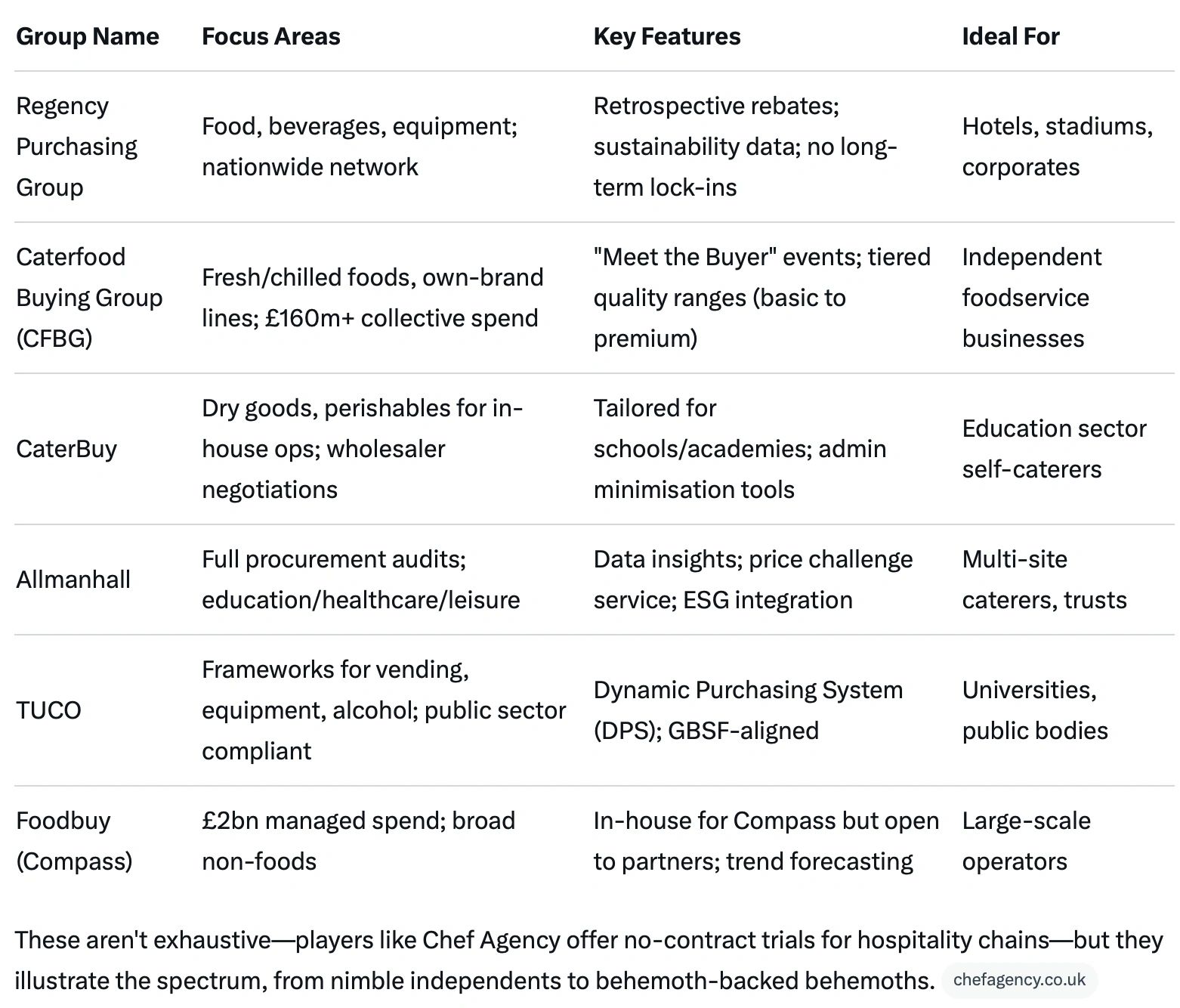
Real-World Wins and Wobbles: Case Studies That Tell the Tale
Theory's fine, but results speak louder. Consider a multi-academy trust (MAT) in the North West partnering with CaterBuy. Facing a 15% food inflation spike in 2023, the trust's six schools aggregated £400,000 in annual spend. Post-join, they netted 18% savings on staples like dairy and proteins, redirecting funds to free school meals expansion. Admin time dropped by 40%, as CaterBuy's portal handled ordering and compliance checks—crucial for Ofsted audits. The trust's head chef noted, "We gained bargaining power without losing our menu flair."
Contrast that with a mid-tier corporate caterer in London trialling a generic GPO. Seduced by 12% headline discounts, they overlooked the supplier roster's gaps in organic lines. When a client demanded vegan escalations, delays ensued, costing £20,000 in penalties and goodwill. Rebates arrived biannually, straining liquidity during a quiet Q2. They exited after 18 months, wiser but £5,000 lighter in fees.
Then there's Allmanhall's triumph with a hospital group in the South East. Audits revealed 22% over-spend on fragmented contracts. Switching to Allmanhall's model yielded £150,000 annual savings, plus streamlined ESG reporting that boosted their tender success rate by 30%. One procurement manager quipped, "It's like having a CPO on retainer without the salary bill."
These vignettes underscore a truth: success hinges on alignment. Groups shine for volume-heavy, compliance-bound ops but falter where customisation reigns.
Weighing the Scales: When Do They Tip in Favour?
So, are purchasing groups worth it? The verdict: emphatically yes for most, with caveats. If your annual procurement exceeds £250,000, predictability trumps variety, and sustainability's non-negotiable, the ROI is compelling—often 15-20% net after fees. Emerging trends amplify this: with 66% of enterprises eyeing wellness-focused catering and digital tools like Sodexo's nutrition trackers gaining traction, groups' aggregated R&D (e.g., TUCO's plant-based frameworks) future-proofs your ops.
Yet, for boutique caterers or those in volatile niches like events (where 70% of contracts are one-offs), solo sourcing might preserve edge. Hybrid models—using groups for 70% of spend, independents for the rest—offer a middle path.
Navigating the Decision: Your Roadmap to Joining (or Not)
Ready to dip a toe? Start with a spend audit: map your top 20 categories and benchmark against group tariffs (many offer free trials, like Chef Agency's no-obligation reviews). Vet for fit: does their supplier pool match your menu? Probe fees, exit clauses, and support—aim for transparency via annual disclosures.
Engage stakeholders: chat with current members via LinkedIn or trade shows like the Public Sector Catering Conference. Pilot a three-month trial on low-risk items (e.g., disposables) to test waters. And remember, tech's your ally—platforms like Access Procure Wizard integrate group deals with real-time tracking, mitigating admin woes.
Wrapping Up: A Savvy Bite or a Bitter Pill?
Contract catering purchasing groups aren't a magic bullet, but in a market squeezed by inflation (up 6.48% CAGR through 2031) and sustainability scrutiny, they're a potent tonic for many. They deliver savings, simplicity, and strategic heft, turning procurement from a chore into a competitive advantage. Yet, their worth boils down to your operation's DNA: scale it right, and you'll feast; mismatch, and it might leave a sour taste.
If you're teetering on the edge, weigh your volumes, values, and velocity. Consult peers, crunch numbers, and perhaps start small. In the end, the best procurement isn't about joining the crowd—it's about feeding your business to thrive. What's your take? Drop a comment below; let's dish on the details.
Sources
- Verified Market Research, UK contract catering market
- Caterfood Buying Group
- Regency Purchasing Group
- Caterbuy
- allmanhall
- The Access Group, contract catering and its challenges
- Source1, the pros and cons of group purchasing organisations
- Global Growth Insights, contract catering market report
- Precoro, group purchasing organisations
- Public Sector Catering, the major procurement players
- Chef Agency buying group