Do You Know What Your Children Are Eating at School?
A Parent’s Guide to School Meals in the UK (2025) – Now Featuring the Real Impact of Universal Free School Meals (UFSM)
As parents, we want the very best for our children – especially when it comes to the food that fuels their growing bodies and busy minds. Yet every day, millions of UK children eat at least one meal at school, often prepared out of sight and with little transparency. Have you ever stopped to wonder: do you really know what your child is eating at school?
The answer might surprise you. There is a growing nutritional divide between state-maintained schools and private (independent) schools that most parents are completely unaware of. While some children enjoy freshly prepared, restaurant-quality meals made with premium ingredients, others are served highly processed food that barely meets basic school food standards – all because of budget differences that can be as stark as £2.30 versus £6–£10 per child per day.
Since September 2024, the rollout of Universal Infant Free School Meals (UIFSM) has been joined by a growing number of local authorities and the new Labour government’s pledge to extend free school meals to all primary pupils in England (phased Universal Free School Meals – UFSM). It sounds wonderful – every child gets a hot lunch, no stigma, no paperwork. But behind the scenes, many schools and caterers are struggling to deliver genuine nutrition under the extra pressure. Let’s look at the full picture.
The Two-Tier Reality of UK School Meals
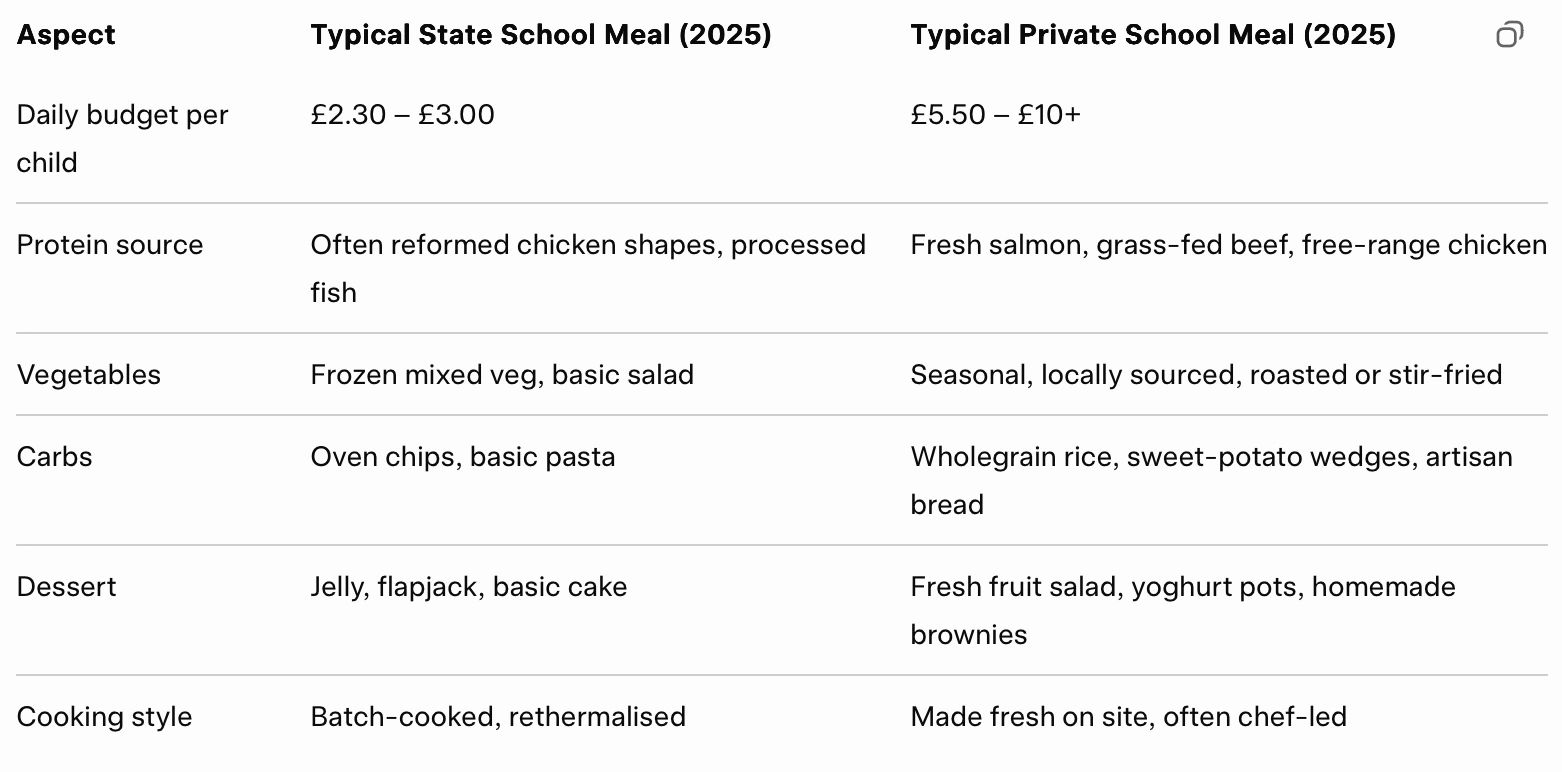
State-maintained schools are bound by the excellent School Food Standards, but the average funding for a primary-school lunch remains around £2.50–£2.80 (often less after VAT and overheads). Private schools still enjoy £5.50–£10+ per day. The table below shows how that gap looks on the plate:
The Hidden Challenges of Universal Free School Meals (UFSM & UIFSM)
Everyone cheered when UIFSM was introduced in 2014 and when new pledges were made in 2024–2025, but the funding reality has not kept pace with ambition. Here are the very real challenges schools and contract caterers are facing right now:
- Funding has not increased in line with uptake and inflation The government allocation for UIFSM is still £2.53 per meal (2025/26 rate). After food inflation since 2022 (which hit +35 % on some lines), labour increases, and energy costs, caterers are effectively receiving less in real terms than they were a decade ago – yet they must now feed 100 % of Reception, Year 1 and Year 2 children (and in pilot areas, all primary pupils).
- Sudden doubling or tripling of meal numbers Before UIFSM/UFSM trials, many schools served hot meals to only 40–55 % of pupils. Overnight, that jumps to 90–100 %. Kitchens designed for 200 meals a day are now expected to produce 500–600 with the same equipment, same staff, and the same two-hour service window.
- Staffing crisis School catering wages are among the lowest in hospitality. Experienced chefs have left the sector in droves since Covid and Brexit. Schools report vacancies of 20–40 % in many regions, meaning unqualified staff are often doing the cooking.
- Infrastructure lag Hundreds of primary schools still have no on-site kitchen – they rely on “rethermalisation” (heating up pre-cooked, chilled meals delivered from a central production unit). Extending free meals to every child without building new kitchens has forced even more reliance on ultra-processed, cook-chill food.
- Plate waste skyrockets When every child is automatically given a full hot meal (rather than choosing and paying), waste can rise from 10–15 % to 30–40 %. That wasted food still costs money the school doesn’t get back, further squeezing the budget for ingredients.
- Nutritional compromise To stay within budget when feeding double the children, many caterers have quietly shifted to cheaper, higher-yield items: more reformed meat, more oven-based cooking (chips, nuggets, pizza), cheaper frozen veg, and smaller portions of fresh produce. It’s still compliant with the Standards – but only just.
Real-world example: a large London borough we advised in 2025 increased hot-meal uptake from 48 % to 97 % after joining the UFSM pilot. Their catering cost per head fell from £2.71 to £2.41 because they had to switch from fresh chicken breast to turkey twizzlers and from fresh broccoli to frozen “broccoli florets in a cheese sauce pouch”. The headteacher told us, “We’re feeding more children, but the food quality has undeniably dropped.”
Why School Meal Nutrition Matters More Than Ever
The science hasn’t changed:
- Omega-3s, iron, zinc, and B-vitamins directly affect concentration and behaviour (Oxford University 2024 study: nutrient-dense lunches = 8–12 % better cognitive performance).
- Poor diet is linked to rising childhood obesity, Type-2 diabetes, and mental-health difficulties.
- The gut-brain axis means junk fuel = poorer emotional resilience.
When UFSM is delivered on a shoestring, we risk replacing packed-lunch sandwiches with processed hot meals that are sometimes worse nutritionally.
How to Find Out What Your Child Is Really Eating
- Ask for the menu and full ingredient matrix.
- Check protein origin – “chicken curry” is not the same as “fresh diced chicken curry”.
- Look for Food for Life Served Here awards.
- Visit at lunchtime if possible.
- Ask your child specific questions: “What vegetables did you have today?”
Positive Change Is Still Happening
Despite the challenges, brilliant things are occurring:
- Some local authorities (e.g., Devon, Islington, and Wales) have topped up the government rate to £3.20–£3.80, protecting quality.
- Innovative caterers are using pulse-based proteins, bulk whole grains, and seasonal root veg to stretch budgets without sacrificing nutrition.
- Campaigns like Feed Better 2025 and the National School Food Review are pushing for a proper funding settlement.
What Parents Can Do Right Now
- If your school is part of a UFSM pilot and quality has slipped, politely ask: “How is the increased uptake being funded, and what measures are in place to protect nutritional standards?”
- Pack a healthy lunchbox on the days the menu is weak (many schools still allow this).e awards.
- Pack a healthy lunchbox on the days the menu is weak (many schools still allow this).
- Join your School Food Working Group – parent voices are more powerful than ever.
The Bottom Line
Universal Free School Meals are a fantastic principle, but without proper funding and infrastructure they risk widening, not narrowing, the nutritional divide. In 2025 Britain, a child in a private school still eats restaurant-quality fresh food while many state-school children – even those now receiving “free” meals – are served highly processed items born of impossible budgets.
Every child deserves food that is fresh, tasty, and genuinely nourishing – regardless of postcode, parental income, or whether their meal is paid for by the taxpayer.
At On The Pass Consultancy, we’re working with schools, local authorities, and caterers across the country to prove that high-welfare, nutrient-dense school meals are possible even on tight budgets. We also help private schools stay ahead of the curve and independent schools maintain their gold standard.
If you’re a headteacher wrestling with UFSM rollout, a caterer fighting to protect quality, or a parent who believes every plate matters – let’s talk.
Do you know what your children are eating at school? Now more than ever, it’s time to ask.
On The Pass Consultancy – raising the standard of school dining, one meal at a time.