Traditional Christmas Pudding Recipe for 50 People
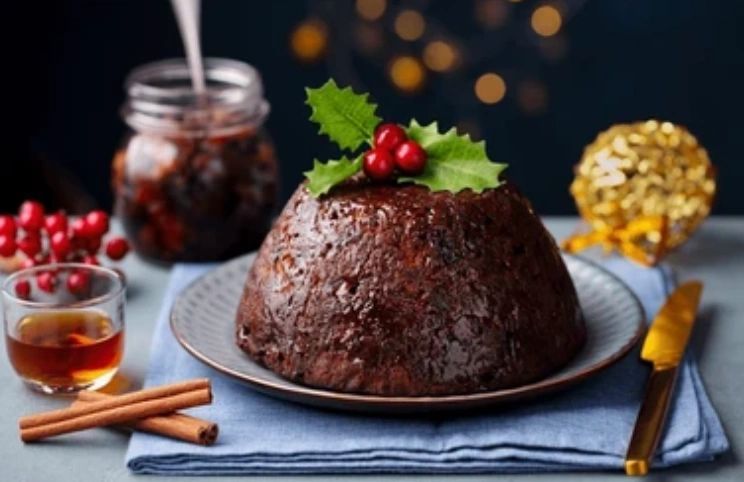
A proper Christmas pudding is one of the few desserts that actually gets easier at scale, provided you start early enough. The mixture is forgiving, the steaming is unattended once it is running, and the whole thing improves for six weeks in a cupboard while you get on with everything else. What it will not forgive is being made in the week before Christmas.
This is scaled for 50 covers at 150 g a portion, built across five 2 litre basins. It makes roughly 8 kg of raw mixture, which gives you around 54 portions once trimmed, so you have margin for the odd uneven wedge and a basin held back.
Yield and timings
- Makes: 50 portions at 150 g, from 5 x 2 litre basins, approximately 8 kg of mixture
- Prep: 45 minutes, plus overnight soaking
- First steam: 9 hours for 2 litre basins, see the note on steaming times below if you are using anything else
- Maturing: 4 to 8 weeks, minimum 2
- Reheat on the day: 3 hours
- Best made: mid-November for Christmas service
Equipment
- 5 x 2 litre pudding basins
- Commercial steamer, or large pans with trivets
- Largest mixing bowls you have, or a 50 litre mixing tub
- Box grater or food processor for the apple
- Digital scales
- Digital probe thermometer
- Baking parchment, foil and butcher's string
Ingredients
The fruit
| Ingredient | Quantity |
|---|---|
| Raisins | 1.1 kg |
| Sultanas | 1.1 kg |
| Currants | 900 g |
| Dried figs or prunes, stoned and roughly chopped | 400 g |
| Mixed candied peel | 400 g |
| Bramley apples, peeled, cored and coarsely grated | 500 g (about 2 large) |
| Zest and juice of oranges | 2 large |
| Zest and juice of lemons | 2 large |
The dry mix
| Ingredient | Quantity |
|---|---|
| Fresh white breadcrumbs | 550 g |
| Shredded suet, vegetable or beef | 550 g |
| Dark muscovado sugar | 600 g |
| Plain flour | 275 g |
| Mixed spice | 30 g |
| Ground cinnamon | 10 g |
| Ground nutmeg, freshly grated if you can | 8 g |
| Fine sea salt | 8 g |
| Blanched almonds, roughly chopped (optional) | 200 g |
The wet
| Ingredient | Quantity |
|---|---|
| Medium free-range eggs, beaten | 10 |
| Stout | 600 ml |
| Brandy | 200 ml |
| Extra brandy for feeding and flaming | 300 to 400 ml |
Method
1. Soak the fruit, the night before
Combine the raisins, sultanas, currants, chopped figs or prunes, candied peel and grated apple with the citrus zest and juice in your largest bowl or tub. Pour over the stout and the 200 ml of brandy. Stir thoroughly, cover and leave overnight at ambient. The fruit should be plump and most of the liquid taken up by morning.
2. Mix the dry ingredients
Combine the breadcrumbs, suet, muscovado, flour, mixed spice, cinnamon, nutmeg and salt. Work in batches if your bowls will not take it. Add the almonds now if you are using them. Break up any lumps of muscovado properly, they will not disperse later.
3. Combine
Add the soaked fruit and all its liquid to the dry mix, then the beaten eggs. Mix thoroughly until there is no dry flour anywhere and the texture is uniform. This takes longer than you expect at this volume. Stop when a spoonful holds its shape but drops cleanly off the spoon.
4. Fill the basins
Grease the basins generously. Divide the mixture evenly, roughly 1.6 kg per 2 litre basin, which leaves around a quarter of the basin empty for expansion. Press down to knock out air pockets, then level the top. Cover each with a pleated circle of buttered parchment, then pleated foil, and tie securely under the rim with string. The pleat matters, without it the cover splits as the pudding rises.
5. First steam, 9 hours
Stand the basins on trivets in your steamer or pans with boiling water coming halfway up the sides. Steam for 9 hours, topping up with boiling water as needed. Never let a pan run dry. If you are using a commercial steamer, hold at full steam and check the water level every couple of hours. If you are weighing up whether a steamer earns its place in your kitchen, that is a catering equipment question worth asking before December, not during it.
A note on steaming times
The 9 hours above is for 2 litre basins filled to roughly 1.6 kg. It is the size of the individual basin that sets the time, not the size of the batch. Five basins in a steamer take the same 9 hours as one basin on its own, so if you scale this recipe down but keep the same basins, the timing does not change. Change the basin and it does.
As a starting point from this mix:
| Basin | Approximate fill | First steam | Reheat |
|---|---|---|---|
| 2 litre | 1.6 kg | 9 hours | 3 hours |
| 1.5 litre | 1.2 kg | 7 to 8 hours | 2 to 2.5 hours |
| 1.2 litre | 1 kg | 6 to 7 hours | 2 hours |
| Individual moulds, 200 ml | 180 g | 2 to 2.5 hours | 30 to 40 minutes |
Those are starting points and nothing more. Steamers vary more than recipes admit, a commercial unit at full steam works faster than a pan with a lid on it, and a wetter mix takes longer than a dry one. The pudding is ready when it is dark, firm to the press and a skewer comes out clean. On the day, the only number that actually matters is the probe reading, above 75°C in the centre. Trust your own eye and your thermometer over the clock, and over me.
6. Cool and mature
Lift out and cool completely at ambient, which will take several hours. Replace the parchment and foil with fresh, label with the date, and store somewhere cool, dark and dry. Feed each pudding with a tablespoon of brandy every week or two, poked through a few holes made with a skewer. Four to eight weeks is where this gets good.
7. Reheat and serve
Steam for 3 hours from cold on the day. Probe the centre and confirm it has reached above 75°C before service. Turn out, warm 100 ml of brandy, pour over and light it at the table if the room suits it. Cut into 150 g wedges and serve with brandy butter, rum sauce, custard or clotted cream.
Allergens, read this before you serve it
This pudding contains cereals containing gluten from four separate sources, not one:
- Plain flour, wheat
- Breadcrumbs, wheat
- Shredded suet, which contains wheat flour. Atora vegetable suet lists wheat flour as its second ingredient after the vegetable oils
- Stout, which is brewed from barley
It also contains eggs, sulphites in almost all commercial dried fruit, nuts if you use the almonds, and milk if you grease the basins with butter.
Swapping the flour alone does not make this gluten free, and that is a mistake worth being clear about, because a pudding described as gluten free when the suet and the stout are not is how someone gets hurt. A genuine gluten free version needs gluten free flour, gluten free breadcrumbs, a gluten free suet confirmed with your supplier, and a gluten free stout or a substitute such as apple juice. Check every one of those against the current pack, not against what the pack said last year.
For a vegetarian pudding, use vegetable suet rather than beef. For an alcohol free version, replace the stout and brandy with cloudy apple juice or cold black tea, accept that it will not keep nearly as long, and make it a fortnight out rather than two months.
Costing notes
Dried fruit is the bulk of your cost here and it moves a lot in the run up to Christmas. Costing a festive menu properly is a job in itself, and it is the sort of thing menu development work exists to sort out. Buy in October if you can, prices climb through November. Beef suet is usually cheaper than vegetable and gives a better set, but it closes the door on vegetarian covers from the same batch, so most kitchens running mixed service find it simpler to make everything with vegetable suet.
The almonds are genuinely optional. They add texture and about a fifth to your ingredient cost, and most guests will not notice their absence in a pudding this rich.
Why make it rather than buy it
Bought puddings are not bad any more. The gap is in the fruit, where the bought ones are thin, and in the maturing, where six weeks of feeding does something no factory schedule can match. At 50 covers the ingredient cost of making your own sits well below buying in at the quality you would want to serve, and the labour is 45 minutes of mixing plus a day of steaming that needs nothing from you but a water check.
Make it in November, forget about it, and the hardest part of Christmas dessert service is already done.
If your Christmas service needs more thought than one pudding, get in touch and we can look at the whole menu.