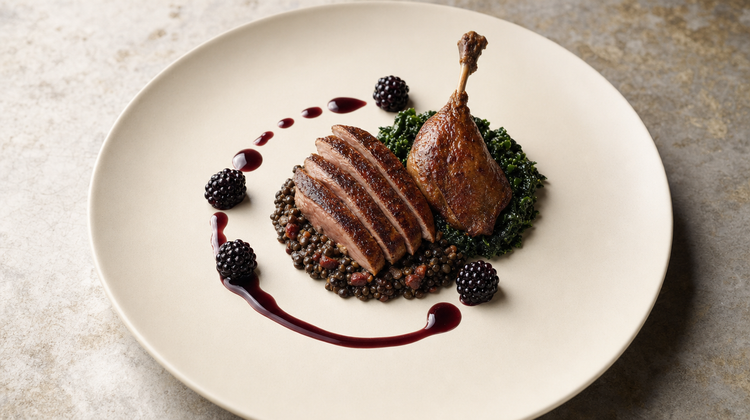
Confit Duck Legs with Morel Mushrooms and Madeira Sauce
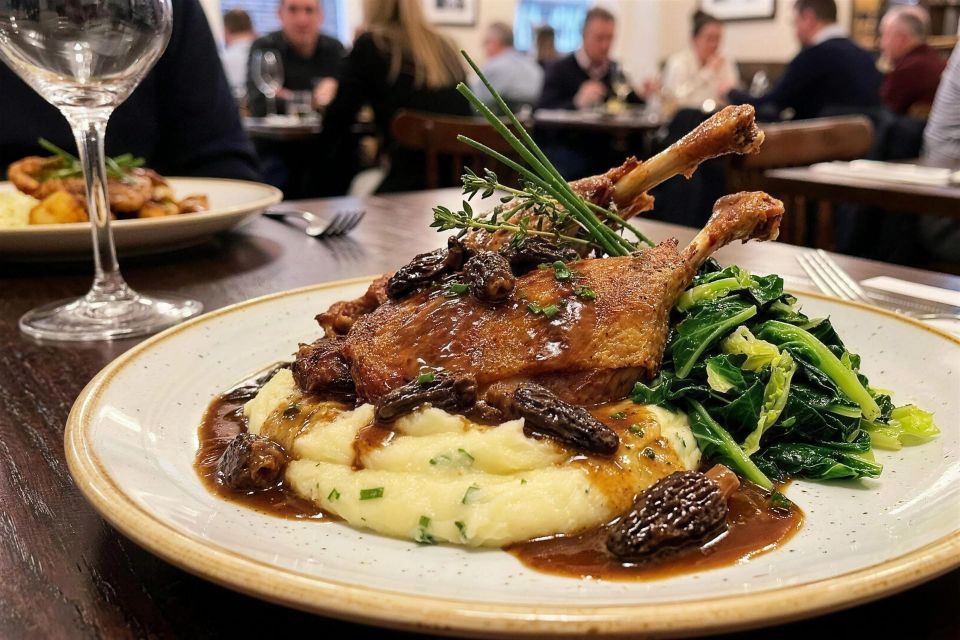
S/W Chive Mash and Spring Greens
By On The Pass Consultancy | Category: Weekly Recipe | Serves: 20 | Prep: 45 min | Confit: 6–8 hrs | Skill Level: Intermediate–Advanced | Keywords: confit duck legs recipe UK catering, morel mushroom sauce, Madeira sauce recipe, spring menu ideas UK, duck leg catering volume
Mid-April is morel season. Morels are the ingredient that divides kitchens into two camps: those who use them, and those who haven't yet. They're earthy, nutty, almost meaty — and they have a hollow, honeycomb structure that soaks up sauce in a way that no other mushroom does. They're also expensive, which is exactly why they deserve to be on a menu right now, when they're at their absolute best and the price reflects genuine scarcity rather than year-round import markup.
Pair morels with confit duck legs and you've got something that earns its place on a serious spring menu. The rich, yielding fat-cooked duck and the deep, umami-loaded mushroom sauce are built for each other. Add a properly made chive mash — not just mash with chives in it, but mash made with enough butter to make a French chef nod — and buttered spring greens, and you have a plate that looks like it belongs somewhere you'd pay good money to eat.
Confit is one of the great preservation techniques in classical French cooking. It produces duck legs that are impossibly tender, with crisp skin when finished correctly, and it has a significant operational advantage: you can confit the legs two or three days in advance and hold them in the fat until service. That makes this dish genuinely manageable at volume — the labour-intensive work happens off-service, and the finish is fast and clean. This recipe is written for 20 covers. It scales. It holds.
Serves 20 | Prep: 45 min | Confit: 6–8 hours | Finish: 45 min
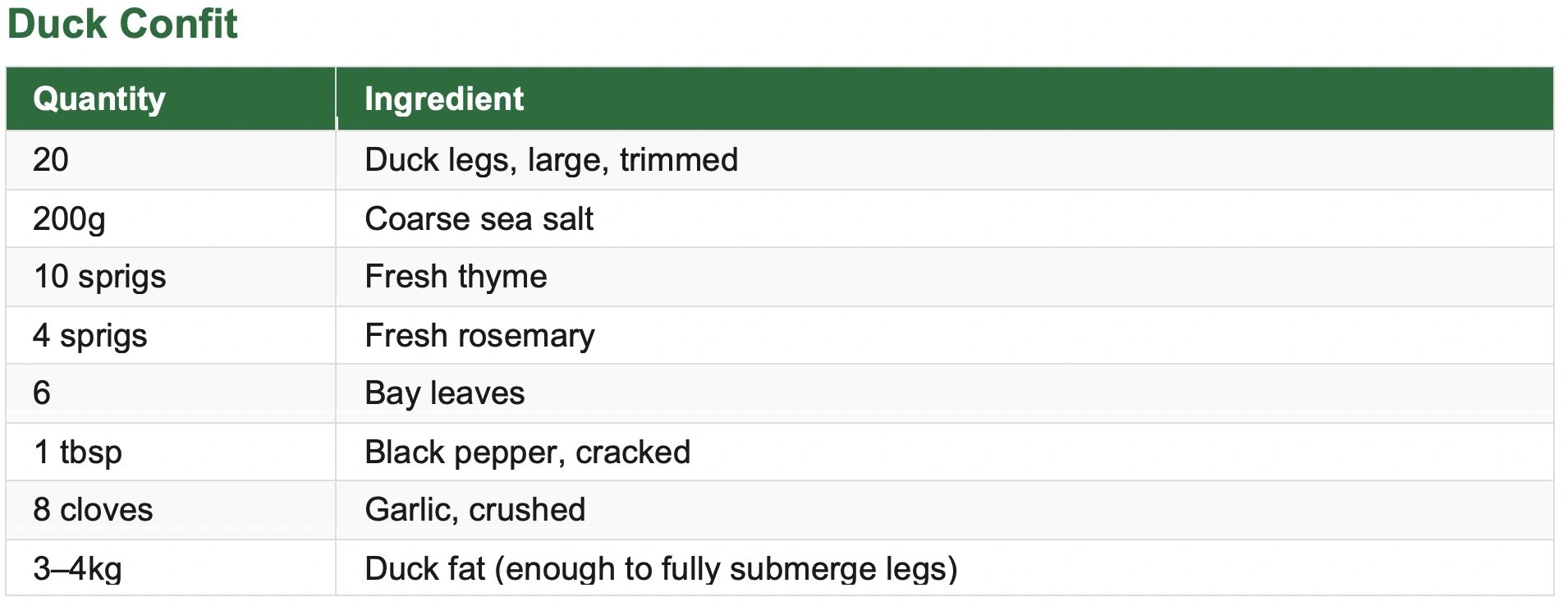
Ingredients
Method
Stage 1 — Cure the Duck (24 hours before service)
1. Combine the sea salt, thyme, rosemary, bay leaves, cracked black pepper and crushed garlic in a large bowl. Mix well to distribute the aromatics evenly through the salt.
2. Lay the duck legs skin-side down in a single layer across two deep gastronorm trays. Pack the cure mix firmly over the flesh side of each leg. Cover with cling film and refrigerate for 12–24 hours. Minimum 12 hours; 24 hours gives a cleaner result.
3. When ready to confit, remove the legs from the trays and rinse each one thoroughly under cold running water. Pat completely dry with kitchen paper. Any residual cure left on during cooking will make the finished duck too salty — take the time to rinse properly.
Stage 2 — Confit the Duck (6–8 hours before service, or up to 3 days ahead)
4. Preheat your oven to 140°C (fan 120°C). Melt the duck fat gently in wide, deep gastronorm trays on the stove. You need enough fat to fully submerge the legs.
5. Lower the dried, cured legs into the warm fat. They must be completely submerged. Lay a sheet of greaseproof paper directly on the surface, then cover tightly with foil.
6. Transfer to the oven and cook for 6–8 hours. The legs are done when the meat is completely yielding and starting to pull away from the bone at the knuckle. At 140°C this will take 6 hours for smaller legs, 8 hours for larger ones.
7. Remove from the oven and allow to cool in the fat. Once cooled, legs can be held in the fat in the refrigerator for up to 3 days. This is the make-ahead step that makes the dish service-viable at volume.
Stage 3 — Morel Mushroom and Madeira Sauce
8. Place the dried morels in a heatproof jug. Pour over 1 litre of boiling water. Soak for 30 minutes. Lift the morels out carefully — don't pour, as grit settles to the bottom. Pass the soaking liquid through a fine sieve lined with muslin and reserve. This liquid is deeply flavoured and essential to the sauce.
9. In a wide, heavy-based saucepan melt 60g of butter over medium heat. Add the shallots and cook gently for 10–12 minutes until fully softened. Add the garlic and cook 2 minutes more.
10. Add the soaked morels (and fresh morels if using, halved). Cook for 4–5 minutes. Pour in the Madeira and white wine. Increase heat and reduce by two-thirds — 8–10 minutes. This concentrates the flavour significantly.
11. Add the reserved morel soaking liquid and the stock. Add thyme sprigs. Reduce by half over medium heat — 20–25 minutes. Skim as needed.
12. Add double cream and reduce 5 more minutes until the sauce coats the back of a spoon. Remove thyme. Finish by whisking in the remaining 60g of cold butter in small pieces — this gives the sauce gloss and body. Season with salt and white pepper. Keep warm or reheat gently at service.
Stage 4 — Chive Mash
13. Peel and quarter the potatoes. Cook in well-salted boiling water until completely tender — approximately 20–25 minutes. Drain thoroughly and return to the pan over a low heat for 2 minutes to drive off all excess moisture. Wet potatoes make loose mash.
14. Pass through a drum sieve or mouli-légumes directly into a clean saucepan — never use a food processor, which turns mash glutinous. Over a low heat, beat in the butter in four additions, allowing each to incorporate fully. Gradually add the warm milk and cream. The mash should be smooth, rich and thick.
15. Fold in the snipped chives. Season generously. Keep warm in a bain-marie, stirring occasionally to prevent a skin forming.
Stage 5 — Finish the Duck and Plate
16. Remove the duck legs from the fat. For volume service, place legs skin-side up on wire racks over roasting trays and blast in a 220°C (fan 200°C) oven for 10–12 minutes until the skin is deeply golden and crisp. This is the most practical method at 20 covers and gives consistently crisp skin across the batch.
17. While the duck is finishing, cook the spring greens: melt the butter in a wide sauté pan over high heat, add the sliced garlic and cook 30 seconds. Add the greens, toss well, season, and cook for 2–3 minutes. They should retain bite and vivid colour.
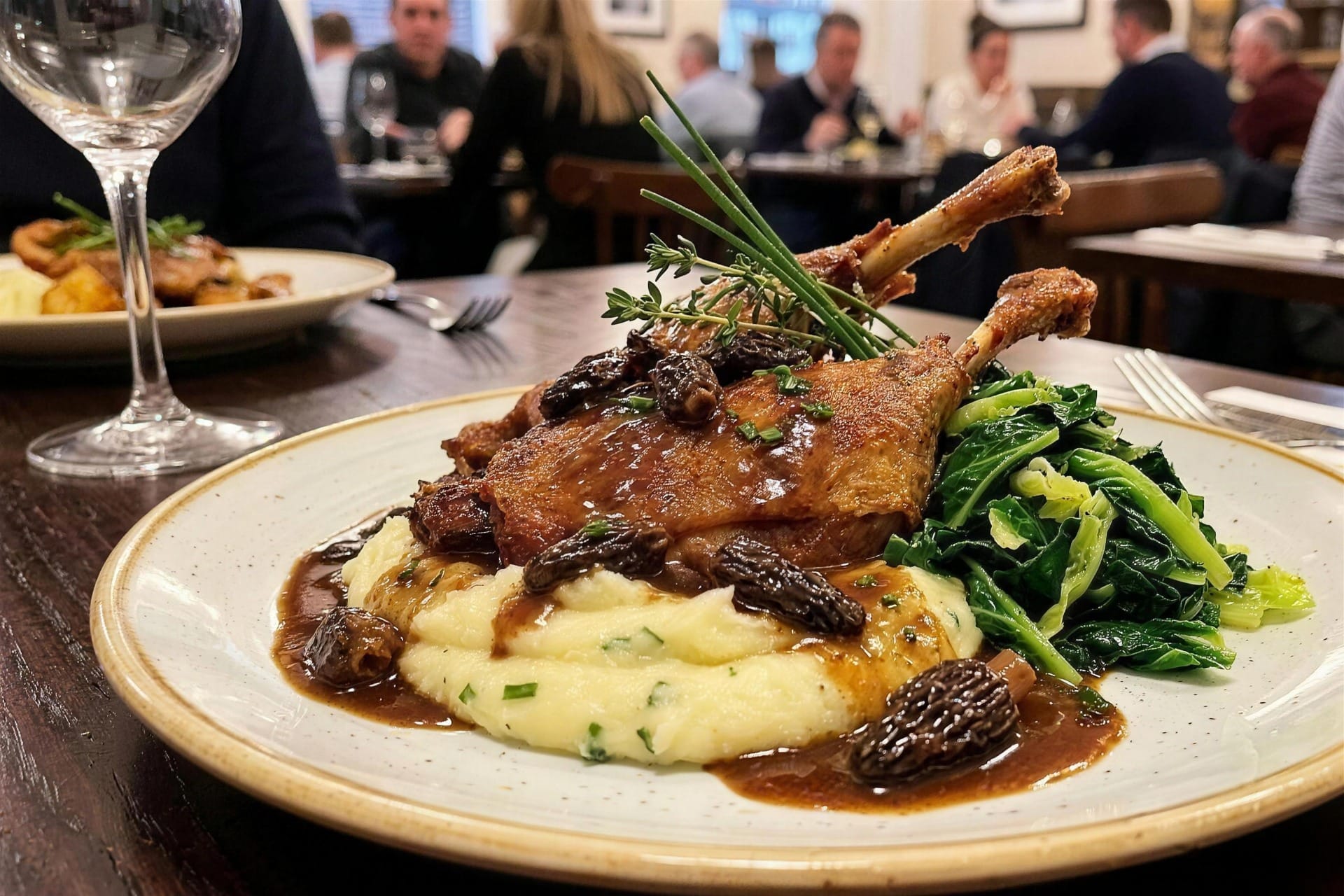
18. To plate: Spoon a generous portion of chive mash to one side of the plate. Lay the spring greens alongside. Place the duck leg across both, skin-side up. Spoon the morel and Madeira sauce generously over the duck and around the plate. Finish with chopped flat-leaf parsley.
Chef's Notes
On the morels: Dried morels work very well in the sauce — the soaking liquid they produce is intensely flavoured and should never be discarded. If you can get fresh morels from a specialist supplier, add them alongside the rehydrated ones. The combination of dried (for depth) and fresh (for texture) is what gives the sauce its character.
On the fat: Good-quality duck fat is available from most catering suppliers. The fat you confit in can be strained, refrigerated and reused two or three more times — it gets better with use.
Make-ahead potential: This is an ideal banquet or function dish. Confit the legs up to 3 days ahead. Make the sauce up to 2 days ahead — hold without the final butter finish and add that fresh at service. The finish at service is under 15 minutes for 20 covers.
Madeira substitution: If Madeira isn't available, a good dry Marsala is an acceptable substitute. Do not use cooking wine — use something you'd drink.
Enjoyed this recipe?
Subscribe below and we'll send a new professional recipe to your inbox every Friday — built for commercial kitchens, tested at service volume.
→ Subscribe at the Top of the page & find other delicious Recipes Here