Elderflower Posset Recipe with Summer Strawberries 20 Portions

By On The Pass Consultancy | Category: Weekly Recipe | Serves: 20 | Prep: 45 minutes (plus setting time) | Cook: 20 minutes | Skill Level: Beginner–Intermediate | Keywords: elderflower posset recipe, summer dessert menu, macerated strawberries, shortbread, seasonal produce
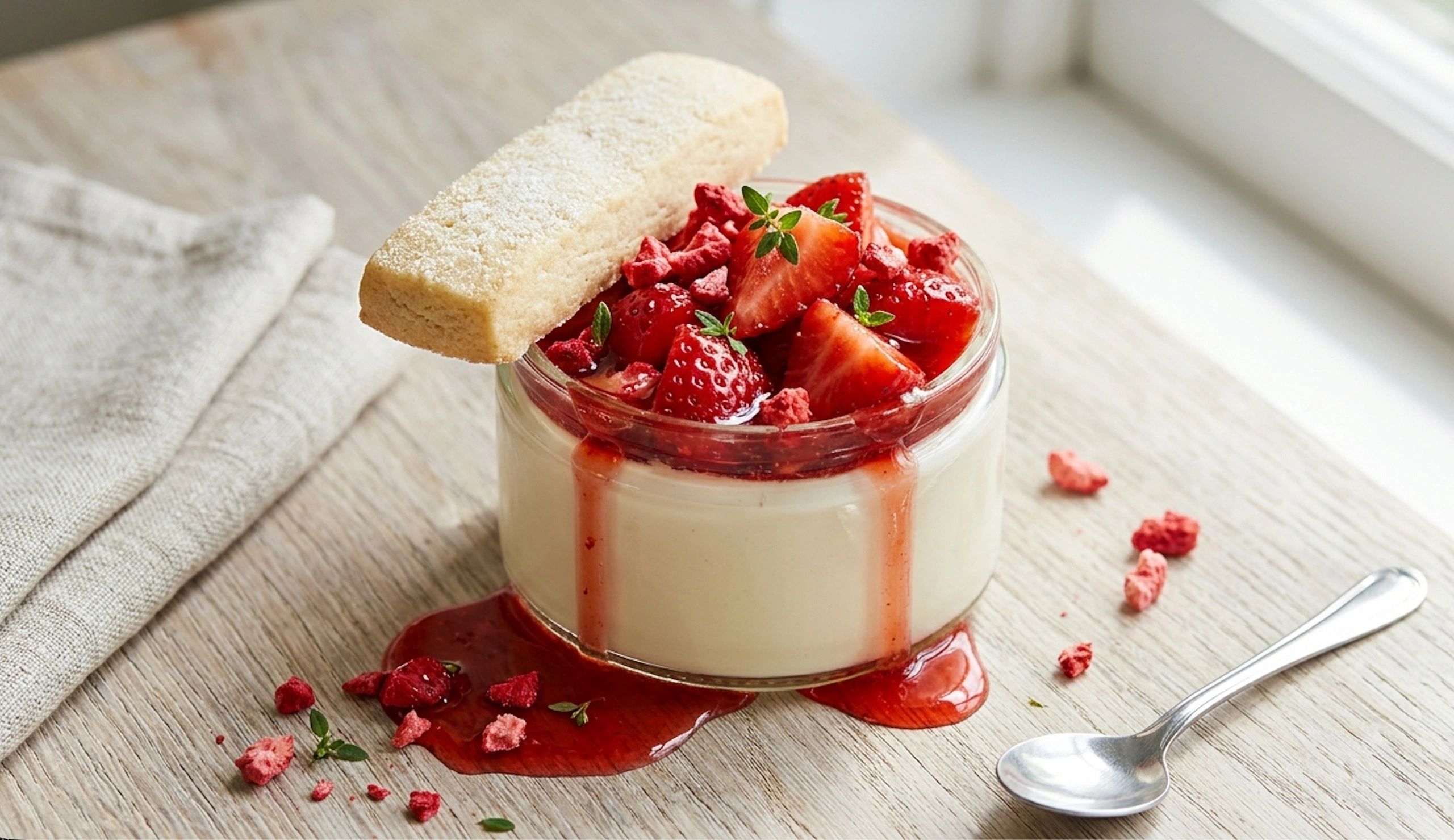
An elderflower posset recipe for commercial kitchens — silky set cream, macerated British strawberries and buttery shortbread, prepped ahead for 20 covers.
Elderflower Posset Recipe with Summer Strawberries
By On The Pass Consultancy | Category: Weekly Recipe | Serves: 20 | Prep: 45 minutes (plus setting time) Cook: 20 minutes | Skill Level: Beginner–Intermediate | Keywords: elderflower posset recipe, summer dessert menu, macerated strawberries, shortbread, seasonal produce
Why This Dish — and Why Now
There's a fortnight or so each June when the hedgerows are heavy with elderflower and the first British strawberries are finally worth buying, and the two of them belong together on a plate. This is the window. Miss it and you're back to imported berries with no scent and elderflower from a bottle that never quite tastes of the lane it came from.
A posset is the most forgiving dessert a commercial kitchen can run. It's three ingredients at heart — cream, sugar and acid — and it sets in the fridge with no gelatine, no leaves, no water bath, no temping a custard and praying it doesn't split. The acid does all the work. Add elderflower cordial for perfume and a pile of strawberries macerated in their own juice, sit a finger of proper shortbread alongside for the crunch, and you have a dessert that costs very little, prepares entirely ahead, and tastes like the season it's made in.
I've put this one in front of more than one café and gastropub owner who told me they "don't really do puddings." They do now. Here's how it goes together for 20 covers, and how to run it so the only thing left at service is the plating.
Serves 20 | Prep: 45 minutes (plus setting time) | Cook: 20 minutes
Ingredients
Elderflower posset
| Ingredient | Quantity |
|---|---|
| Double cream | 1.8 litres |
| Caster sugar | 450 g |
| Elderflower cordial | 250 ml |
| Lemon juice (about 6–7 lemons) | 180 ml |
| Lemon zest | from 4 lemons |
Macerated strawberries
| Ingredient | Quantity |
|---|---|
| British strawberries, hulled and quartered | 2 kg |
| Caster sugar | 100 g |
| Elderflower cordial | 100 ml |
| Lemon juice | from 1 lemon |
| Lemon thyme or mint, picked (optional) | small bunch |
Shortbread
| Ingredient | Quantity |
|---|---|
| Plain flour | 500 g |
| Cornflour | 50 g |
| Unsalted butter, cold and diced | 350 g |
| Caster sugar | 200 g (plus extra to finish) |
| Sea salt | 1 pinch |
| Lemon zest (optional) | from 1 lemon |
To finish
| Ingredient | Quantity |
|---|---|
| Freeze-dried strawberry pieces or fresh elderflowers | to garnish |
| Lemon thyme or mint tips | to garnish |
Method
Stage 1 — Shortbread (make the day before)
1. Beat the cold diced butter with the caster sugar, salt and lemon zest until just combined — you want it creamy but not aerated. Sift in the flour and cornflour and bring it together to a dough with as few turns as possible. The cornflour is there for a reason: it lowers the gluten and gives that short, sandy, melt-in-the-mouth texture that all-flour shortbread never quite reaches.
2. Press the dough into a lined tray to about 1 cm thick, or roll and cut to fingers. Chill for at least an hour, ideally overnight. Chilling firms the butter and relaxes the gluten, so the shortbread holds its shape in the oven and bakes short rather than tough. Skip this and it spreads and toughens — I've seen a whole tray come out like biscuit-coloured leather because someone was in a hurry.
3. Bake at 160°C (fan 150°C) for 15–18 minutes, until pale gold, not brown. Shortbread is meant to be barely coloured; take it past blond and you lose the buttery flavour to bitterness. Dust with caster sugar while still warm, cool in the tray, then cut if you baked it as a slab. Store airtight — it keeps three or four days, so this is genuinely a make-ahead job.
Stage 2 — Posset (make the day before, or at least 6 hours ahead)
4. Put the cream, caster sugar and lemon zest in a wide pan and bring slowly to the boil, stirring to dissolve the sugar. Once it's at a rolling boil, hold it there for 2–3 minutes. This brief boil concentrates the cream very slightly and is part of what lets it set firmly later — don't rush it to the boil and don't let it catch on the base.
5. Take the pan off the heat and let the bubbles settle for a minute. Stir in the lemon juice and the elderflower cordial. The acid in the lemon is what sets a posset — it gently coagulates the proteins in the cream as it chills. The cordial brings the perfume but almost no acid, so resist the urge to swap more cordial in for lemon. Keep the lemon up or your posset will stay loose.
6. Strain the mixture through a fine sieve to catch the zest, then pour into 20 glasses, ramekins or small jars, roughly 100 ml each. Leave to cool to room temperature, then refrigerate for at least 6 hours, or overnight, until set with a soft, spoonable wobble. Setting them in the serving vessel means there's nothing to unmould at service — they go straight from fridge to pass.
Stage 3 — Macerate the strawberries (up to 2 hours before service)
7. Toss the quartered strawberries with the caster sugar, elderflower cordial and lemon juice. Leave them at room temperature for 30 minutes to 2 hours. The sugar draws the juice out of the berries by osmosis and turns it into a light, glossy syrup while intensifying the flavour. Early-season British berries are already sweet, so go easy on the sugar — you're lifting them, not drowning them. Don't macerate them the night before or they'll collapse to mush and bleed out.
8. Taste and adjust. A grind of black pepper or a few torn lemon thyme leaves sharpens the whole thing if the berries are very sweet. Keep them at room temperature for service — cold straight from the fridge mutes the perfume.
Plating
Set a posset in the centre or to one side of a chilled plate, or serve it in its glass on a small board. Spoon a generous tumble of strawberries and their syrup over or alongside, letting the juice run. Lay a finger of shortbread against the posset at an angle so it stays crisp out of the syrup. Scatter a few freeze-dried strawberry pieces for sharpness and colour, finish with a tip or two of lemon thyme or mint, and send it. The plate should read cream, scarlet and gold, with the syrup pooling just enough to tempt a spoon through it.
Chef's Notes
On the cream Use proper double cream at around 48% fat — not whipping cream, not "extra thick," not a UHT pot. The fat content is what carries the set and the richness. Lower-fat creams give a thin, sulky posset that never firms up properly, and no amount of extra lemon fixes it.
On the acid and the set A posset lives or dies on the lemon. If you've scaled the recipe or your lemons are tired, do one test glass first, chill it for a couple of hours and check the wobble before you commit the full batch to the fridge. Too loose, add a touch more lemon to the next batch; far better to learn that on one glass than on twenty.
On the elderflower Bottled cordial is fine and consistent, but if you've got fresh elderflower on the doorstep and an afternoon spare, a homemade cordial is worth it for the perfume alone. Pick the heads on a dry morning, away from busy roads, and shake out any little passengers before you use them.
On running at volume This dessert is built for a busy section because almost none of it happens at service. Shortbread and possets go the day before; strawberries macerate during afternoon prep; plating is a 60-second job per cover with nothing to cook and nothing to time. For a function or a wedding, it scales as far as you've got fridge space for glasses — which is the only real ceiling.
On the GP This is one of the kindest desserts you'll put on a menu. Cream, sugar, seasonal berries and a bag of flour and butter cost very little spread across 20 covers, and a posset carries real perceived value — people happily pay dessert money for something that looks and tastes like summer. Costed and priced sensibly, it sits comfortably in strong gross-profit territory while barely touching your prep labour.
Make-ahead summary
- Shortbread → the day before, store airtight
- Possets → the day before (or at least 6 hours ahead), set in the serving glass
- Strawberries → macerate up to 2 hours before service, hold at room temperature
- Garnish and plate → to order, around 60 seconds per cover
Enjoyed this recipe? Hit Subscribe and get a new professional recipe delivered every Friday — built for commercial kitchens, written from more than 35 years on the pass.
A dessert that costs very little but hits the right notes