Grilled Bavette Steak with Chimichurri, Roasted Courgettes

By On The Pass Consultancy | Serves: 20 | Marinade: 12 hrs overnight | Prep: 40 min | Cook: 30 min + rest | Intermediate
Why This Dish and Why Now
Bavette doesn’t appear on enough menus. That’s not a quality problem — it’s a knowledge problem. Most operators default to rump, sirloin or ribeye because they’re predictable. Bavette requires understanding: you need to know where the grain runs, you need to cook it fast and hot, and you need to rest it properly before slicing against that grain. Do those three things and you’ve got one of the most flavourful pieces of beef you’ll put on a plate all year. Miss any one of them and you’ll spend the rest of service explaining to guests why their steak is chewy.
The financial case is just as compelling. Bavette is a loose-grained flat muscle from the flank — not a premium section of the animal, which is exactly why it’s priced the way it is. At volume, the difference between building a steak dish around bavette versus sirloin is significant. The flavour is comparable. The yield is excellent. The GP is considerably better. For a kitchen that’s managing food cost carefully, that’s not a minor consideration.
Chimichurri is the right sauce for this cut. It’s Argentinian in origin — a sharp, green, herb-heavy condiment built on parsley, oregano, garlic, chilli and red wine vinegar. The acidity does the same job as béarnaise with sirloin, but with more directness. It cuts through the fat and iron of the beef without competing with it, and because it’s made cold and uncooked, it brings a brightness that hot sauces lose. Make it the day before. The difference between a chimichurri made four hours before service and one that’s had overnight to develop is not subtle.
Courgettes are at the start of their British season right now. Roasted properly — with real colour, not steamed into submission — they hold their own alongside the beef. Watercress provides the peppery bitterness that ties the plate together and ensures it doesn’t feel heavy in a summer service.
This is a dish that belongs on a late June menu. It’s seasonal, it’s achievable at volume, and it demonstrates the kind of ingredient intelligence that separates a considered kitchen from one that’s just running the same rotation.
Ingredients
For the Bavette:
- 5kg bavette (flank) steak, untrimmed — yields approximately 4.2kg portioned
For the Marinade:
- 120ml olive oil
- 60ml red wine vinegar
- 8 garlic cloves, crushed
- 2 tbsp smoked paprika
- 2 tbsp dried oregano
- 20g fine sea salt
- 10g black pepper, coarsely ground
For the Chimichurri:
- 120g flat-leaf parsley, leaves picked (approximately 3 large bunches)
- 30g fresh oregano leaves (or 2 tsp dried if fresh unavailable)
- 8 garlic cloves, very finely chopped
- 2 red chillies, finely chopped (seeds in for heat, out for mild)
- 1 tsp dried chilli flakes
- 150ml red wine vinegar
- 200ml extra virgin olive oil
- 15g fine sea salt
- Black pepper to taste
For the Roasted Courgettes:
- 3kg courgettes (mixed green and yellow if available), halved lengthways
- 80ml olive oil
- 15g fine sea salt
- 1 tsp black pepper
- 6 sprigs fresh thyme
- 4 garlic cloves, bashed
For the Watercress:
- 600g watercress, washed and dried
- 60ml extra virgin olive oil
- 30ml lemon juice
- Sea salt and black pepper
Method
Part One: The Chimichurri (Make the Day Before)
1. Chop, don’t blitz. Finely chop the parsley and oregano leaves by hand. The temptation in a busy prep kitchen is to go straight to the blender — don’t. Blitzed chimichurri turns into a uniform green paste that loses all texture and becomes a pesto impersonator. Hand-chopped gives you a sauce with body: you can see what’s in it, the oil sits in pockets around the herb fragments, and it holds its character across service. Spend the five minutes. It’s worth it.
2. Build the sauce. Combine the chopped herbs, finely chopped garlic and chilli in a bowl. Add the dried chilli flakes. Pour in the red wine vinegar and stir — the vinegar will immediately begin to soften the garlic and draw colour from the herbs. Add the extra virgin olive oil and stir again to combine. Season with salt and black pepper. The sauce should taste sharp, garlicky and grassy with a background heat. If it tastes flat, it needs more vinegar. If it’s harsh, it needs more oil or another hour of rest.
3. Rest overnight. Cover and refrigerate. The vinegar will continue to work on the garlic and herbs overnight, rounding the raw edges and deepening the flavour. This is the single most important step in the chimichurri method. A fresh chimichurri tastes aggressive; a rested chimichurri tastes considered. Remove from the fridge at least one hour before service to come back to room temperature — cold oil dulls everything.
Part Two: The Bavette
4. Trim and portion. Examine the bavette carefully. Remove any thick silver skin — it won’t render and it toughens during cooking. Leave the thin fat cap if there is one; it will baste the meat during cooking and render cleanly on a hot grill or griddle. The grain on bavette runs long across the muscle. Identify it now, before the steak goes in the marinade, so you know which way to slice at service. Portion into 200g pieces, cutting with the grain for portioning. You will slice against the grain at service.
5. Marinate overnight. Combine all marinade ingredients and toss the portioned bavette thoroughly to coat. Transfer to gastronorm trays, cover tightly with cling film and refrigerate overnight. The acid in the red wine vinegar will begin to break down the surface proteins slightly, improving tenderness. The smoked paprika and oregano build a crust base that caramelises on the grill. Minimum marinade time is two hours; overnight is significantly better. Remove from the fridge one hour before cooking to take the chill off.
Part Three: The Courgettes
6. Prep and season. Halve the courgettes lengthways. Score the cut face lightly with a knife in a crosshatch if you want more caramelisation surface. Toss with olive oil, salt, pepper, thyme and bashed garlic. The garlic is for aromatics during roasting, not to eat.
7. Roast with intention. Spread cut-side down on roasting trays in a single layer — don’t pile them. Oven at 220°C (200°C fan). Roast for 18–22 minutes until the cut face is deeply golden and the flesh is tender but not collapsing. The colour is the point. A pale, steamed-looking courgette contributes nothing to the plate. A properly roasted one with real caramelisation on the cut face has flavour, texture and visual weight. Check at 15 minutes — oven performance varies. Hold warm, covered with foil, for up to 30 minutes before service.
Part Four: Service
8. Grill the bavette. Grill or griddle on the highest heat available. Bavette wants a fast, fierce cook — 3 to 4 minutes per side for medium-rare on a 200g portion, depending on thickness. Don’t move it once it’s down. You want the Maillard reaction working uninterrupted to build the crust the marinade has prepared for. If it’s sticking, it’s not ready to turn. It will release cleanly when the sear is complete. Internal temperature target: 52–54°C before resting.
9. Rest properly. Non-negotiable. Bavette is a hard-working muscle with a tight structure and high moisture content. Cut it straight off the grill and that moisture runs. Rest on a wire rack, loosely tented with foil, for a minimum of 5 minutes per 200g portion. At service volume, stagger your cooking so rested steaks are always ready at the pass rather than holding steaks that are still cooking through.
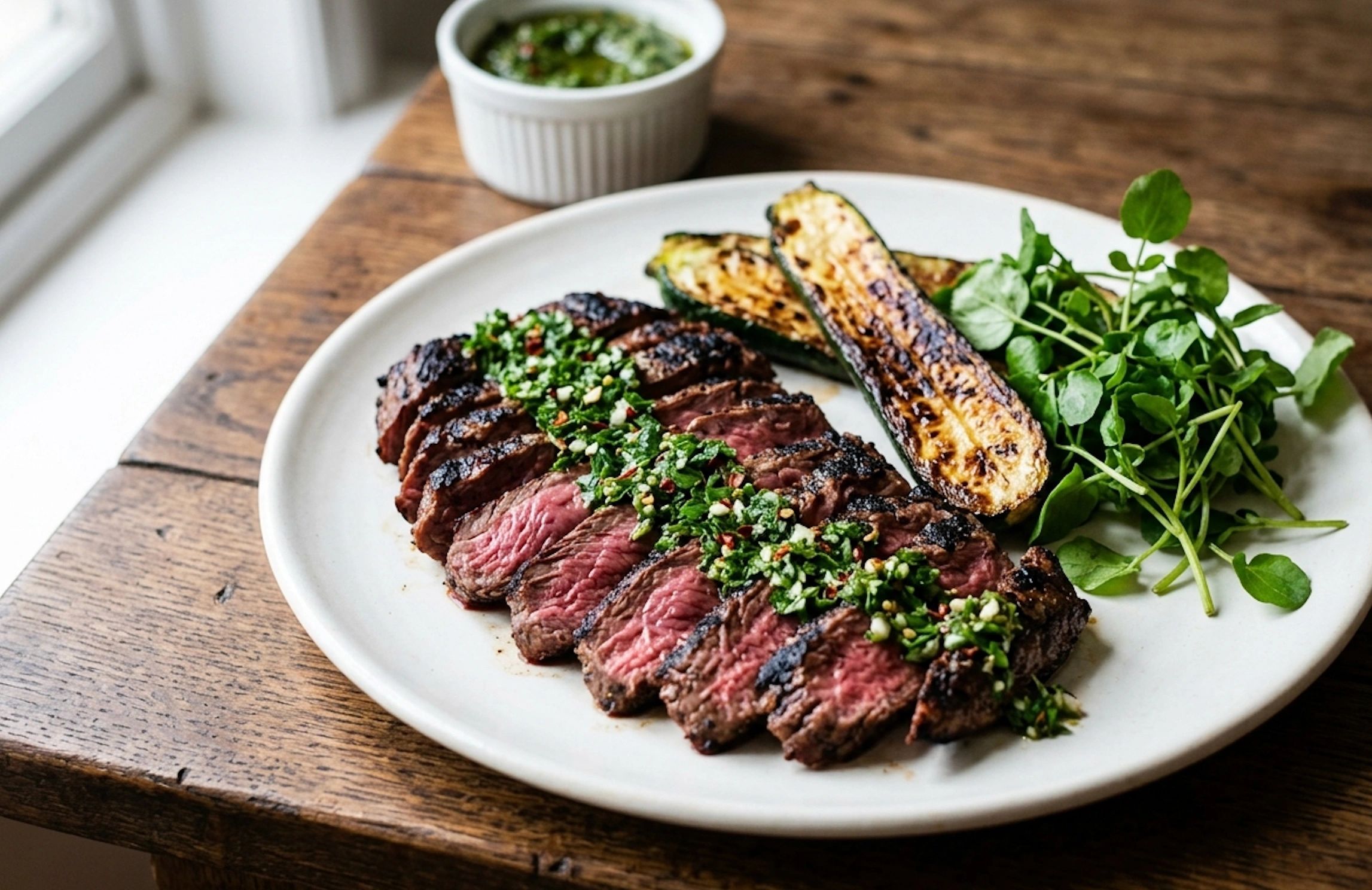
10. Slice against the grain and plate. Slice each portion against the grain into 4–5 pieces, fanned slightly on the plate to show the interior. A properly cooked bavette at medium-rare will be a deep, even pink throughout with a well-defined outer crust. Lay the roasted courgette alongside. Add a handful of watercress dressed with olive oil, lemon juice, salt and pepper — dress it at the last second. Spoon chimichurri generously over the beef and serve the remainder in a ramekin or small jug at the table.
Chef’s Notes
- On sourcing the bavette: Buy from a butcher or meat supplier who can confirm the cut is genuine bavette d’aloyau — the flap muscle from the flank. Some suppliers label skirt or hanger steak as bavette interchangeably. They’re all excellent cuts but they behave differently. Skirt is thinner and cooks faster; hanger has a tough central sinew to remove. Know what you’re ordering. For 20 covers at 200g portioned weight, order 5kg unprepared to allow for trim.
- On the chimichurri ratio: The recipe above is a balanced starting point — adjust to your kitchen’s palate. More vinegar sharpens it, more oil mellows it. Some kitchens add a teaspoon of honey to round the acidity. That’s a legitimate call, particularly for a mixed audience less used to sharp condiments.
- On courgette colour selection: Yellow courgettes roast identically to green but add visual contrast on the plate. If your supplier has both, use a mix. Courgette flowers, if available in late June, can be stuffed with soft cheese and lightly fried as a garnish or separate starter — they’re a summer ingredient worth knowing.
- On scaling: This recipe scales directly for 40 covers — double everything. Above 40, split the chimichurri into separate batches rather than making one enormous quantity; the garlic-to-vinegar ratio becomes harder to control at scale. Portion sizes can be adjusted down to 180g for a lighter summer menu without significantly affecting the dish.
- On the watercress: Dress it at the pass, not in advance. Watercress wilts quickly once dressed, and dressed watercress that’s sat for ten minutes looks tired on the plate. Keep it dry, keep it cool, dress it per portion as it goes.
Enjoyed this? Subscribe below and get a new recipe every Friday — written for professional kitchens, grounded in more than 35 years of real experience.