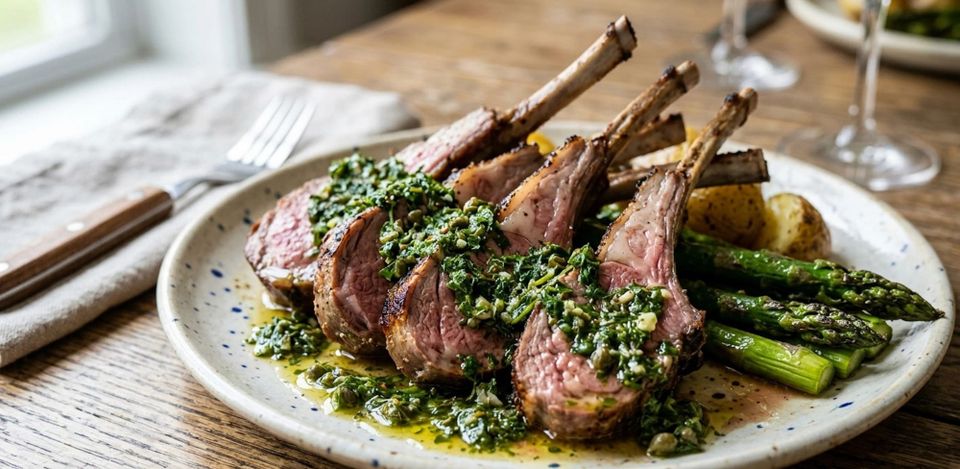
Roast Rack of Spring Lamb with Wild Garlic Salsa Verde, Dauphinoise Potatoes and Asparagus: Catering Recipe for 20
By On The Pass Consultancy | Category: Weekly Recipe | Serves: 20 | Prep: 60 min | Dauphinoise: 2 hrs | Lamb: 25–30 min | Skill Level: Intermediate–Advanced | Keywords: rack of spring lamb recipe UK catering, wild garlic salsa verde, dauphinoise potatoes, spring menu ideas UK, English asparagus, commercial kitchen recipe 20 covers
Why This Dish — and Why Now
There is a window in May when two things happen at once that don't happen together at any other point in the year: British spring lamb is at its absolute best, and wild garlic is still covering every damp woodland floor from Wales to Wiltshire. That window is open right now. In another three weeks, the wild garlic will be past it, and by July the lamb will have moved into heavier territory. This dish only works — really works — in May.
Welsh spring lamb in particular has a sweetness and delicacy that you don't get later in the year. The animals are young, milk-fed on the hills, and the meat has a fine grain and a clean flavour that you don't need to overpower. What you need is something that cuts through the richness — and wild garlic salsa verde does exactly that. It's the Italian classic built around what's growing now: wild garlic leaves instead of regular garlic, parsley, capers, anchovies, Dijon, olive oil. Vivid green, punchy, and acidic in the right way.
Alongside: a classic dauphinoise, made in deep gastronorm trays, baked low and slow until the cream is fully absorbed, then weighted and pressed overnight and portioned to order. And English asparagus — the real thing, not the imported stuff that arrives nine months of the year — finished simply in brown butter and a little lemon. No garnish required. The plate does the work.
Rack of lamb at volume is about confidence in the method. Properly French-trimmed racks, seasoned and seared hard, then roasted to a consistent internal temperature and rested before carving. Cut to order, two or three cutlets per person depending on rack size and menu position. This is the kind of dish that belongs on a May wedding menu, a hotel restaurant, or a serious gastropub that knows what to do with a seasonal window.
Serves 20 | Prep: 60 min | Dauphinoise: 2 hrs (make the day before) | Lamb: 25–30 min + 10 min rest
Ingredients
Rack of Spring Lamb
| Ingredient | Quantity |
|---|---|
| Racks of spring lamb, French-trimmed (6–7 bone) | 7–8 racks (approx. 20 portions at 2–3 cutlets each) |
| Rapeseed or light olive oil | 4 tbsp |
| Coarse sea salt | To season |
| Freshly cracked black pepper | To season |
| Fresh rosemary sprigs | 6 |
| Garlic cloves, halved | 6 |
| Unsalted butter | 80g |
Wild Garlic Salsa Verde
| Ingredient | Quantity |
|---|---|
| Wild garlic leaves, washed and dried | 80g |
| Flat-leaf parsley, leaves only | 60g |
| Fresh mint leaves | 20g |
| Capers, rinsed | 40g |
| Anchovy fillets in oil | 6 |
| Dijon mustard | 2 tsp |
| Red wine vinegar | 3 tbsp |
| Extra virgin olive oil | 180–200ml |
| Sea salt and black pepper | To season |
Dauphinoise Potatoes
| Ingredient | Quantity |
|---|---|
| Maris Piper or Desiree potatoes | 5kg (peeled weight) |
| Double cream | 1.5 litres |
| Whole milk | 500ml |
| Garlic cloves, minced | 6 |
| Fresh thyme sprigs | 8 |
| Bay leaves | 4 |
| Gruyère, finely grated | 300g |
| Unsalted butter (for greasing and finishing) | 80g |
| Fine sea salt and white pepper | To season |
| Freshly grated nutmeg | To season |
English Asparagus
| Ingredient | Quantity |
|---|---|
| English asparagus spears, trimmed | 2.5kg (approximately 100 spears) |
| Unsalted butter | 120g |
| Lemon juice | 2 tbsp |
| Sea salt and black pepper | To season |
Method
Stage 1 — Dauphinoise Potatoes (make the day before service)
1. Preheat your oven to 160°C (fan 140°C). Generously butter two deep full-size gastronorm trays (100mm deep). In a wide, heavy-based saucepan, combine the double cream, milk, minced garlic, thyme sprigs, and bay leaves. Bring gently to a simmer over a medium-low heat — do not boil. Season well with salt, white pepper, and a generous grating of nutmeg. Remove from the heat and allow to infuse for 10 minutes. Remove the thyme and bay leaves.
2. Peel and slice the potatoes to 3mm thickness on a mandoline — consistency of thickness is essential. Do not rinse the sliced potatoes; the surface starch helps the gratin set and hold its shape for portioning. Work quickly once sliced to prevent oxidation.
3. Layer the potato slices into the buttered trays, slightly overlapping, seasoning each layer lightly as you go. Pour the warm cream mixture evenly over both trays — it should come almost to the top of the potato. Cover tightly with foil.
4. Bake for 1 hour 45 minutes, covered. Remove the foil, scatter the grated Gruyère evenly over the surface, and return to the oven uncovered for a further 15–20 minutes until the cheese is golden and bubbling and the potatoes are completely tender when probed with a skewer.
5. Remove from the oven. Place a sheet of greaseproof paper over the surface of each tray, then place a second empty gastronorm tray on top and weight it with something heavy — tins, a second tray filled with water, or purpose-made pressing weights. Refrigerate overnight. The pressing removes excess cream, firms the gratin into a solid slab, and makes clean portioning possible. This step is what makes the dish service-viable.
6. To portion: the next day, run a palette knife around the edges and turn out the pressed dauphinoise onto a chopping board. Cut into portions — rectangles or squares, approximately 100g each. Store portioned, covered, in the refrigerator. At service, place portions on a lightly buttered tray and reheat at 180°C (fan 160°C) for 12–15 minutes until hot through and golden on top.
Stage 2 — Wild Garlic Salsa Verde (make on the day, 2–3 hours ahead)
7. Wash and thoroughly dry the wild garlic leaves and flat-leaf parsley — any excess water will split the sauce. Roughly chop together with the mint leaves. Place in a food processor or blender with the capers, anchovy fillets, Dijon mustard, and red wine vinegar. Pulse until roughly combined — the sauce should have texture, not be a smooth purée. Keeping it coarse is correct.
8. With the motor running, slowly drizzle in the olive oil until you have a thick, spoonable sauce. Taste and adjust: it should be punchy, acidic, herby, and have a clear but not aggressive garlic heat from the wild garlic. Season with salt and pepper. The anchovies add salt, so taste before you season.
9. Transfer to a clean container and press a sheet of cling film directly onto the surface to prevent oxidation. Hold at room temperature if using within 2 hours; refrigerate if making further ahead and bring back to room temperature before service. The sauce will keep for up to 2 days refrigerated but is best made on the day — the wild garlic loses some brightness overnight.
Stage 3 — Roast the Lamb (to order / batch at service)
10. Remove the racks from the refrigerator at least 30 minutes before cooking — cold lamb from the fridge will not cook evenly. Season generously on all sides with coarse sea salt and cracked black pepper. Press the seasoning in firmly.
11. Heat a large, heavy-based roasting tray or wide sauté pan over a high heat until smoking. Add the rapeseed oil. Sear the racks fat-side down first, pressing them gently into the pan. Sear for 3–4 minutes until the fat is deeply golden and beginning to render — this is where the flavour and colour come from. Turn and sear the meat side for 2 minutes. Add the rosemary sprigs, halved garlic cloves, and butter to the pan. Baste the racks continuously for 1–2 minutes as the butter foams.
12. Transfer the racks to wire racks set over roasting trays, bone-side down, and roast in an oven preheated to 200°C (fan 180°C). For medium-rare — the correct finish for spring lamb — this takes approximately 18–22 minutes depending on rack size. Use a probe thermometer: you are looking for 55–57°C internal temperature at the thickest part of the eye. Remove from the oven at 55°C; it will carry over to 57–58°C on the rest.
13. Rest the racks on the wire rack for a minimum of 10 minutes before carving. Do not cover tightly with foil — this steams the meat and softens the crust. A loose tent is sufficient. Carve between the bones into individual cutlets at the point of plating. Two cutlets per portion for a main course; three for a premium or à la carte offering.
Stage 4 — English Asparagus
14. Trim the woody ends from the asparagus — bend each spear and snap at the natural break point, or trim uniformly with a knife at approximately 4–5cm from the base for a smarter presentation. Bring a large, wide pan of heavily salted water to a rolling boil.
15. Blanch the asparagus in batches for 2–3 minutes depending on thickness — they should be tender with a little bite still present and holding their vivid green colour. Immediately plunge into iced water to stop the cooking. Drain and dry on kitchen paper. This can be done up to 2 hours ahead of service.
16. At service, melt the butter in a wide sauté pan over a high heat. Allow the butter to foam and begin to turn a light golden brown — this is brown butter (beurre noisette), and the nutty aroma is what you're after. Working in batches if necessary, add the asparagus and toss well. Add the lemon juice and toss again. Season with sea salt and black pepper. The asparagus needs 60–90 seconds in the brown butter — enough to heat through and pick up the flavour without losing its colour or bite.
Plating
To plate: Reheat the dauphinoise portion and place towards the back-centre of the plate. Lay 4–5 asparagus spears across the front of the plate at a slight angle. Carve and place two or three lamb cutlets, leaning against the dauphinoise, bone pointing upward. Spoon the wild garlic salsa verde directly over the lamb and allow it to pool naturally onto the plate — don't dot or brush it, spoon it generously. Serve immediately.
Chef's Notes
On sourcing the wild garlic: Wild garlic (Allium ursinum) grows in damp, shaded woodland throughout the UK and is at peak in April and May. If you're not foraging yourself, specialist produce suppliers — Natoora, Secretts, most good wholesale greengrocers — carry it in season. Buy more than you think you need. It wilts fast and the yield after washing and picking is lower than it looks. In the unlikely event it's unavailable, substitute with a mix of regular garlic (1 clove, crushed) and extra flat-leaf parsley — it won't be the same but it's a workable salsa verde.
On buying the lamb: Ask your meat supplier for Welsh or Herdwick spring racks, French-trimmed, with the chine bone removed. Specify the size — you want racks with 6 or 7 bones, not the smaller 4-bone racks. For 20 covers at 2 cutlets each, order 7 racks. For 3 cutlets each, order 10. Build your order around your portion decision, not the other way around.
On the dauphinoise: The overnight press is non-negotiable if you want clean, service-ready portions. A dauphinoise that hasn't been pressed will fall apart when you cut it and lose its shape on the plate. Press it, chill it, portion it cold — reheat to order. This method also means you can make it two days ahead if needed.
On lamb temperature: Spring lamb is best served medium-rare. Well-done spring lamb is a waste of the ingredient. If you have guests requesting well-done, cook to 68–70°C internal — but know that you're losing the point of the dish. Brief your front of house team on the correct serve.
Make-ahead summary: Dauphinoise — 1–2 days ahead. Salsa verde — day of service. Asparagus blanched — 2 hours ahead. Lamb — cook to order or in timed batches.
Enjoyed this recipe? Subscribe below and get a new professional recipe delivered every Friday — built for commercial kitchens, written from more than 35 years on the pass.