Signal Crayfish and Sweetcorn Bisque
Why This Dish — and Why Now
Signal crayfish are tearing through British rivers. They were introduced from North America in the 1970s for aquaculture, escaped into the wild, and have spent the decades since eating everything in sight, undermining riverbanks and carrying a plague that has pushed the native white-clawed crayfish close to extinction. The Environment Agency has been asking chefs, restaurants and the public to catch and eat them for years. Putting signal crayfish on a September menu is not a trend — it is the right call.
The flavour is the other argument. Signal crayfish taste like a cross between a langoustine and a brown shrimp: sweet, nutty, with more depth than a prawn and none of the blandness of farmed alternatives. Built into a bisque, they produce a shellfish stock that holds its own against lobster. The shell work is the effort. Everything after that is classical technique.
Sweetcorn is the pairing. British sweetcorn peaks in September — ears arriving with natural sugar that breaks down within hours of picking, which is why supermarket corn and farm shop corn taste nothing alike. Charring the cobs before stripping the kernels adds a roasted depth that gives the bisque a more complex base and prevents it reading as a one-note cream soup.
This recipe is written for 50 covers as a starter at 180ml per portion. The bisque base can be made the day before and chilled. Crayfish tails are reserved from the prep and added at service. From there, it is a straightforward reheat and garnish operation at the pass.
Serves 50 | Starter 180ml per portion | Prep: 1 hr | Cook: 1 hr 30 min
Ingredients
For the Bisque Base
| Ingredient | Quantity |
|---|---|
| Signal crayfish, live or freshly cooked | 5kg |
| British sweetcorn cobs | 20 (approx 3kg kernels stripped) |
| Unsalted butter | 200g |
| Olive oil | 100ml |
| White onions, roughly diced | 4 large (approx 800g) |
| Carrots, roughly diced | 3 medium (approx 400g) |
| Celery stalks, roughly sliced | 6 stalks (approx 300g) |
| Leeks, trimmed and sliced | 2 large (approx 400g) |
| Garlic cloves, crushed | 6 |
| Tomato purée | 150g |
| Brandy or Cognac | 200ml |
| Dry white wine | 750ml |
| Fish or shellfish stock | 4 litres |
| Double cream | 1 litre |
| Smoked paprika | 2 tsp |
| Cayenne pepper | pinch |
| Bay leaves | 4 |
| Sea salt and white pepper, to season |
For the Herb Cream
| Ingredient | Quantity |
|---|---|
| Crème fraîche | 400ml |
| Chives, finely chopped | 1 large bunch (30g) |
| Fresh tarragon leaves, finely chopped | 20g |
| Lemons, zest and juice | 2 |
| Sea salt and white pepper, to season |
For the Garnish
| Ingredient | Quantity |
|---|---|
| Reserved crayfish tails (from above) | approx 150 pieces (3 per portion) |
| Chive tips or micro herbs | to finish |
| Charred sweetcorn kernels, reserved | optional, a few per bowl |
Method
Stage 1 — Prepare the Crayfish (Day Before)
1. If working with live crayfish, dispatch them cleanly in heavily salted boiling water — 2 minutes is enough. Transfer immediately to iced water to stop the cook. If sourcing pre-cooked, proceed directly.
2. Shell the crayfish over a deep tray, separating the tail meat from the shells. Keep everything: the shells, the heads, and any coral. This is the base of your bisque and the most flavourful part of the whole dish. Reserve the tail meat in a covered container in the fridge. You should get approximately 150 clean tail pieces from 5kg of crayfish, depending on size. Aim for 3 per portion.
3. Roast the shells and heads on gastronorm trays in a hot oven at 220°C (fan 200°C) for 15 minutes until deep orange. Roasting drives off moisture and concentrates the flavour significantly. Skipping this step is the most common reason a shellfish bisque tastes thin.
Stage 2 — Char the Sweetcorn
4. Char the sweetcorn cobs directly on a chargrill plate or under a salamander on high heat, turning occasionally, until the kernels are blackened in patches, around 8 to 10 minutes per cob. Stand the cobs upright and strip the kernels with a sharp knife into a bowl. Reserve a small quantity of charred kernels for garnish. The rest goes into the bisque.
Charring is not decorative. It produces Maillard compounds in the sweetcorn that add roasted depth to the bisque and distinguish it from a cream of corn soup. If you have a Rational iCombi Pro or similar combi, the grill mode at high fan achieves an even char across 20 cobs in two batches without supervision.
Stage 3 — Build the Bisque
5. In a large rondeau or stockpot, heat the butter and olive oil over a medium heat. Add the onion, carrot, celery and leek and sweat for 12 to 15 minutes until completely soft with no colour. Add the garlic and cook for a further 2 minutes.
6. Add the tomato purée and stir it into the vegetables. Cook for 3 to 4 minutes to caramelise the purée slightly — this removes the raw tinned taste and adds colour. The base should smell rich and sweet before the liquid goes in.
7. Add the roasted crayfish shells and heads and stir to combine. Pour in the brandy and, if conditions allow, tilt the pan to flambé. If not, increase the heat and let the alcohol cook off fully — about 2 minutes. The alcohol is doing two jobs: deglazing the pan and extracting fat-soluble flavour compounds from the shells that water and stock cannot reach alone.
8. Add the white wine and reduce by half, approximately 4 minutes. Add the fish or shellfish stock, the charred sweetcorn kernels, smoked paprika, cayenne and bay leaves. Bring to a simmer and cook uncovered for 45 minutes. The liquid should reduce slightly and the shells will have given up everything they have.
Stage 4 — Blend and Pass
9. Remove the bay leaves. Working in batches, blend the bisque on high until completely smooth. Pass through a fine-mesh sieve or conical strainer, pressing firmly with a ladle to extract maximum liquid from the shells and corn. Discard the solids.
10. Return the strained bisque to a clean pot. Add the double cream and bring back to a simmer. Taste and adjust: it should be rich, shellfish-forward, with sweetness from the corn and background heat from the cayenne. Season carefully with sea salt and white pepper. At this point, the bisque can be chilled rapidly and refrigerated overnight.
11. For the herb cream: combine the crème fraîche, chives, tarragon, lemon zest and a good squeeze of lemon juice. Season and stir to combine. Hold refrigerated until service.
Stage 5 — Service
12. Reheat the bisque to 85°C. Hold in a bain-marie or warmed sauté pan during service. Do not boil it once the cream is in — the cream can split at a rolling boil and the texture becomes grainy.
13. Pan-fry the reserved crayfish tails in a hot pan with a small knob of butter for 30 to 40 seconds, turning once, until they pick up a little colour on the outside. The tails are already fully cooked from Stage 1 — this step is for colour and a slight caramelised exterior only, not to heat through. Keep the pan very hot and the time very short.
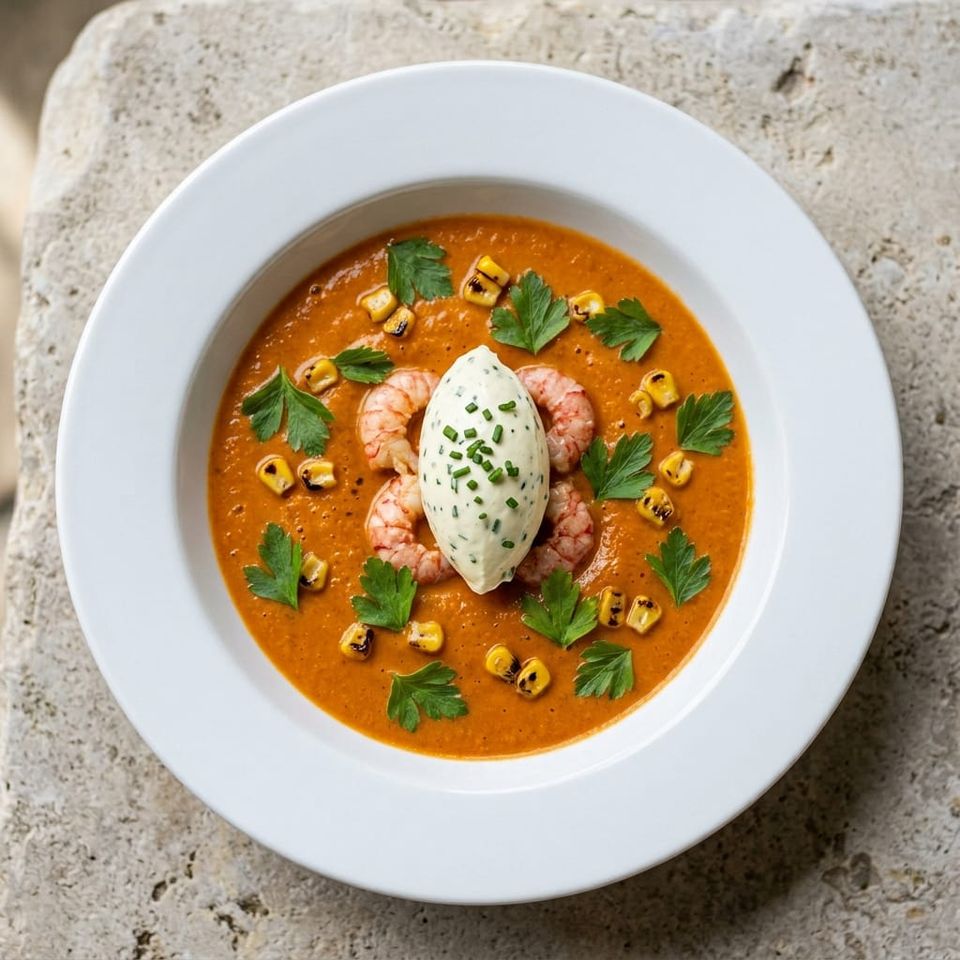
14. Ladle 180ml of bisque into each warm soup bowl. Place 3 pan-fried tails on top of the bisque. Add a spoonful of herb cream in the centre. Finish with chive tips, a few charred sweetcorn kernels if using, and serve immediately.
Plating
Serve in deep warm soup cups or wide-rimmed bowls. The bisque goes in last, poured from a warmed jug or ladle at tableside if your service style allows for it — the colour and aroma have impact when delivered in front of the guest. Three crayfish tails sit on top of the bisque. The herb cream sits as a quenelle or a generous spoonful in the centre, pale against the orange bisque. Chive tips across the top. The whole plate should read as precise without being fussy.
Chef's Notes
On sourcing signal crayfish: Specialist suppliers including The Crayfish Company and selected fishmongers handle signal crayfish. Some kitchen teams work with local river authorities or gamekeepers who trap them commercially. They are cheapest bought live and in bulk. For 50 covers, 5kg gives you enough tail meat with shells to spare for the stock. Pre-cooked tail meat is a fallback, but you lose the shells and the base of the bisque suffers for it.
On the sustainability angle: Signal crayfish are classified as an invasive non-native species. Under the Wildlife and Countryside Act, once caught they cannot be returned to the water alive. There is no closed season and no licence required to trap them. Putting them on a menu is, genuinely, environmentally responsible. That is a story worth telling to the front of house team and worth noting on the menu itself.
On running at volume: The bisque makes without stress the day before service. Chill it rapidly after straining and refrigerate. The herb cream makes in five minutes. On the day, the pass work is reheating the bisque, a quick pan-fry on the tails for colour and assembling. A section chef can run 50 covers of this starter without difficulty once the prep is in place. It is a dish that front-loads labour and simplifies service.
On the GP: Signal crayfish bought live in bulk sit at the economical end of the shellfish market. Sweetcorn is cheap in September. Double cream and crème fraîche are the main cost variables. Built right, this starter lands sensibly on food cost while reading and eating at a price point well above its production cost. The sustainability narrative also supports premium menu positioning without inflating the ingredient cost.
Make-ahead summary: - Day before: roast shells, build and pass bisque, chill rapidly, make herb cream - Day of service: reheat bisque to 85°C, pan-fry tails briefly for colour, plate and pour bisque over to serve
Enjoyed this recipe? Subscribe below and get a new professional recipe delivered every Friday — built for commercial kitchens, written from 35+ years in hospitality.